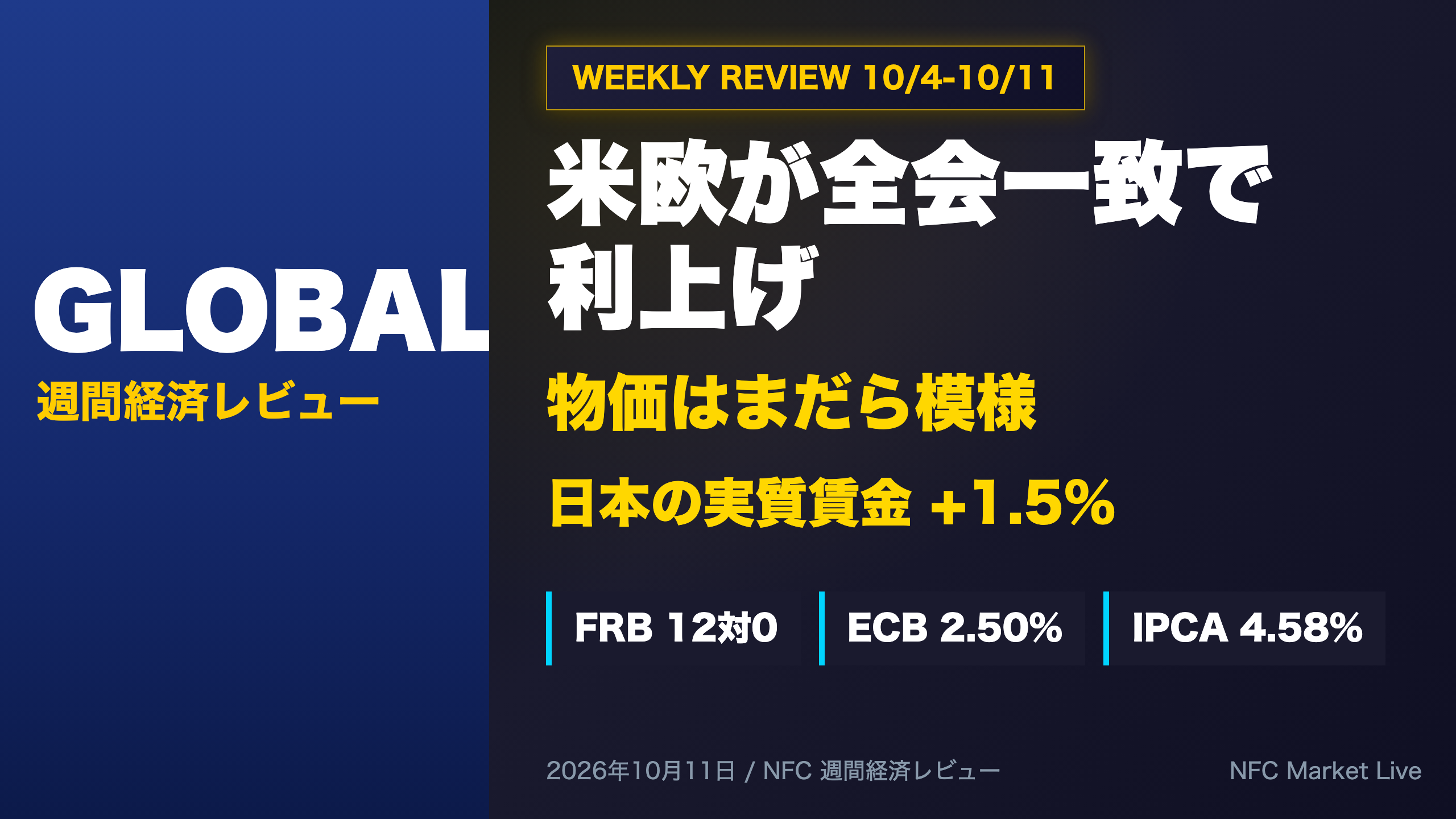
📺 Watch the Full Video Analysis
This article was automatically generated by the NFC Market Live AI analysis system. (Updated: 2026-10-11 08:45 JST)
📊 Weekly review for Oct 4-11.
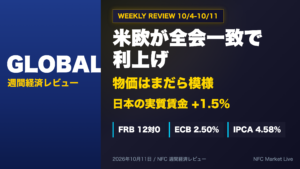
🏦 Fed minutes show September’s 25bp hike was unanimous at 12-0, and all ECB members backed the move to a 2.50% deposit rate.
📈 Inflation was patchy: Norway’s core CPI-ATE hit 3.0% and Brazil’s IPCA 4.58%, while euro-area core slowed to 2.4%.
💡 Japan’s real wages rose for an eighth straight month; the coincident index fell 1.9 points but the official view stayed ‘improving’.
⚠️ The US trade deficit widened to $105.6bn on AI-related imports, and Michigan current conditions fell to 44.7.
Next week: US jobless claims and the Fed’s H.4.1, both on Thursday the 15th.
オープニング
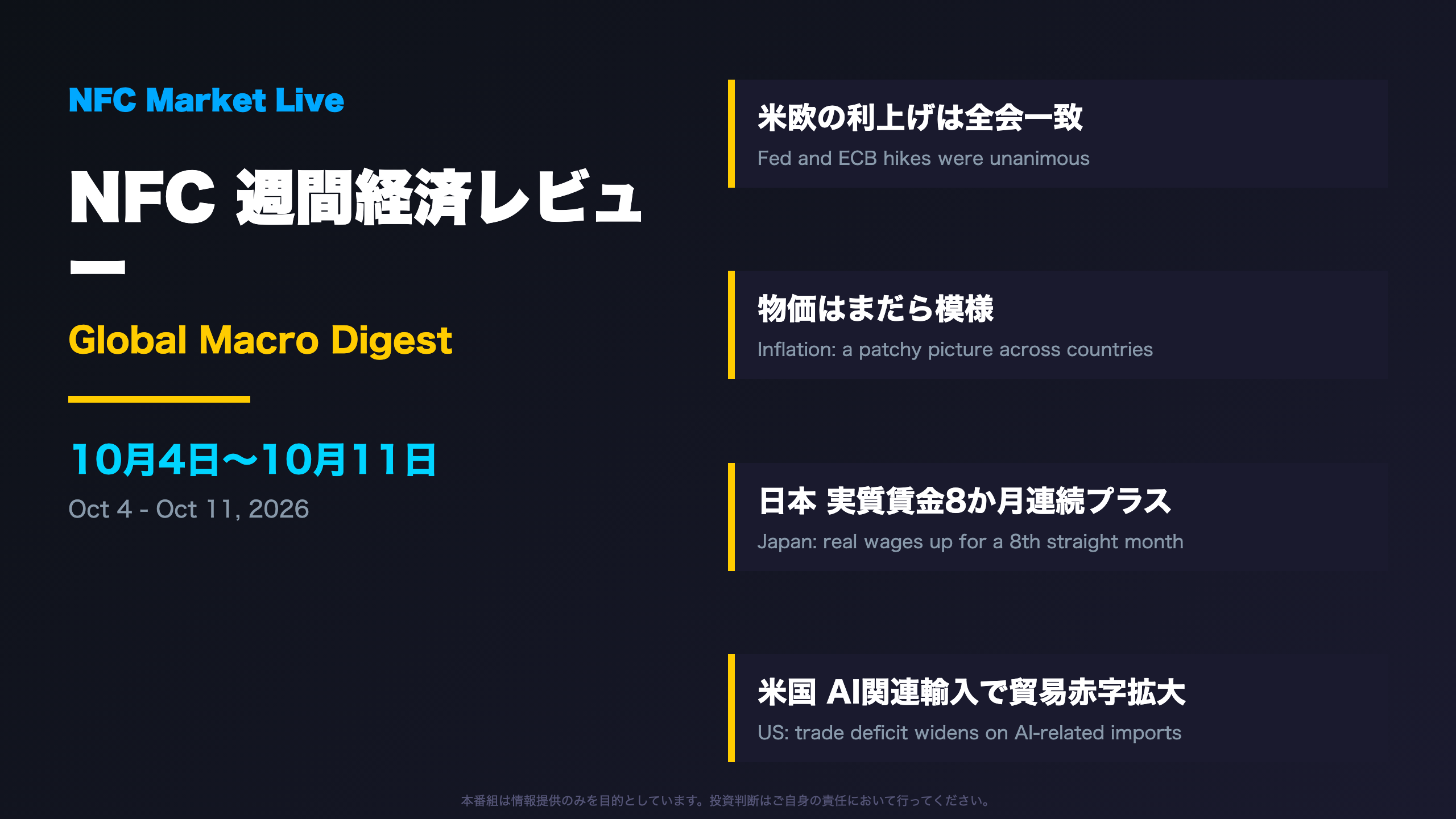
This week in one frame
Over October 4-11, four threads stand out: the Federal Reserve and the European Central Bank both confirmed unanimous quarter-point hikes in their September minutes; inflation readings diverged by country; Japan’s wage and capital-flow data sent mixed signals; and AI-related imports widened the US trade deficit. We dig into inflation, Japan and the United States, then map central-bank stances and the checklist for next week.
今週の総括:引き締めの広がりとまだら模様の底堅さ
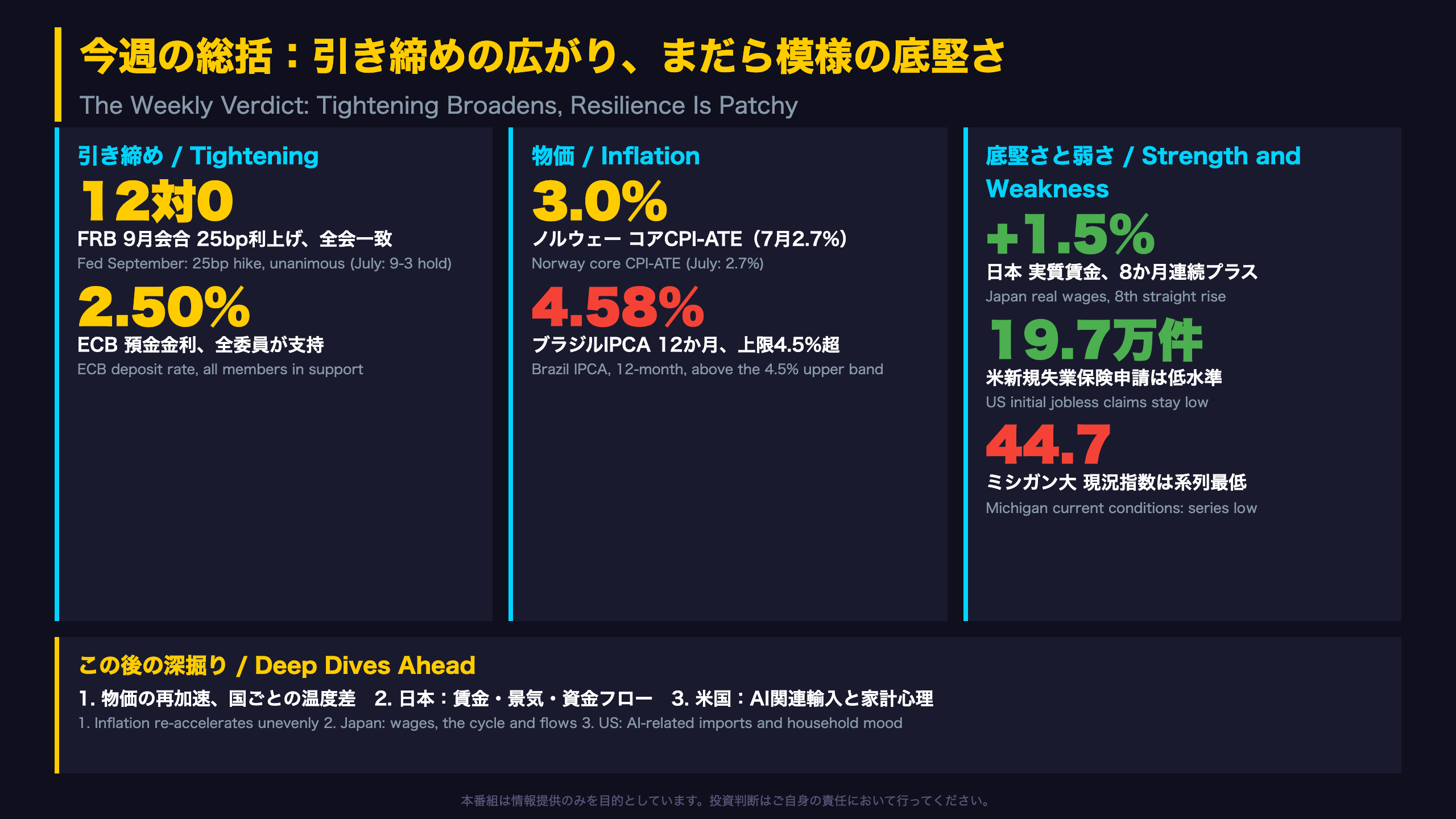
The week at a glance
This week combined a broadening tightening cycle with mixed signs of resilience. The Federal Reserve (the US central bank) and the European Central Bank (ECB) published minutes showing that their September quarter-point hikes were unanimous.
Scoreboard
- Fed: 12-0 vote to hike, versus a 9-3 vote to hold in July
- ECB: deposit rate 2.50%, up from 2.25%
- Norway core CPI-ATE: 3.0% (July: 2.7%)
- Brazil IPCA, 12-month: 4.58% (August: 4.22%), above the 4.5% upper band
- Japan real wages: +1.5%, the eighth straight positive month
- University of Michigan current conditions: 44.7, lowest in its 24-month table
Items we did not dive into
Canada lost 68,000 jobs in September, the second monthly decline, though the unemployment rate was 6.5% and average hourly wages rose 2.3% year on year. US wholesale sales rose 1.8% in August and the inventory-to-sales ratio fell to 1.18. The US yield curve steepened: the 2-year yield fell to 4.78% while the 30-year rose to 5.61%.
Why a balanced read matters
A quick glance could suggest a purely hawkish week. But low jobless claims (197,000) and positive Japanese real wages sit alongside weak sentiment surveys and a larger trade gap. Neither camp has a clean win.
Next
Whether the inflation upticks persist and whether the US gap between sentiment and jobs narrows.
物価の再加速、国ごとの温度差
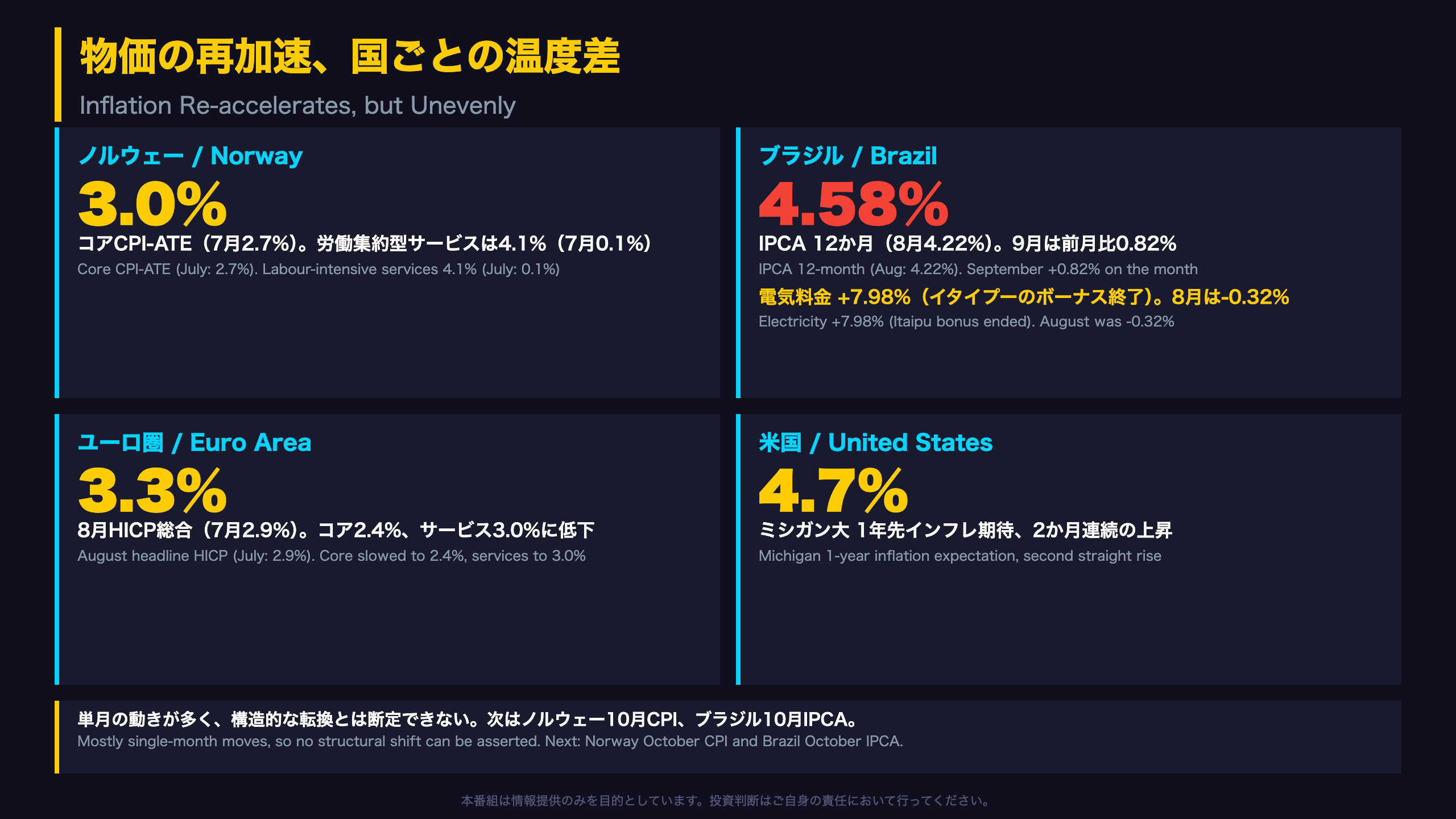
Inflation: three upside readings, three different causes
Norway. Statistics Norway publishes CPI-ATE, the index adjusted for tax changes and excluding energy, which Norges Bank watches most closely. It rose to 3.0% in September from 2.7% in July, while labour-intensive services jumped to 4.1% from 0.1%. Goods and services accelerated together, which is why this reading matters more than the 3.4% headline.
Brazil. IBGE’s IPCA is the benchmark CPI, with a 3.0% target and a 4.5% upper band. It printed +0.82% in September after -0.32% in August. IBGE attributes the swing to the end of the Itaipu electricity bonus: residential power rose 7.98%. Over the two months combined inflation was about 0.50%, so part of the surge is a reversal. The 12-month rate of 4.58% is still below May’s 4.72%.
Euro area. August flash HICP rose to 3.3% on energy (+14.3%), but core slipped to 2.4% and services to 3.0%.
Why it matters
The US Michigan survey shows 1-year expectations at 4.7%, while the euro area shows a split between headline and core. Fed and ECB minutes both describe inflation risks as skewed to the upside.
What to watch
Norway’s October CPI on November 10, Brazil’s October IPCA (last year’s base month was only +0.09%), and whether services inflation keeps cooling in Europe.
日本:賃金・景気・資金フローの現在地
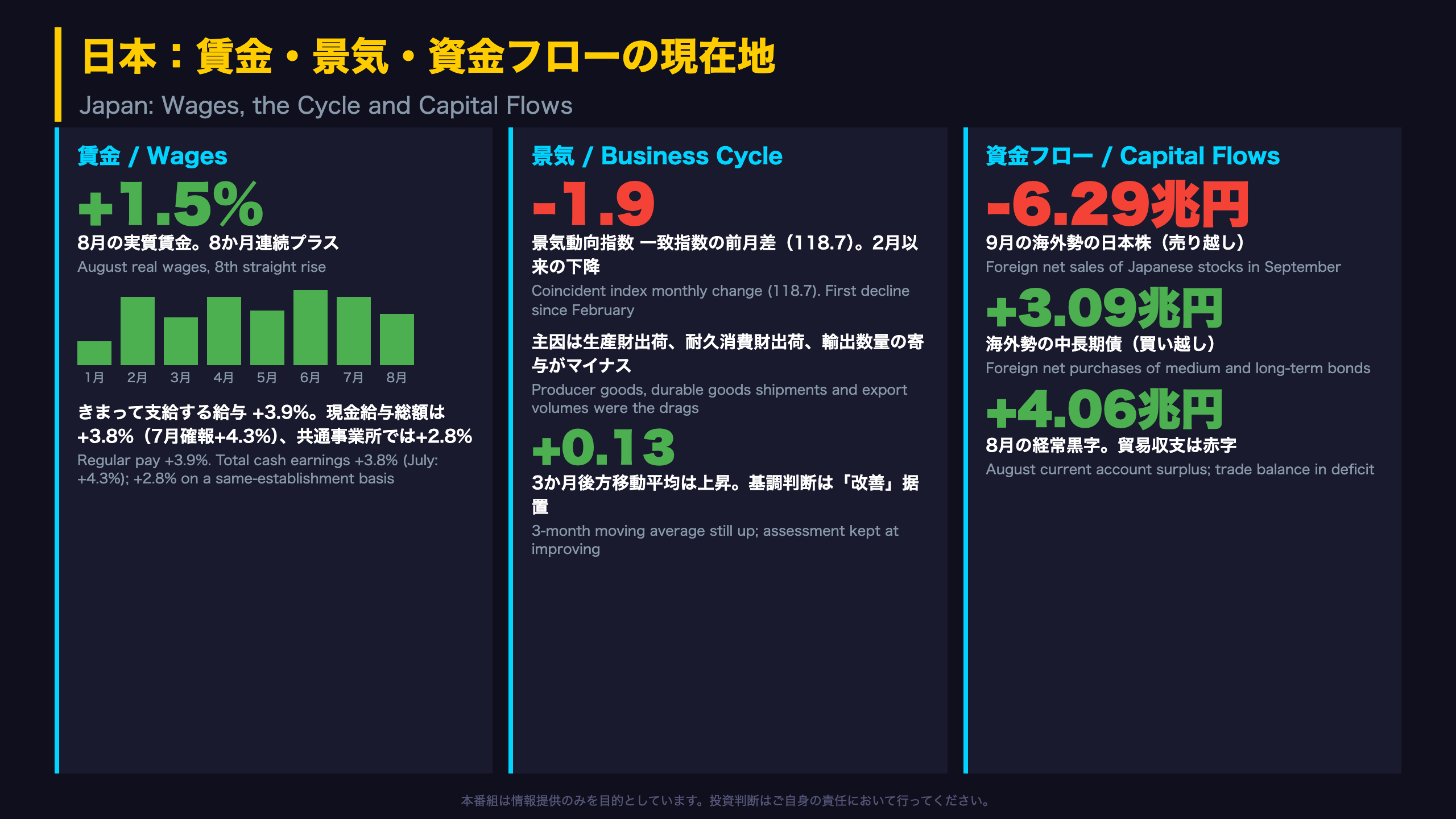
Japan: wages, the cycle and capital flows
Context for non-Japan readers. The Monthly Labour Survey (Ministry of Health, Labour and Welfare) is Japan’s main wage gauge, which the Bank of Japan watches as evidence of a wage-price cycle. The Cabinet Office’s Coincident Index (CI) combines ten series such as industrial output and shipments, and its headline judgement relies on moving averages rather than a single month.
Wages
Real wages (deflated by CPI excluding imputed rent) rose 1.5% in August, with consumer inflation at 2.2%. Regular pay rose 3.9% and overtime pay 5.2%, while bonuses were flat. On a same-establishment basis total pay rose only 2.8%, so the headline may partly reflect changes in sample composition. A year-ago base of -1.7% in real terms also flatters the comparison.
Cycle
The coincident index fell 1.9 points to 118.7 after a jump to 120.6 in July. Shipments of producer goods, durable consumer goods and export volumes were the main drags. The three-month moving average still rose 0.13 points, so the official judgement stayed at ‘improving’.
Flows
Ministry of Finance data (contract basis) show foreigners sold 6.29 trillion yen of Japanese equities in September, almost all of it in the middle ten days, while buying 3.09 trillion yen of medium and long-term bonds. That mix argues against a blanket exit from Japanese assets, although the data cannot identify who sold or whether positions were hedged.
Watch next
August final wage data on October 23 and the September CI.
米国:AI関連輸入と家計心理の綱引き
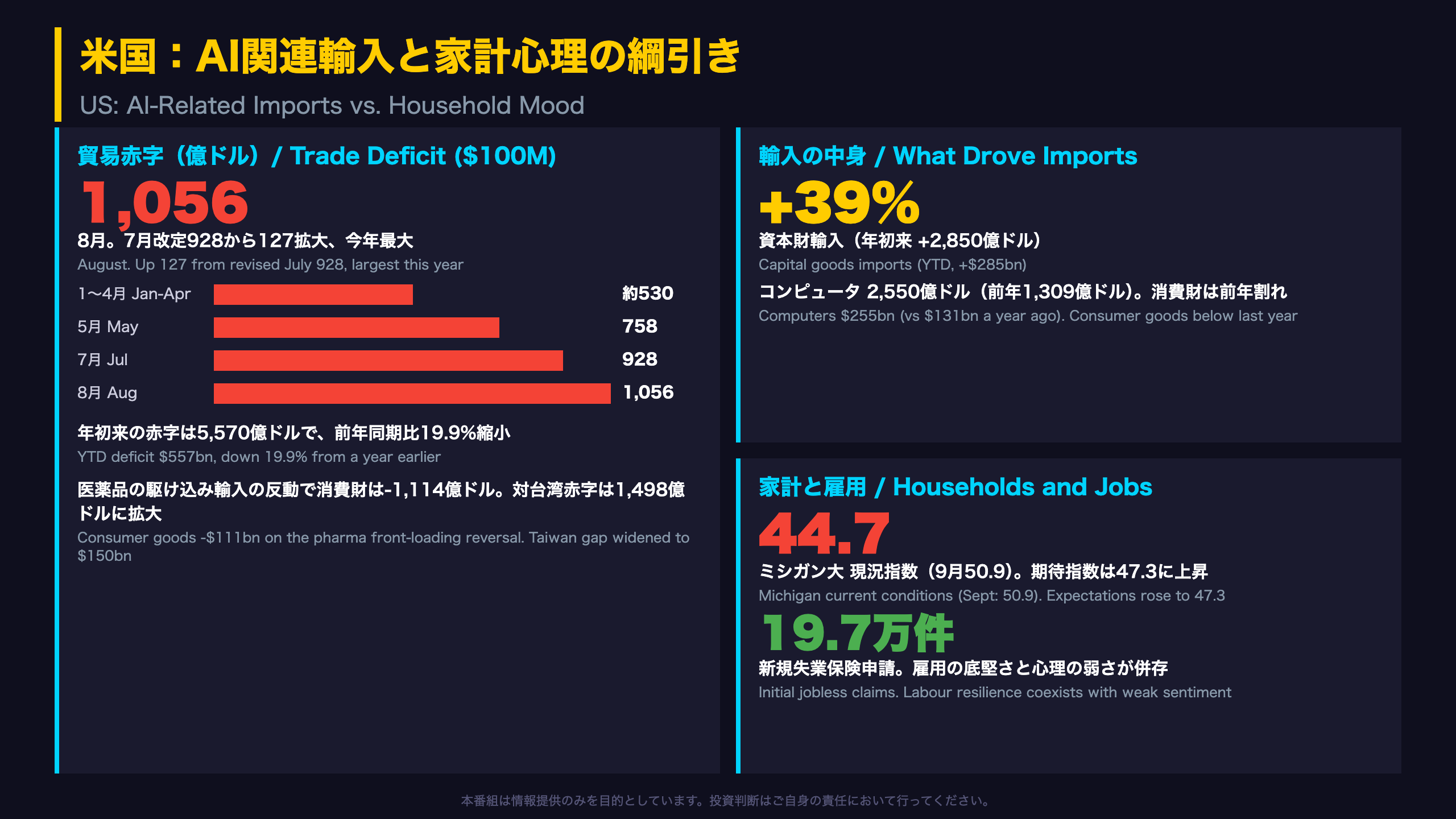
US: AI imports versus household mood
Data context. The FT-900 is the Census Bureau and BEA’s monthly trade release. The Michigan survey is a University of Michigan consumer sentiment gauge, split into current conditions and expectations.
A deficit driven by investment goods
The August goods-and-services deficit of $105.6 billion compares with roughly $53 billion a month in January-April. Composition matters: capital goods imports are up $285 billion year to date, while consumer goods imports are down $111 billion, mostly pharmaceuticals ($91 billion) reversing last year’s tariff front-loading. In the advanced technology product statistics, the ICT deficit has roughly doubled to $424 billion. The gap with Taiwan reached $150 billion year to date versus $85 billion a year earlier, while China’s narrowed to $113 billion.
Strength elsewhere
Semiconductor exports rose 26% and total goods exports are up $215 billion year to date. Nominal figures include price effects, however: the real goods deficit widened 8.2% on the month, versus 11.1% in nominal terms.
The consumer
Current conditions at 44.7 are below the May low of 45.8, with durable-goods buying conditions plunging. Expectations improved to 47.3. Initial jobless claims of 197,000 show little layoff pressure. The Fed minutes describe labour-market risks as roughly balanced, and the data are consistent with a split picture.
Watch next
The final Michigan reading and the September trade data.
中央銀行・政策スタンスの現在地
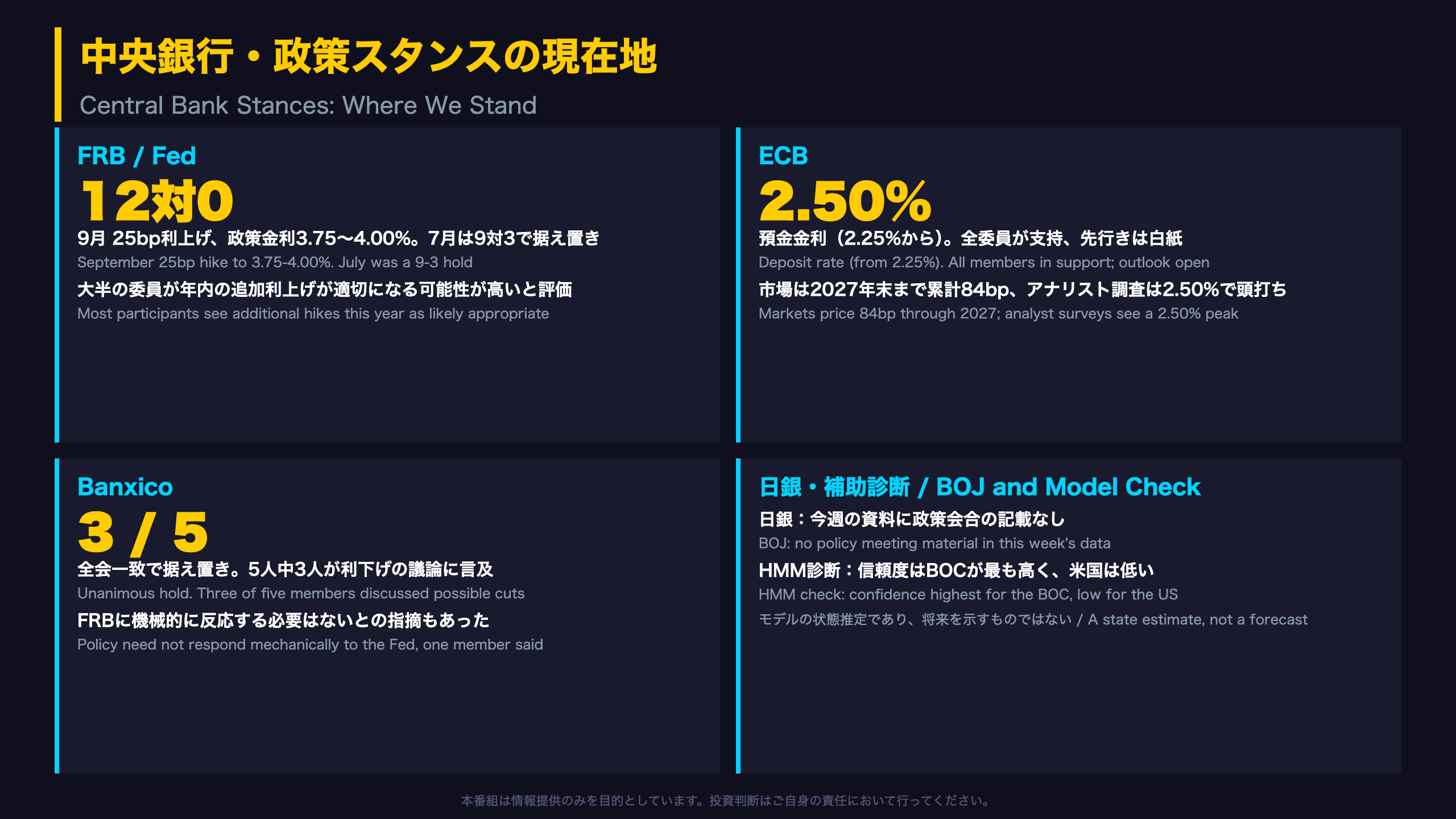
Central banks: the US and euro area lean toward tightening
Why minutes matter. Minutes are the written record of a meeting held weeks earlier. They show how broad the consensus was and what was debated, and they are not a forecast of the next decision.
Federal Reserve
In July the committee voted 9-3 to hold, with three members preferring a hike. In September the vote was 12-0 for a 25 basis point increase to 3.75-4.00%. The minutes cite inflation re-accelerating to an estimated 3.8% in August and labour-market risks moving from tilted down to roughly balanced. Several participants described policy as not restrictive or only mildly so.
European Central Bank
Growth projections were nudged up and inflation projections for 2027-28 were raised. Markets price 84 bp of cumulative tightening through end-2027, whereas analyst surveys see the deposit rate peaking at 2.50%. The minutes call the gap worth further study, and say communication sent neither a ‘first of many’ nor a ‘last’ signal.
Banxico
A unanimous hold, but three of five members discussed cuts, and the minutes say policy need not respond mechanically to the Fed. The most hawkish member warned that failure of inflation to converge could reopen the discussion of following the Fed.
Bonds
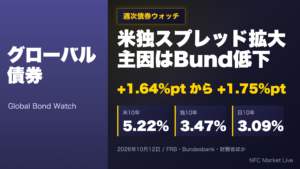
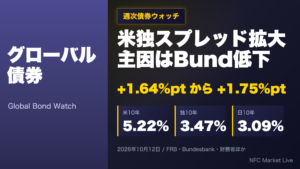
The US 10-year yield is 5.24% and the 30-year 5.61%, versus Japan’s 10-year at 3.09%.
Watch next
The next FOMC meeting and ECB minutes fall outside next week.
来週(10/12〜10/16)の注目イベント
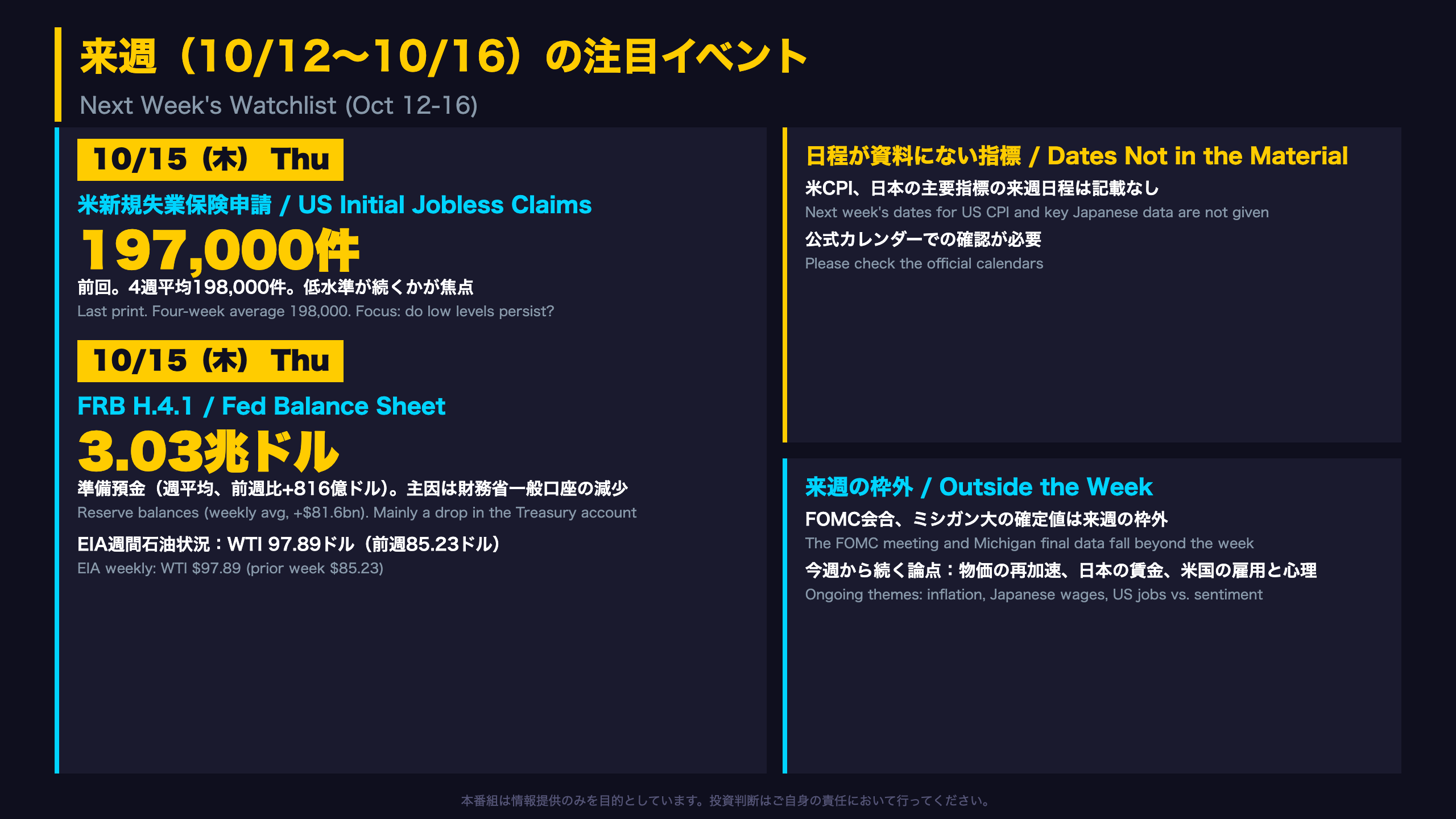
Next week’s checklist (October 12-16)
Only two scheduled releases can be confirmed from this week’s material, both on Thursday, October 15.
US initial jobless claims (Department of Labor)
The 197,000 print (-2,000 week on week) sits with a four-week average of 198,000, the lowest in about a year of the release’s table. The DOL calls claims a leading indicator but notes that weekly administrative data are volatile. Continuing claims across all programs were 1.52 million, down 47,372.
Fed H.4.1 balance sheet
The Fed’s weekly balance-sheet release shows reserve balances of $3.03 trillion, up $81.6 billion, mostly because the Treasury General Account (the government’s cash account at the Fed) fell $68.4 billion to $880 billion. The reverse repo facility stood at $329.5 billion.
Energy
The EIA weekly report is published every week. WTI was $97.89, versus $85.23 a week earlier and $61.65 a year ago, yet retail gasoline fell to $4.354 from $4.465.
What is not on the list
The material does not list next week’s dates for US CPI or Japanese data, so we do not guess. The next FOMC meeting and the final Michigan reading fall beyond the week.
Continuing themes
Whether inflation upticks spread, whether Japan’s wage growth stays above 2.2% inflation, and whether US labour strength and weak sentiment reconcile.
Disclaimer: This article is for informational purposes only. All investment decisions are made solely at your own risk.