This article was automatically generated by the NFC Market Live AI analysis system. (Updated: 2026-11-02 07:06 JST)
Global Bond Watch Weekly, Nov 2, 2026.
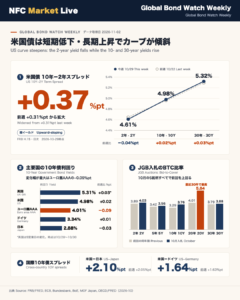
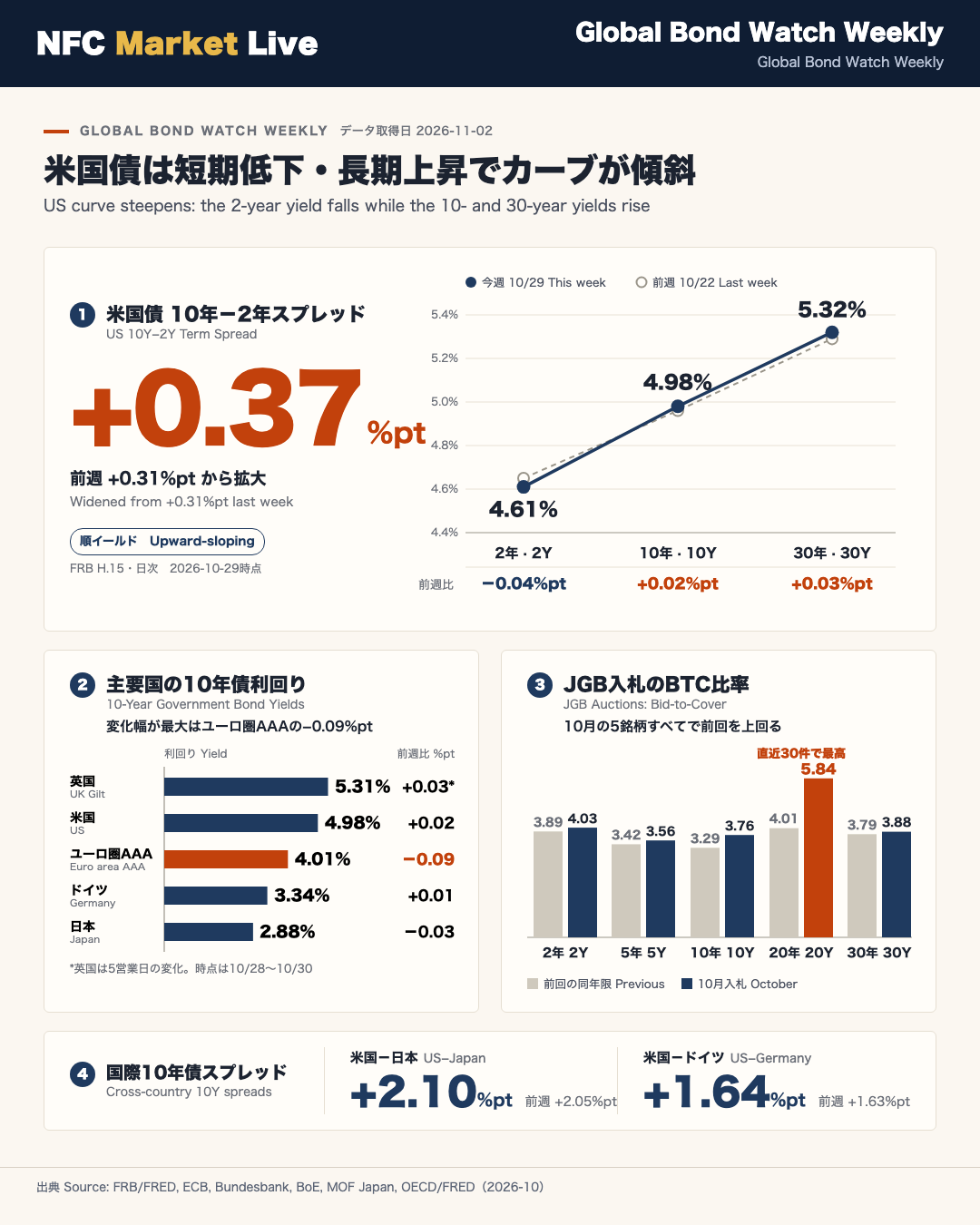
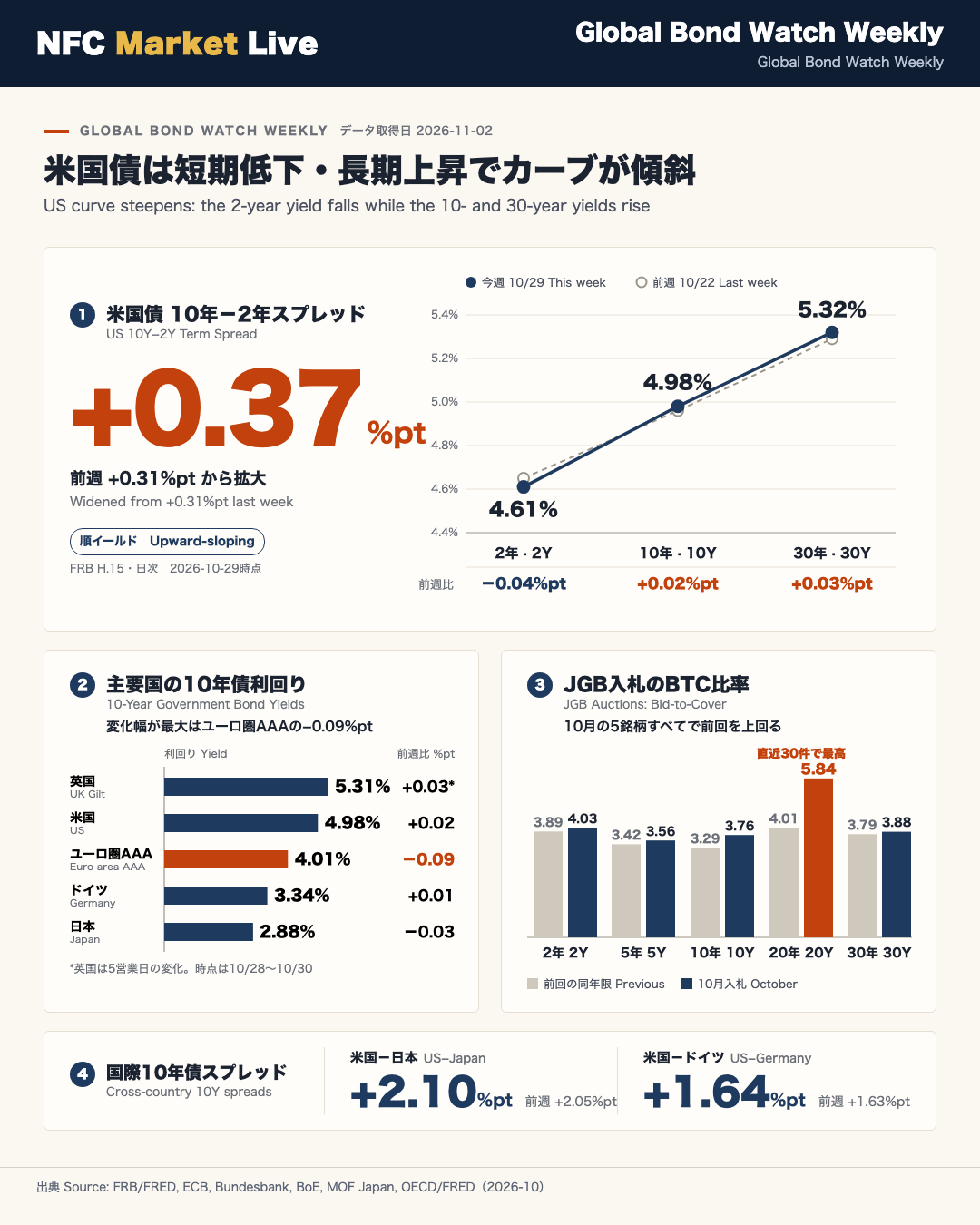
The biggest change this week was a wider US term spread. The 2-year Treasury yield fell to 4.61% (-0.04pt on the week) while the 10-year rose to 4.98% (+0.02pt) and the 30-year to 5.32% (+0.03pt), lifting the 10s-2s spread to +0.37pt from +0.31pt (Oct 29, FRB H.15).
In Europe, the euro-area AAA 10-year yield was 4.01% (Oct 29, ECB), down from 4.10% a week earlier. The German 10-year was 3.34% (Oct 30, Bundesbank) and the UK 10-year gilt 5.31% (Oct 28, Bank of England).
In Japan, JGB yields on Oct 29 were 1.90% (2-year), 2.88% (10-year) and 3.96% (30-year). The 10s-2s spread was +0.98pt (prior +1.00pt) and the US-Japan 10-year spread +2.10pt (prior +2.05pt). In Ministry of Finance auctions held in October, the bid-to-cover ratio exceeded that of the previous auction of the same maturity for all five tenors (2-, 5-, 10-, 20- and 30-year). The Oct 29 2-year auction was 4.03 and the Oct 20 20-year auction 5.84.
NFC HMM regimes: ECB Moderate, BoE Restrictive Hold, US Slack Recovery, BOJ Hawkish.
Sources: FRB/FRED, ECB, Bundesbank, BoE, MOF Japan, OECD/FRED
グローバル金利スナップショット / Global Rate Snapshot
Weekly Snapshot: The US Curve Steepened as Short Yields Eased and Long Yields Edged Up
This edition combines daily series from the Federal Reserve’s H.15 release (via FRED, the St. Louis Fed database), the ECB, the Bundesbank, the Bank of England and Japan’s Ministry of Finance, plus monthly OECD data for France and Italy.
US Treasuries (Oct 29, 2026): 2-year 4.61% (-0.04pt), 10-year 4.98% (+0.02pt), 30-year 5.32% (+0.03pt). The 10s-2s term spread widened to +0.37pt from +0.31pt a week earlier. The prior report showed the 10-year falling 0.14pt over the preceding five sessions, so this week reads as a pause after that decline rather than a fresh move.
Elsewhere (10-year): Japan 2.88% (-0.03pt vs last week), Germany 3.34% (Oct 30), UK gilt 5.31% (Oct 28, +0.03pt over five sessions), euro-area AAA 4.01% (Oct 29, down from 4.10%). France (4.48%, Sept) and Italy (3.99%, Aug) are monthly snapshots and do not reflect this week’s trading.
International comparison: The UK 10-year and the US 30-year both sit above 5%, while Germany and Japan are far lower, so dispersion across major sovereign markets remains wide. Moves in the US, Japan, Germany and the UK were each within 0.03pt on the week; the euro-area AAA curve was the exception.
Caution: Series carry different dates and definitions, so cross-country comparisons are indicative only. This is data commentary, not a forecast.
米国債入札 Deep Dive / US Treasury Auction
US Treasury Auctions: Data Not Available This Week
The auction section of this report, normally sourced from TreasuryDirect (the US Treasury’s official issuance platform) and limited to nominal notes and bonds, returned a data-retrieval failure in both this week’s and last week’s editions. Bid-to-cover, high yield, indirect bidder share and issue size are therefore unavailable, and we do not estimate them.
How to read the metrics when they return
- Bid-to-cover: bids divided by the amount accepted. A higher ratio generally signals stronger demand and is best judged against the previous auction of the same maturity.
- Indirect bidders: a category that includes foreign central banks and official institutions, often used as a gauge of overseas demand.
- High yield (stop-out): the highest accepted yield. Its gap versus pre-auction secondary yields helps show how well supply was absorbed.
What the yield data do and do not say
The 10-year yield was 4.98% and the 30-year 5.32% as of Oct 29, up 0.02pt and 0.03pt on the week, after both had fallen 0.14pt over the five sessions covered by last week’s report. That is a stable long end, but it cannot tell us whether auctions were well bid. Conclusions about demand or fiscal sustainability would require the auction figures.
International comparison: Japan’s Ministry of Finance results, with bid-to-cover for every tenor, were available this week (see the Japan section), which highlights the gap in US data coverage. We will revisit US auctions once the series is restored.
ヨーロッパ債券市場 / European Bond Markets
Europe: Euro-Area AAA and Bund Yields Ease, UK Gilt Holds Above 5%
Sources and definitions. The ECB publishes yield curves for euro-area AAA-rated central government bonds, while the Bundesbank and the Bank of England supply the German Bund and UK gilt series. France and Italy come from OECD monthly data and can lag by up to a month.
Daily data: Euro-area AAA 10-year spot 4.01% (Oct 29), down from 4.10% a week earlier. German 10-year 3.34% (Oct 30): +0.01pt versus the 3.33% in last week’s report, but -0.03pt over the latest five sessions, which implies roughly 3.37% on Oct 26 (our back-calculation). UK 10-year gilt 5.31% (Oct 28), +0.03pt over five sessions; last week’s edition could not retrieve a gilt value.
Monthly reference: France OAT 4.48% (Sept) and Italy BTP 3.99% (Aug). The OAT-Bund spread is +114bps (prior +115bps) and BTP-Bund +65bps (prior +66bps). Because the OAT and BTP figures did not change, the 1bp narrowing simply reflects the daily Bund move. It is not evidence that French or Italian risk eased.
Comparison: The gilt yield is about 2pt above the Bund (dates differ by two days) and close to the US 30-year at 5.32%. The AAA spot and Bund series use different definitions, so their level gap should not be read as a credit-quality gap.
Balance: Falling or flat core-Europe yields are a calmer signal, while a gilt above 5% remains a point of caution. NFC’s HMM labels the ECB ‘Moderate’ and the BoE ‘Restrictive Hold’ (see the trade implications section).
日本国債・日銀政策金利 / JGB & BOJ
Japan: JGB Yields Slip Slightly, October Auctions Show Higher Bid-to-Cover Across All Five Tenors
Sources. Yields and auction results come from Japan’s Ministry of Finance. The BOJ policy rate of 1.04% is the OECD monthly figure for September 2026, not a live quote.
Yields (Oct 29): 2-year 1.90% (-0.01pt on the week), 10-year 2.88% (-0.03pt), 30-year 3.96% (+0.01pt). The 10s-2s spread was +0.98pt versus +1.00pt. The 2-year yield sits 0.86pt above the 1.04% policy rate. The US-Japan 10-year spread widened to +2.10pt from +2.05pt.
Auctions held in October: In each of the five tenors auctioned in October, bid-to-cover exceeded that of the previous auction of the same maturity: 2-year 4.03 (Oct 29, vs 3.89), 20-year 5.84 (Oct 20, vs 4.01), 5-year 3.56 (vs 3.42), 30-year 3.88 (vs 3.79), 10-year 3.76 (vs 3.29). The 20-year figure is the highest among the 30 auctions listed. The gap between stop-out and average yield (our calculation from the reported yields) was flat for the 2-year at 0.7bp and narrower for the others, for example 0.2bp for the 10-year against 1.6bp in September. Narrower gaps point to less dispersion in bidding.
Context and caution: The average 2-year auction yield has risen from 1.369% on May 29 to 1.905%. The Oct 6 10-year auction average (3.101%) was above the Oct 29 secondary-market yield (2.88%), but the two series differ, so we avoid a direct comparison.
International comparison: The US 2-year yield (4.61%) is about 2.7pt above Japan’s, a reminder of how much lower Japanese yields remain. Demand data here are supportive, but they cover only one month of auctions.
FX・CFDへの含意 / Trade Implications
Trade Implications: Checking Yield Spreads Against NFC’s HMM Regimes
What the HMM is. NFC’s hidden Markov model (HMM) classifies each central bank’s policy backdrop into regimes. This week: ECB ‘Moderate’, BoE ‘Restrictive Hold’, US ‘Slack Recovery’, BOJ ‘Hawkish’, each with 100% confidence. The US regime name is unchanged from last week; only the numeric ID moved from 2 to 0, and the report gives no reason.
Spreads (this week vs last): US-Japan 10-year +2.10pt (+2.05pt); US-Germany 10-year +1.64pt (+1.63pt); OAT-Bund +114bps (+115bps) and BTP-Bund +65bps (+66bps), the last two based on monthly OAT/BTP data and therefore only a reference.
Alignment with the regimes:
– BOJ Hawkish: the 2-year JGB yield of 1.90% is above the 1.04% policy rate, and auction yields for that tenor have risen since May. That is directionally consistent, although the 10s-2s spread narrowed slightly to +0.98pt.
– BoE Restrictive Hold: a 5.31% gilt yield fits the label on level alone.
– ECB Moderate: lower AAA yields and a steady Bund show no clear conflict.
– US Slack Recovery: the curve steepened, but the label’s definition is not given, so we do not read much into one week.
Carry perspective: A wider US-Japan spread may work toward a weaker yen versus the dollar, and a correlation with USD/JPY is suggested, but FX also responds to many other drivers. The US-Germany spread barely moved.
Balance: Firmer JGB auction demand and lower European yields are stabilizing signs. A US 30-year and UK 10-year above 5%, together with unavailable US auction data, argue for caution. The picture is balanced, not directional.
Disclaimer: This article is for informational purposes only. All investment decisions are made solely at your own risk.