📺 Watch the Full Video Analysis
This article was automatically generated by the NFC Market Live AI analysis system. (Updated: 2026-10-04 08:39 JST)
This week revealed a clear policy divergence between Japan and the US.
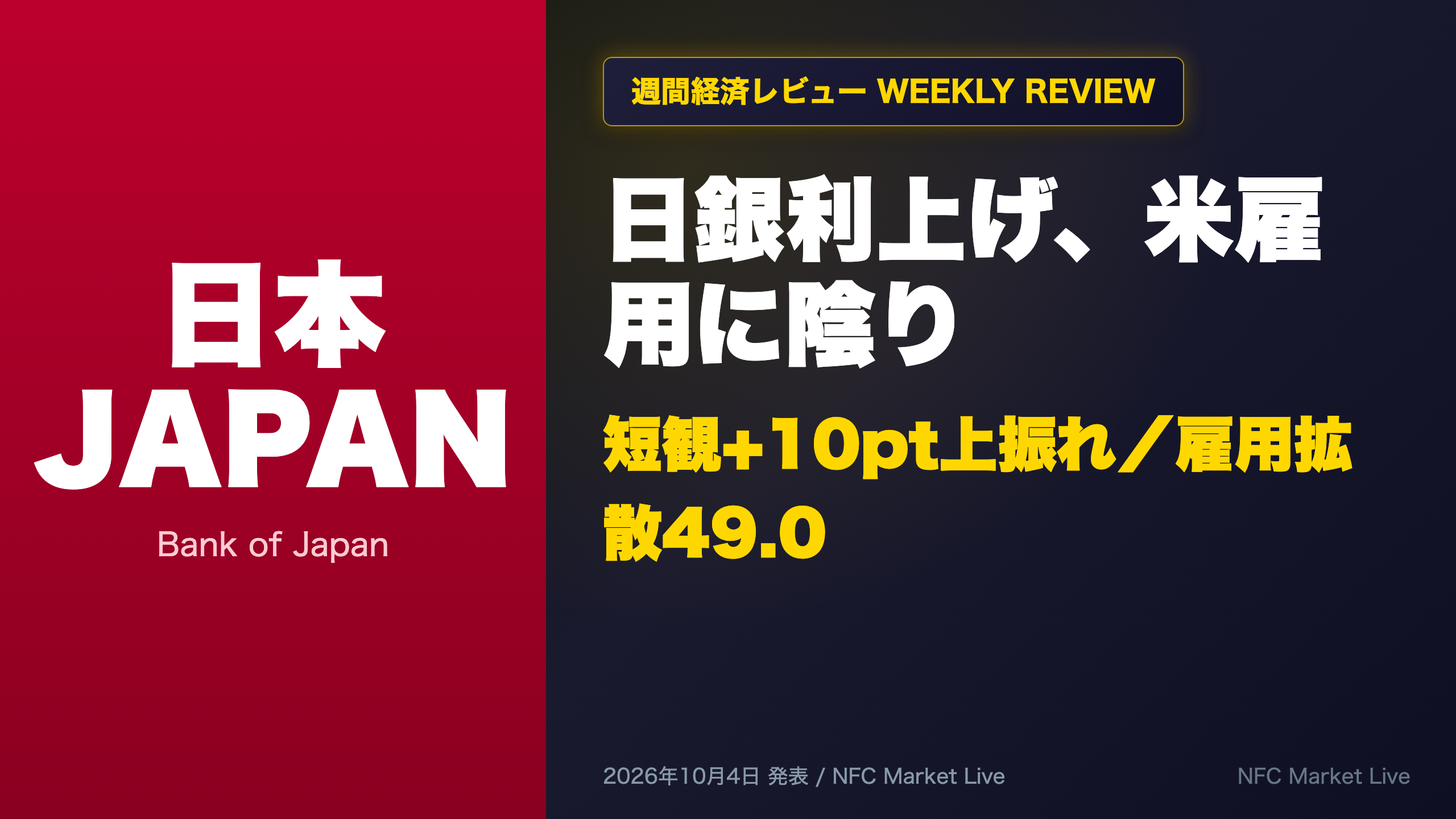
📊 The Bank of Japan delivered another rate hike on Sep 17-18, just 3 months after its last move. The Tankan survey (Oct 1) showed large manufacturers’ sentiment beating June forecasts by 7 points.
📉 Meanwhile, the US jobs report (Oct 2) showed nonfarm payrolls rising just 29,000, with the diffusion index falling below 50 for the first time in about a year. July-August gains were revised down by a combined 60,000.
💡 Yet US GDP was revised sharply up to 2.2%, and core PCE remains elevated near 3%. Strength and softness are coexisting in the US economy.
⚠️ We also cover Brazil’s fiscal data, Australian CPI, BOE, ECB, and the Riksbank, plus next week’s key calendar.
NFC 週間経済レビュー / Global Macro Digest

Program Overview
Between September 27 and October 4, 2026, a dense slate of macro releases and central bank events hit global markets. The dominant theme this week was a policy and data divergence between Japan and the United States: the Bank of Japan (BOJ) accelerated its tightening cycle while US labor market data showed signs of broadening weakness.
This Week’s Key Releases
- Japan: BOJ Monetary Policy Meeting (rate hike), September Tankan Survey, Tokyo CPI, Labour Force Survey, Monetary Base data
- United States: September Employment Situation (BLS), GDP final estimate with annual revision, PCE price index, durable goods orders, JOLTS
- Rest of world: Brazil fiscal statistics and Focus Report, Australian CPI and RBA money aggregates, Bank of England Money and Credit, Eurozone Business and Consumer Survey, Canadian monthly GDP, Riksbank minutes, and Micron Technology’s blowout earnings
What to Expect
This episode explores the coexistence of strength and softness in the US economy, the data behind BOJ’s accelerated hiking path, a comparative look at major central bank stances, and next week’s calendar of key events. Throughout, we aim for balanced, two-sided analysis rather than cherry-picked conclusions.
今週の総括 / The Weekly Verdict
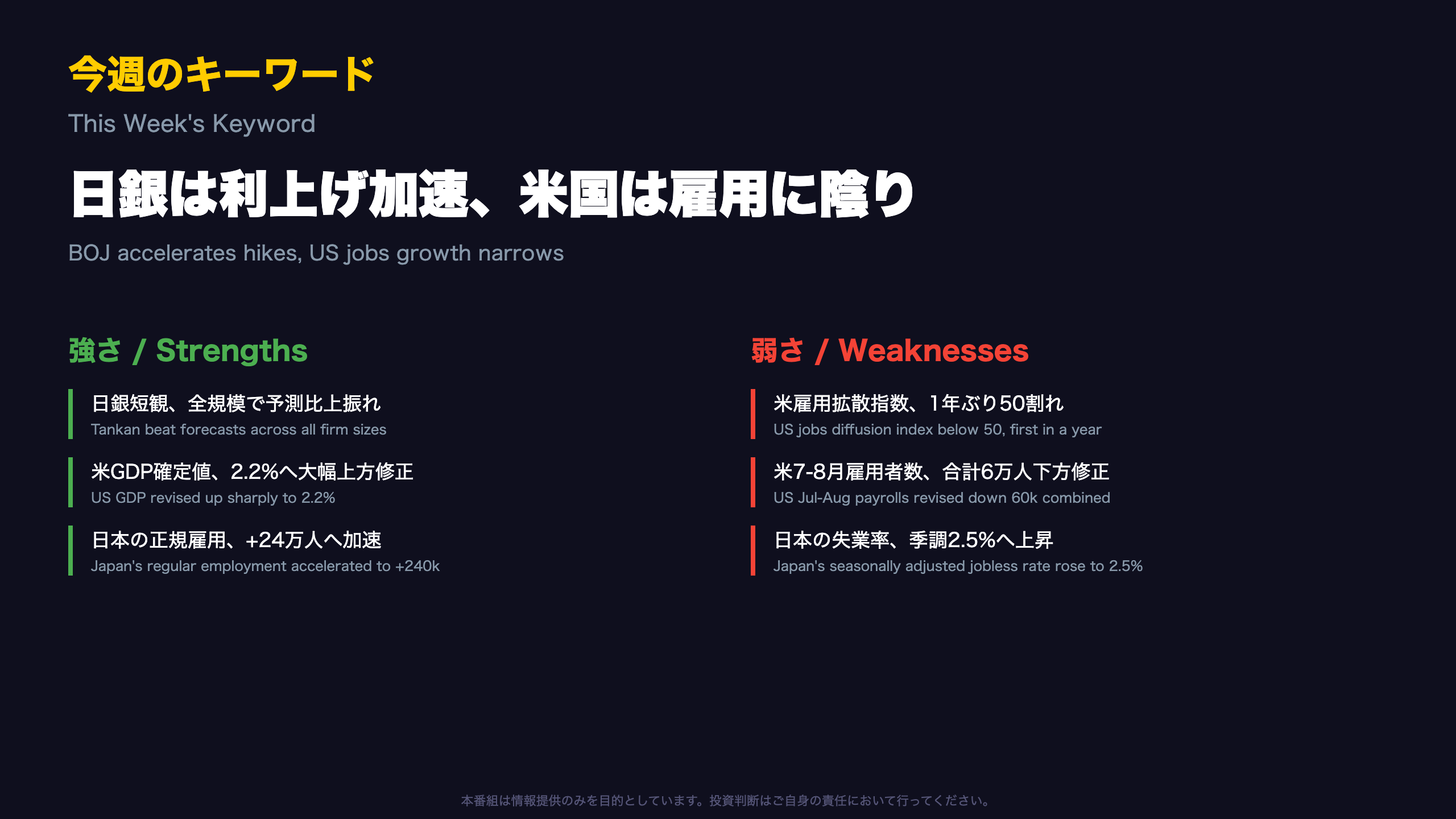
A Week of Coexisting Strength and Softness
This week’s global data defied any single simple narrative of “synchronized slowdown” or “synchronized boom.” Instead, it produced a genuinely mixed picture across major economies.
Mapping the Surprises
| Item | Detail | Assessment |
|---|---|---|
| BOJ Tankan | Beat forecasts by 7-14pts across firm sizes | Upside surprise |
| US Jobs Report | +29,000 payrolls; prior 2 months revised down 60,000 | Downside surprise |
| US GDP (final) | Revised up 0.7pt to 2.2% | Upside |
| Australian CPI | Jumped to 4.0% (largely due to policy unwinds) | Apparent upside |
What Matched Expectations
The Riksbank’s decision to hold rates steady, and Canada’s monthly GDP print of +0.3% (a third straight month of growth), were broadly in line with prior consensus expectations.
Bull Case vs. Bear Case
Bulls can point to a resilient corporate sector on both sides of the Pacific: Japan’s Tankan beat, the US GDP upward revision, and three consecutive months of core capital goods order growth all support this reading.
Bears highlight the narrowing breadth of US job gains and Japan’s uptick in unemployment as early signs of a labor market inflection point.
Neither view can be definitively confirmed from a single week of data alone — both narratives warrant continued monitoring in the weeks ahead. For context, the BOJ’s Tankan survey (short-term economic survey of enterprises) is Japan’s closest analog to the US ISM manufacturing survey, conducted quarterly by the central bank itself rather than a private trade association.
米国特集:雇用の裾野に陰り、GDPは上方修正 / US Focus: Jobs Breadth Narrows, GDP Revised Up
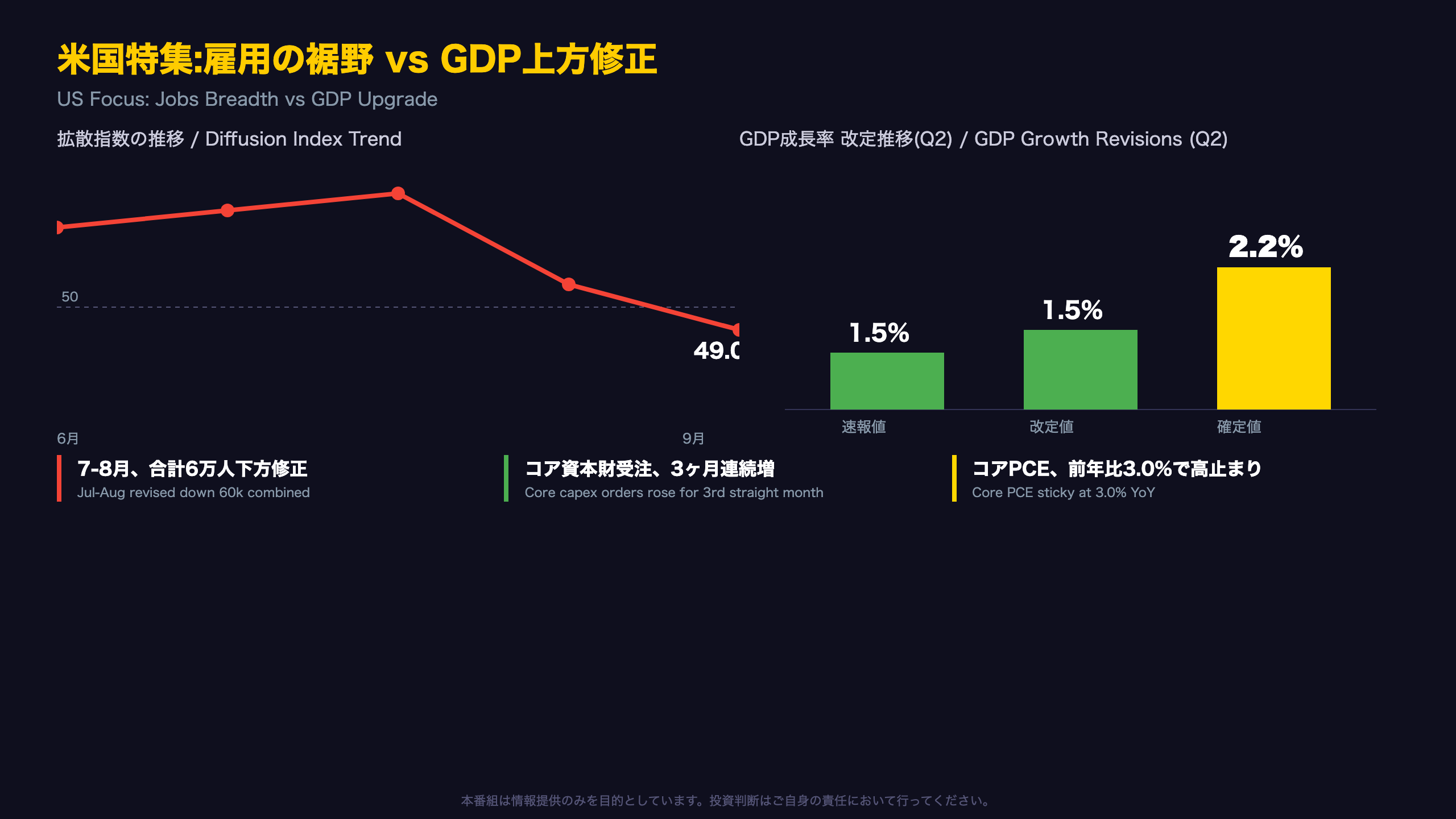
Reading Beyond the Headline Jobs Number
The most important signal in this week’s US jobs report wasn’t the modest +29,000 headline figure itself, but the lack of breadth behind it.
The Diffusion Index Plunge
The diffusion index measures the share of surveyed industries adding jobs; a reading of 50 indicates gains and losses are balanced.
| Category | Prior Month | Current Month |
|---|---|---|
| Total Private (250 industries) | 57.6 | 49.0 |
| Manufacturing (72 industries) | 63.9 | 46.5 |
Manufacturing fell below 50 for the first time in a year. Notably, the BLS itself characterized the headline changes as “changed little,” a reminder that US statisticians view single-month moves with caution — a useful benchmark for international readers unfamiliar with how conservatively US agencies typically phrase monthly releases compared to, say, market commentary.
Why Revisions Matter
The BLS technical note states that “monthly revisions result from additional reports received from businesses and government agencies… and from the recalculation of seasonal factors.” Two consecutive months of downward revisions (-31,000, then -29,000) suggest initial readings may currently be running hot relative to the eventual settled figures — a pattern US rates traders watch closely ahead of FOMC meetings.
Behind the GDP Upgrade
The BEA’s technical notes specifically cite “nonresidential structures (led by commercial and health care, mainly data centers)” as a leading contributor to the upward revision — direct statistical confirmation that AI infrastructure buildout is now showing up in national accounts. Separately, real final sales to private domestic purchasers (RFSPDP), a measure the Fed watches as a cleaner read on underlying demand, came in at 4.6% in Q2, actually exceeding headline GDP, implying net exports and inventories were a drag rather than a tailwind.
Market implication: A narrowing labor market alongside sticky 3% core PCE complicates the Fed’s path — not a clean case for either imminent cuts or hikes. The next jobs report lands November 6; watch whether the diffusion index reclaims 50.
日本特集:利上げ加速と物価上振れ / Japan Focus: Faster Hikes, Inflation Surprise
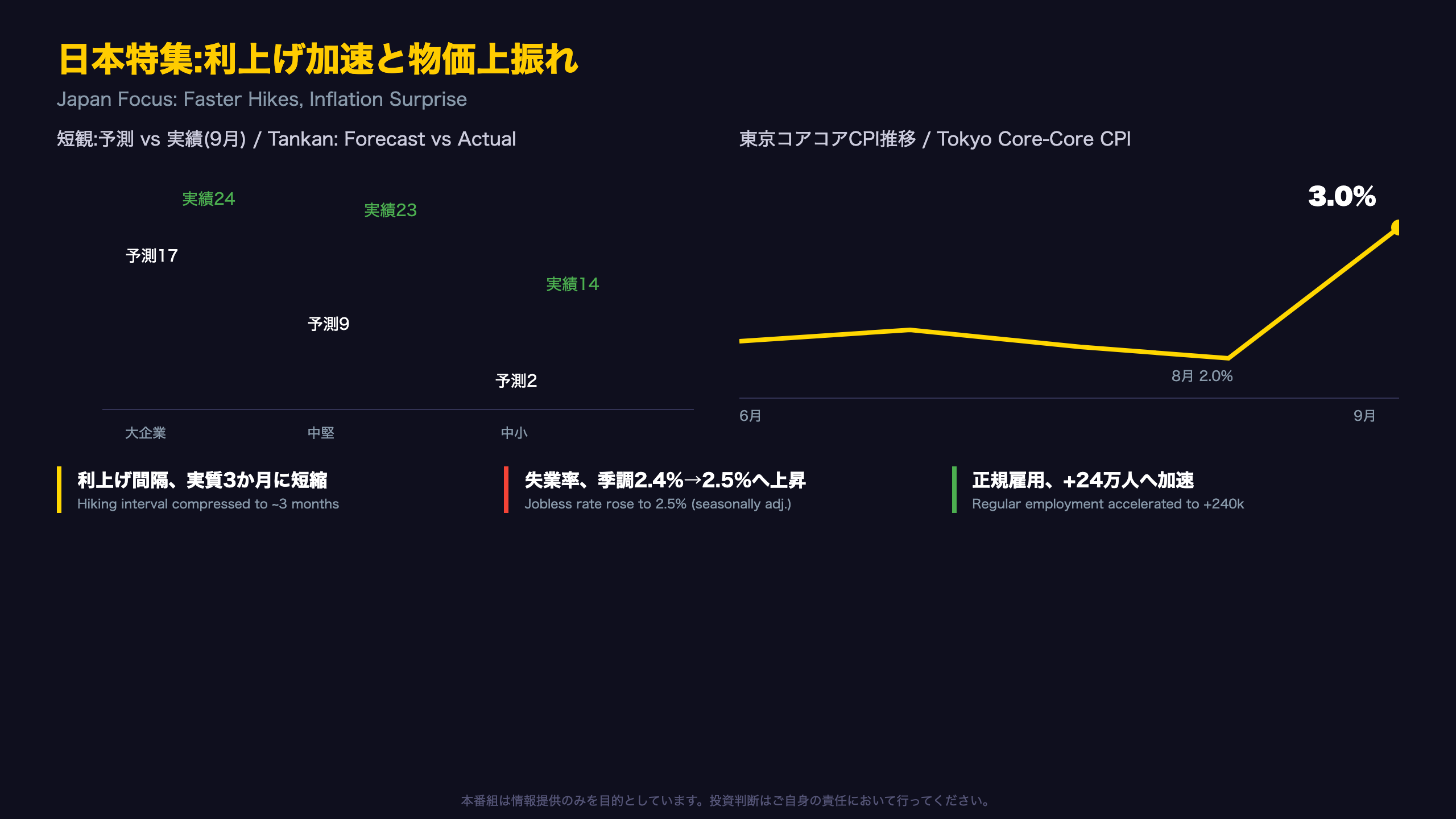
Behind Japan’s Accelerating Hike Cycle
The Bank of Japan’s rate hike cadence compressed from June, through a July pause, to a September hike — effectively a three-month interval. This acceleration isn’t just momentum; it’s backed by concrete data surprises.
What the Tankan “Forecast Miss” Reveals
The gap between companies’ own June forecasts for September sentiment and the actual September reading reached +14 points for mid-sized manufacturers and +12 points for small manufacturers — with every single category beating its own forecast. This suggests firms entered the quarter with excessively cautious expectations.
| Category | June Forecast | Sept. Actual | Surprise |
|---|---|---|---|
| Large Manufacturers | 17 | 24 | +7pt |
| Mid-size Manufacturers | 9 | 23 | +14pt |
| Small Manufacturers | 2 | 14 | +12pt |
For context, the Tankan Survey is the BOJ’s own quarterly business sentiment survey — Japan’s rough equivalent to the US ISM Manufacturing Index, though conducted by the central bank rather than a trade association, lending it unusual weight in BOJ policy deliberations.
A Dramatic Profit Upgrade
Large manufacturers’ ordinary profit plan swung from -6.7% to +13.6%, a 21.7-point revision, underpinned by a weaker assumed yen (revised to ¥154.46 for H1 and ¥154.00 for H2).
Decoding Tokyo’s CPI Spike
Japan’s Statistics Bureau explicitly attributed 0.29 points of the headline acceleration to the year-over-year drop-off from last year’s childcare fee waiver, plus a 65.6% jump in water rates (contributing 0.24pt) — both institutional, not demand-driven. That said, rising hotel rates (+4.6% YoY) and durable goods (+5.9%) reflect genuine yen-driven and inbound-tourism-related price pressure that shouldn’t be dismissed.
“If upside inflation risks materialize, it would deal a major blow to Japan’s economy and public livelihoods, and ultimately force a rapid, large-scale rate hike — creating a double shock.” — a BOJ board member, September meeting
Market implication: A hawkish BOJ alongside a wobbling US labor market narrows the rate differential that has pressured the yen for years — a dynamic worth watching for USD/JPY. The next Tankan survey and BOJ meeting will test whether this accelerated pace is sustainable.
中央銀行政策スタンスの現在地 / Where Major Central Banks Stand
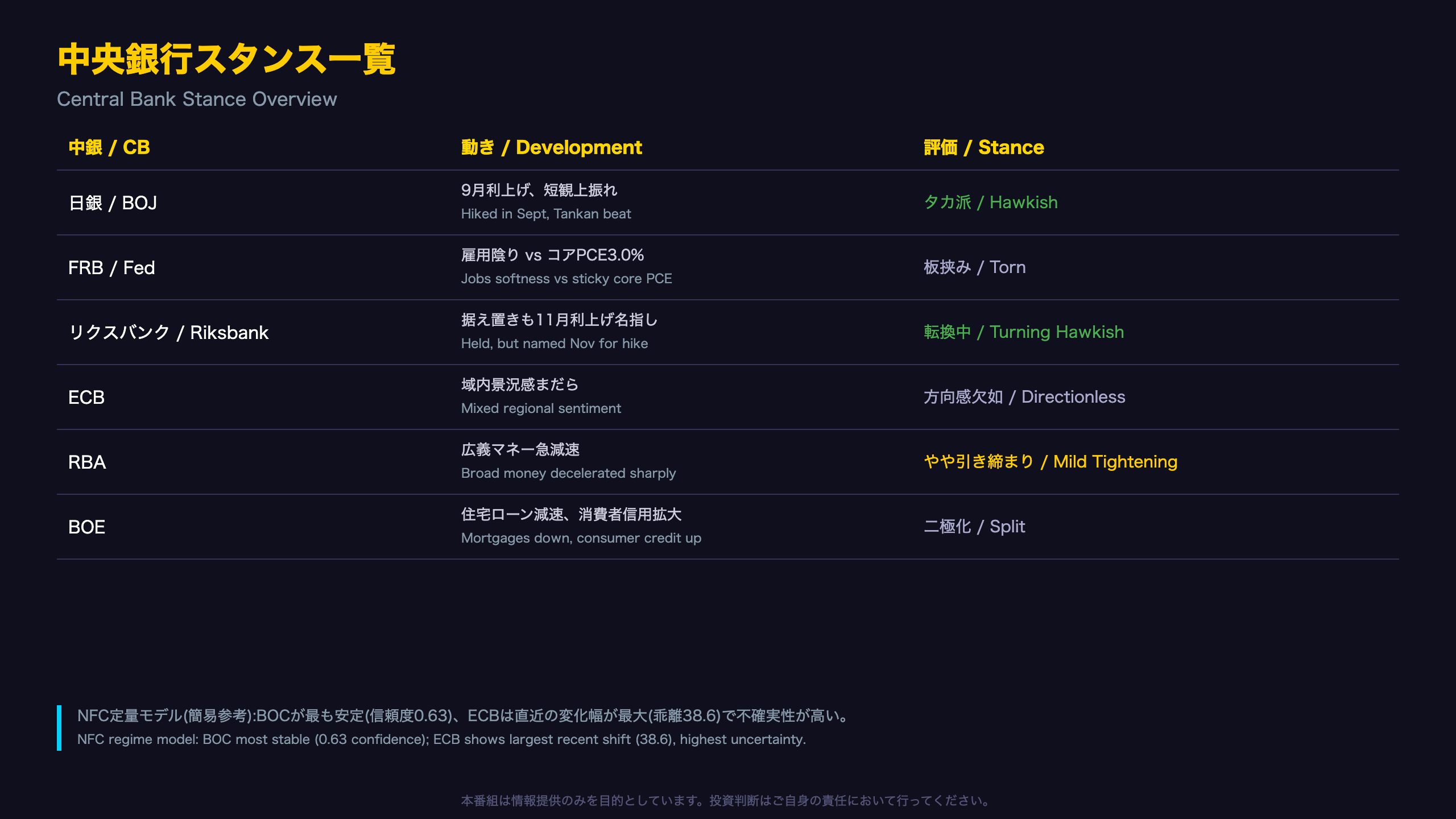
Central Bank Stances at a Glance
| Central Bank | This Week’s Development | Stance |
|---|---|---|
| Bank of Japan | Hiked in September; Tankan beat | Hawkish, accelerating |
| Federal Reserve | Narrowing jobs breadth vs. sticky 3% core PCE | Torn, data-dependent |
| Riksbank | Held steady but named “November” for a hike | Turning hawkish |
| ECB | Mixed regional sentiment, PPI reversal | Directionless |
| RBA | Broad money growth decelerated sharply | Mildly tightening |
| Bank of England | Mortgage approvals falling, consumer credit rising | Split signals |
The Riksbank’s Unusual Specificity
It is unusual for central bank minutes to see multiple board members name a specific future meeting month for policy action. Deputy Governor Seim stated she intends to “argue for a first rate hike at the November meeting,” and Governor Thedéen said a November hike would be “appropriate.” However, board member Jhelm dissented, calling the current rate path “somewhat too high” — a reminder the committee is not unanimous on timing, even as the direction is shared.
For readers unfamiliar with Sweden’s Riksbank: it is the world’s oldest central bank and, like the Fed, operates under a dual mandate balancing price stability with broader economic considerations, though its policy rate decisions tend to draw less global attention than the Fed or ECB despite Sweden’s export-heavy, rate-sensitive economy.
A Note on Our Regime Model
NFC’s proprietary quantitative model, which tracks ten central banks via a hidden Markov regime framework, currently shows the Bank of Canada in its most stable regime (0.63 confidence), while the ECB has seen the largest recent shift in its regime distance (38.6 points) — model-based evidence that the ECB’s policy path is becoming harder to read. This is directional context only, not a forecast of specific policy decisions.
Market implication: Diverging central bank paths — BOJ hawkish, Fed torn, Riksbank turning hawkish — point to continued volatility in rate-differential-driven currency pairs, particularly USD/JPY and EUR/SEK. The next US jobs report (Nov 6) and BOJ’s December Tankan will be key tests of whether these diverging paths hold.
今週の番組制作費 / Production Cost Corner
The Economics of AI-Driven News Production
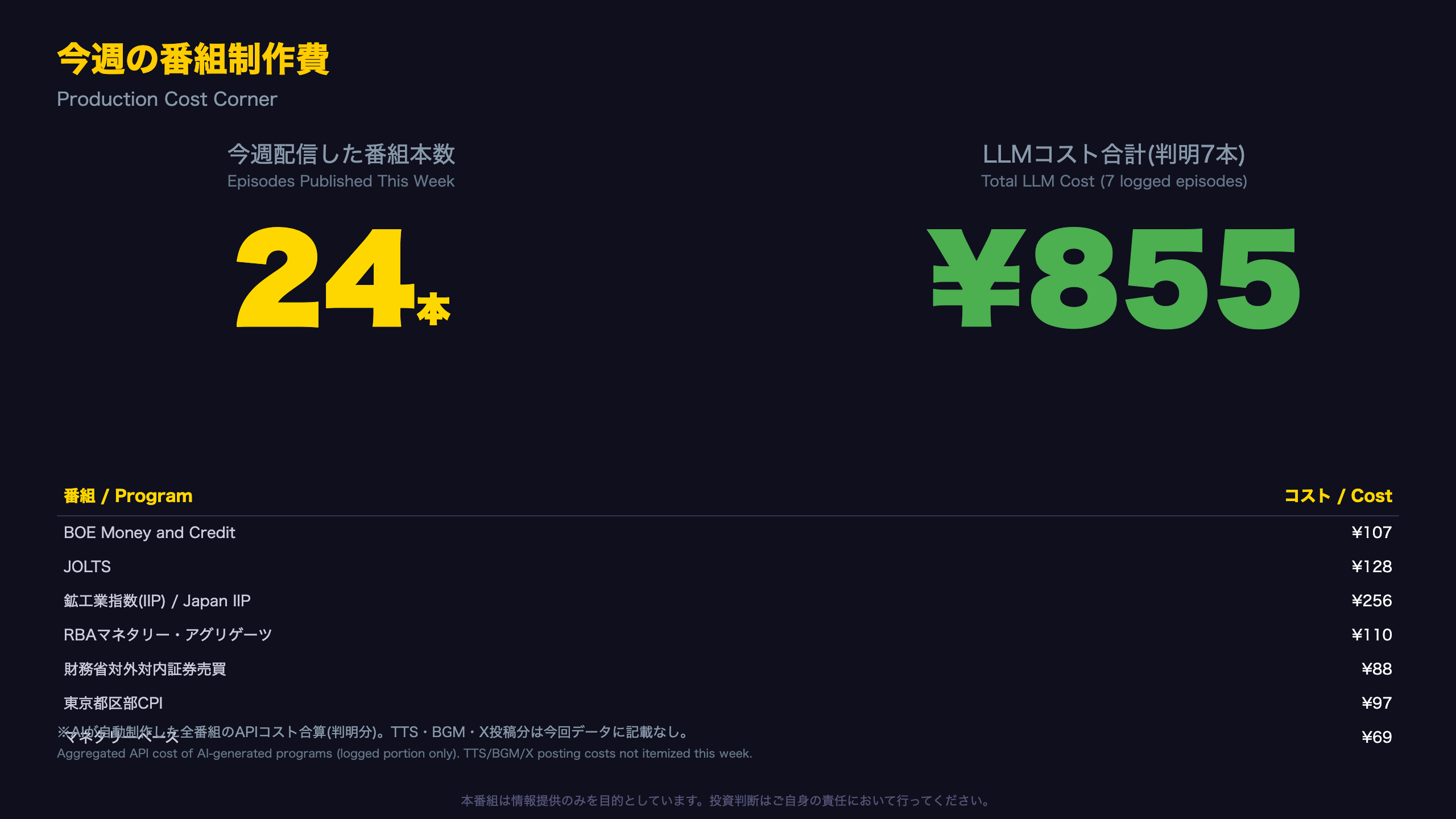
This week’s roster of full episodes, as logged in Section 3 of our internal data pack, totaled 24 programs — spanning the US jobs report, GDP final estimate, PCE, and durable goods data; Japan’s Tankan survey, Tokyo CPI, Labour Force Survey, and monetary base; plus coverage of Brazil, Australia, Canada, the UK, the Eurozone, and Sweden.
What We Can Verify
Of the 24 episodes, cost data (LLM usage only) was explicitly logged for seven:
| Program | Cost |
|---|---|
| BOE Money and Credit | ¥107 |
| JOLTS | ¥128 |
| Japan Industrial Production (IIP) | ¥256 |
| RBA Monetary Aggregates | ¥110 |
| MOF Weekly Securities Flows | ¥88 |
| Tokyo Ward-Area CPI | ¥97 |
| BOJ Monetary Base | ¥69 |
| Total (7 episodes) | ¥855 |
All figures use an exchange rate of roughly 1 USD = ¥157.3–157.4 and were generated using Claude Sonnet 5.
A Transparency Caveat
Only 7 of the 24 episodes this week had itemized LLM cost data; the underlying data pack contains no cost breakdown for text-to-speech (TTS), background music (BGM), or social media (X/Twitter) posting for this batch. So the ¥855 figure represents a partial, LLM-only total — not a complete weekly production budget across all 24 episodes and all cost categories.
Still a Remarkably Lean Model
Even with that caveat, roughly ¥100 (about 65 US cents) in LLM cost per episode is strikingly low compared to traditional, human-staffed financial news production, which typically involves research analysts, scriptwriters, and video editors. This cost structure is one tangible illustration of how AI-driven automation can combine speed and cost efficiency in delivering timely macro commentary — though, as with any automated system, human oversight of accuracy and nuance remains essential.
来週の注目イベントカレンダー / Next Week’s Key Calendar
Key Decision Points for Next Week
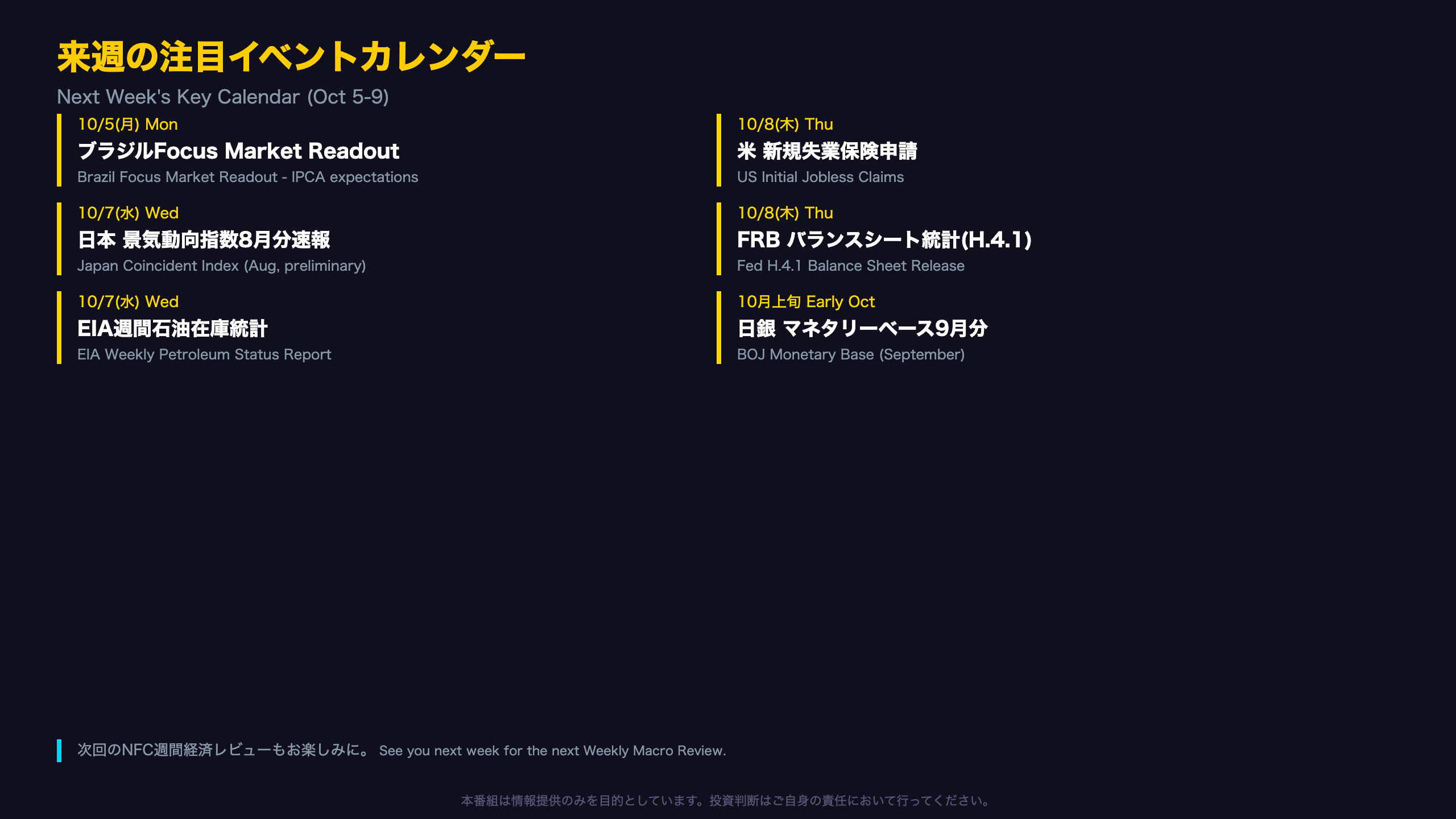
Here is a structured look at next week’s (Oct 5-9) major calendar events.
Event Timeline
| Date | Event | What to Watch |
|---|---|---|
| Oct 5 (Mon) | Brazil Central Bank Focus Market Readout | Will IPCA expectations rise for a third straight week? |
| Oct 7 (Wed) | Japan Cabinet Office Coincident Index (Aug, prelim) | Does the 7-month streak of gains continue from July’s 120.6? |
| Oct 7 (Wed) | EIA Weekly Petroleum Status Report | Pace of distillate drawdown (currently 13% below 5-yr average) |
| Oct 8 (Thu) | US Initial/Continuing Jobless Claims | Does the >10% YoY decline in continuing claims hold? |
| Oct 8 (Thu) | Fed H.4.1 Balance Sheet | Reserves holding near $2.9T, TGA trajectory |
| Early Oct | BOJ Monetary Base (Sept.) | Does the -18.9% YoY reserve compression pace continue? |
Why These Matter
Japan’s Coincident Index: In July, capital goods shipments (ex-transport) contributed +0.61 points alone — a broad-based improvement spanning production, employment, and sales. Whether this breadth holds in the August reading is one input the BOJ may weigh for further tightening.
For international readers: the Coincident Index (CI) is Japan’s Cabinet Office composite indicator, roughly analogous to the US Conference Board’s Coincident Economic Index, used to gauge the current phase of the business cycle in real time.
US labor indicators: Coming just days after this week’s jobs report showed the diffusion index dip below 50, weekly jobless claims will serve as an important real-time cross-check on whether labor market softening is a one-off or a developing trend.
Brazil’s Focus Report: The most recent 5-day sample of IPCA expectations, at 5.08%, runs above the 30-day average of 4.99% — suggesting newer respondents skew more hawkish on inflation. Whether this persists next week could influence the pace of BCB’s (Banco Central do Brasil’s) rate cuts.
Scenario Thresholds
If US jobless claims spike meaningfully above the recent ~200,000 range, labor market softening would likely be upgraded from “noise” to “trend” in market pricing. If claims stay within range, this week’s soft payrolls print will more likely be read as a single-month fluctuation rather than a turning point.
Disclaimer: This article is for informational purposes only. All investment decisions are made solely at your own risk.