This article was automatically generated by the NFC Market Live AI analysis system. (Updated: 2026-11-27 03:49 JST)
📄 Primary Source
Banco de México
https://www.banxico.org.mx/publicaciones-y-prensa/informes-trimestrales/{86A3ED7D-A51D-F541-E160-2FF96DFF2373}.pdf
📊 Banxico, Mexico’s central bank, released its Quarterly Report for July-September on Nov 26.
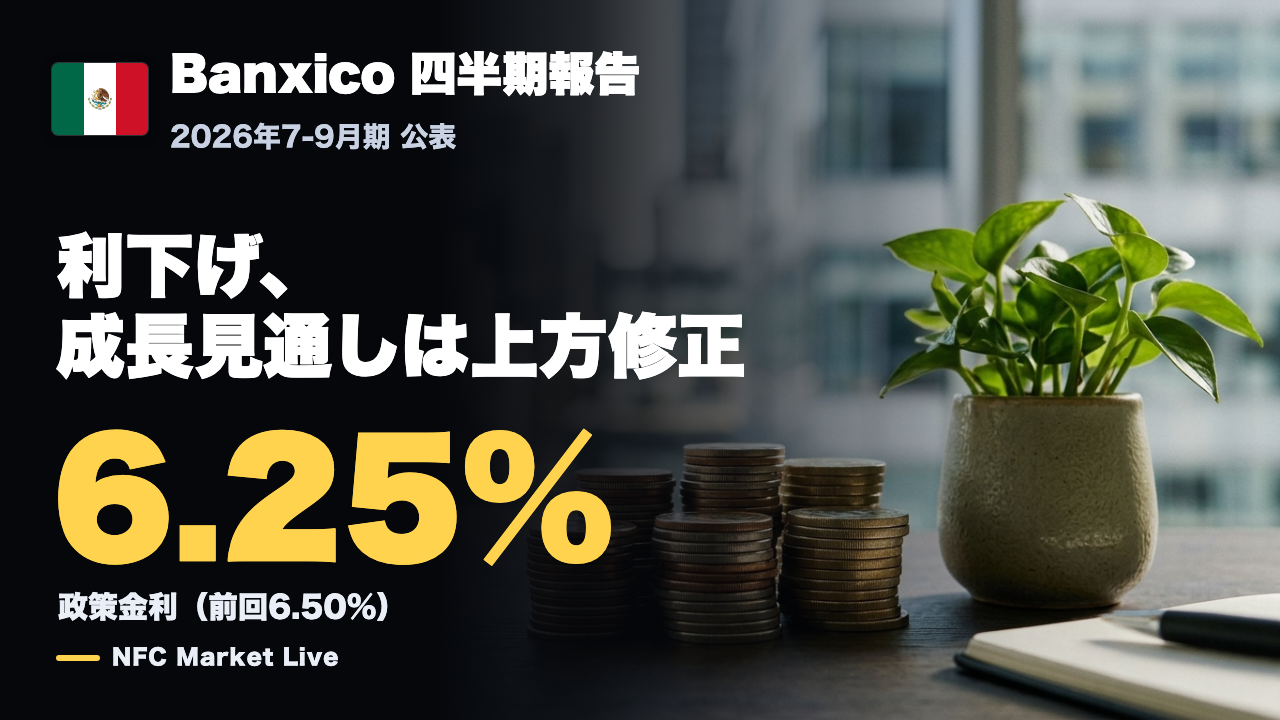
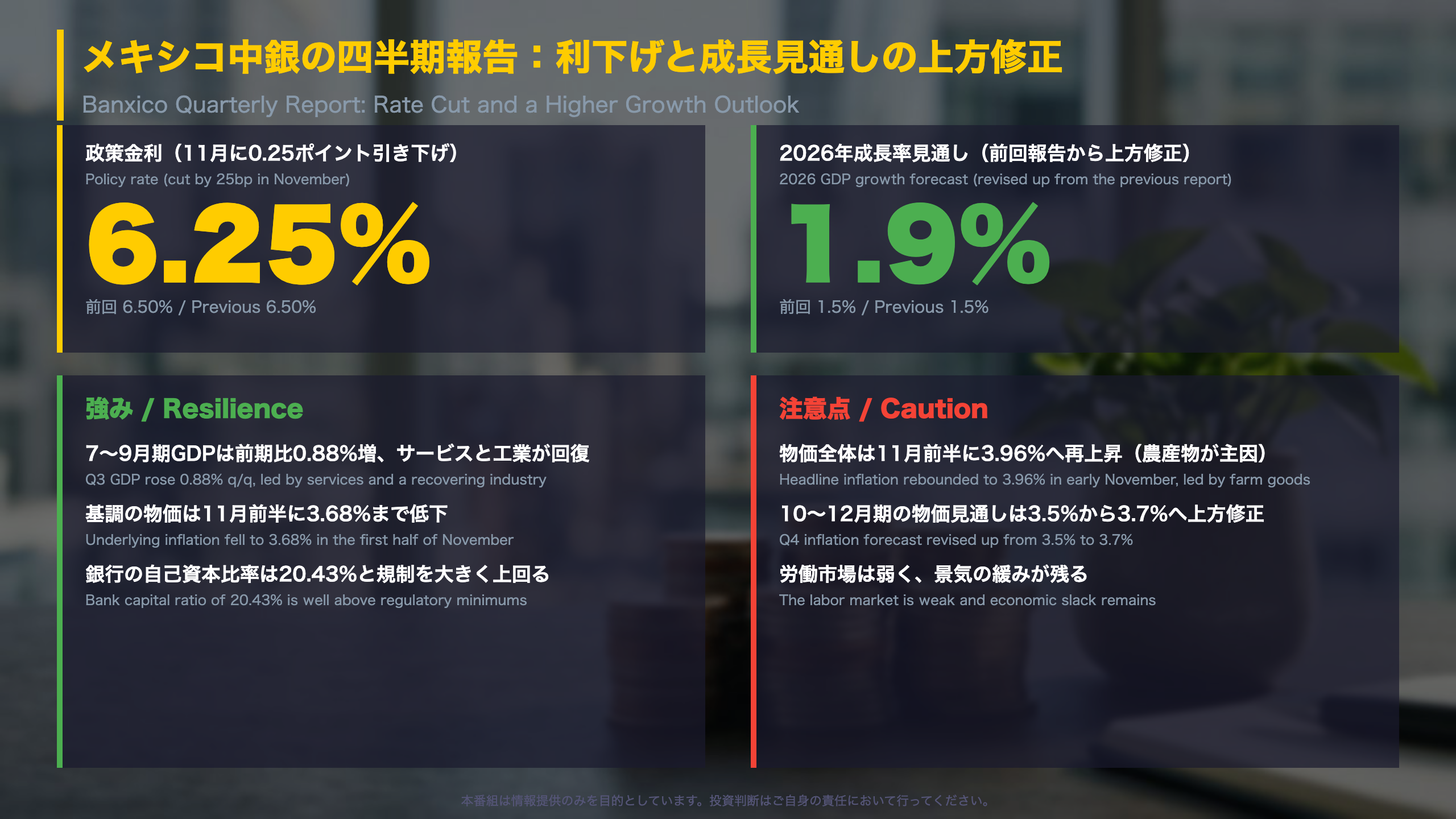
📉 The policy rate was cut 25bp to 6.25%, but the report says holding the rate at this level for a prolonged period will support inflation’s convergence to target.
📈 The 2026 GDP growth forecast was raised from 1.5% to 1.9%; Q3 GDP grew 0.88% q/q.
⚠️ Headline inflation rebounded to 3.96% in early November on volatile farm goods, and the Q4 inflation forecast rose from 3.5% to 3.7%, while underlying inflation eased to 3.68%.
💡 We sort out the strengths and the two-sided inflation picture using the report’s numbers. Next: the Feb 11, 2027 policy announcement.
メキシコ中銀の四半期報告:利下げと成長見通しの上方修正
What this report is
The Informe Trimestral (Quarterly Report) is the document in which Banco de México (Banxico), Mexico’s central bank, reviews inflation, economic activity and the conduct of monetary policy every quarter, as required by its law. This edition covers July-September 2026 and uses information available as of November 24.
How it differs from the August report
- Policy rate: 6.50% in August (after a May cut that Banxico said ended the easing cycle) versus 6.25% now, a 25bp cut described as a one-off adjustment.
- 2026 GDP forecast: 1.9% (range 1.7-2.1%) versus 1.5% (range 1.0-2.0%). The 2027 forecast is unchanged at 2.0%.
- Q4 2026 inflation forecast: 3.7% versus 3.5% for both headline and core.
- 2026 formal job creation (IMSS): 180-280 thousand versus 220-400 thousand.
International comparison
The US Federal Reserve raised its target range by 25bp in September to 3.75-4.00%, its first hike in more than three years. Banxico stated in September that, because macro conditions in Mexico differ from those in the United States, it would not react mechanically to Fed moves. The FOMC’s median 2026 rate projection moved from 3.8% to 4.1%.
What the report says about financial conditions
The peso strengthened to 16.87 per dollar on September 4, then weakened to 19.37 on November 24 as external financial conditions tightened. Between June 30 and November 24, the peso fell 11.0% against the dollar, while Mexican 10-year yields rose 22bp. The report presents these as facts, not forecasts.
Our reading
The report combines a firmer growth outlook with a mixed inflation picture. Underlying inflation is falling, but headline inflation has turned up on volatile items. Banxico’s own guidance, holding the rate at the new level for a prolonged period, is the main thing to track. The next policy announcement is on February 11, 2027, and the next Quarterly Report on March 3, 2027.
景気:回復は確かだが、過熱ではない
Quarterly GDP path
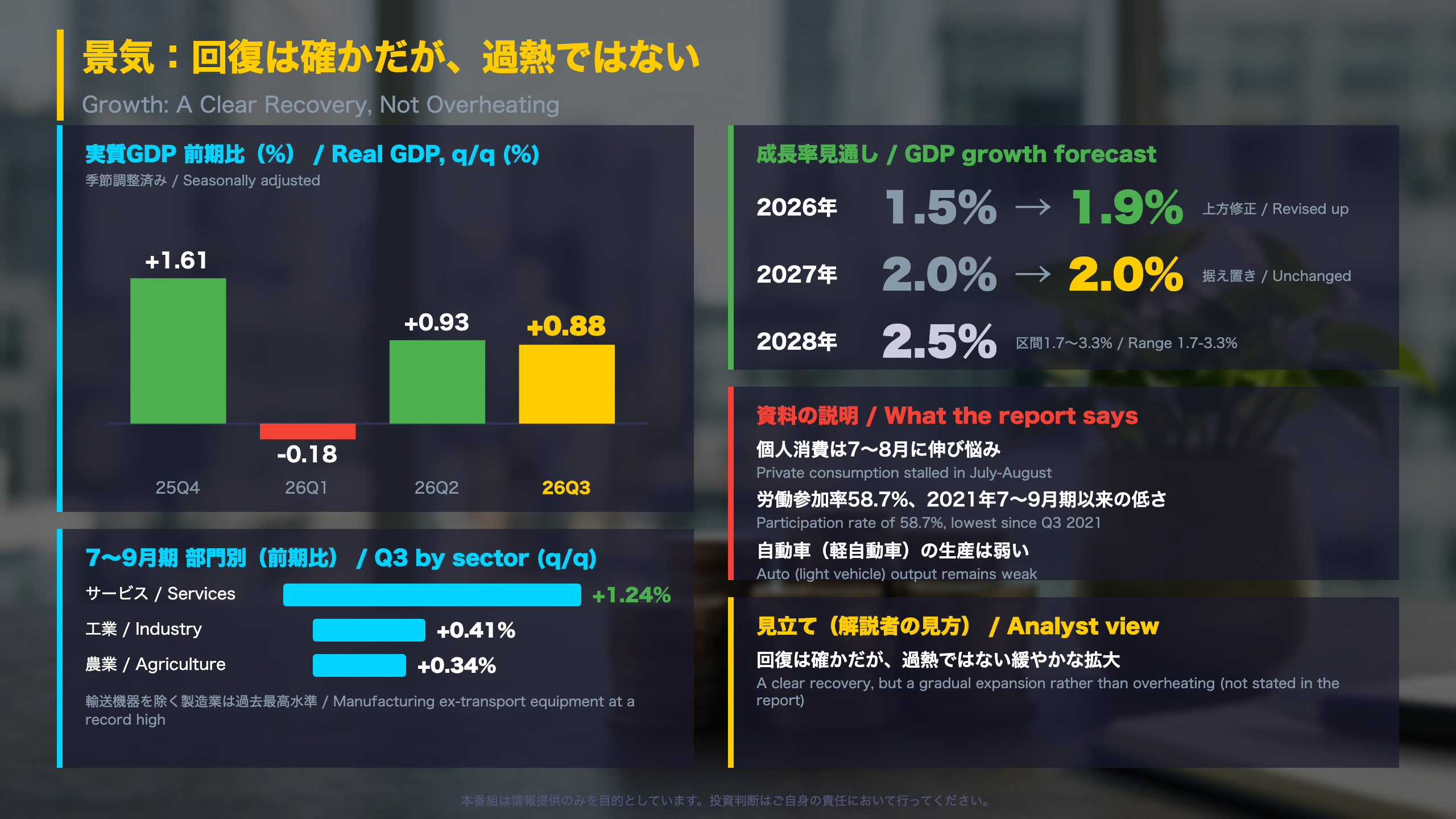
Seasonally adjusted quarter-on-quarter growth was 1.61% in Q4 2025, -0.18% in Q1 2026, 0.93% in Q2 and 0.88% in Q3. The Q2 figure was revised from 1.42% in the previous report to 0.93%. Mexico’s GDP is compiled by INEGI, the national statistics institute.
Sector detail for Q3 (q/q)
- Services: +1.24%, helped by wholesale trade, which benefits from the industrial rebound, as well as retail and transport.
- Industry: +0.41%. Construction is at its highest level on record, though it slowed toward quarter-end.
- Agriculture: +0.34%, the second consecutive increase.
Manufacturing is split
Manufacturing excluding transport equipment rose for a second straight quarter to a record high, driven by computer and communication equipment and machinery. Transport equipment broke its recovery because light-vehicle output was weak. The report links the strength in exports of computer equipment to US demand for technology goods and AI-related investment.
Demand side
Private consumption stalled in July-August. Retail chain sales (ANTAD) slowed sharply and dollar remittances fell, but consumer confidence rose in July-October, ending a decline that began in early 2024. Fixed investment kept recovering, though at a slower pace.
Labor market
The participation rate of 58.7% is the lowest since Q3 2021, and the employment-to-population ratio of 57.2% the lowest since Q2 2022. Unemployment is 2.7%, but informal-sector employment has risen for eight straight quarters.
International comparison
The US economy grew 0.8% q/q in Q3 after 0.6%, driven by domestic demand. Mexico’s 0.88% is similar in pace, and Mexico’s 2026 forecast of 1.9% compares with the IMF’s 2.3% for the United States.
Our reading
The upgrade reflects a better-than-expected Q3, and Banxico expects some moderation in Q4. The output gap is estimated to stay negative through the forecast horizon, a statistical estimate the report itself flags as highly uncertain. The next Quarterly Report is due on March 3, 2027.
物価:基調は低下、足元は農産物で上振れ
Inflation breakdown (year over year)
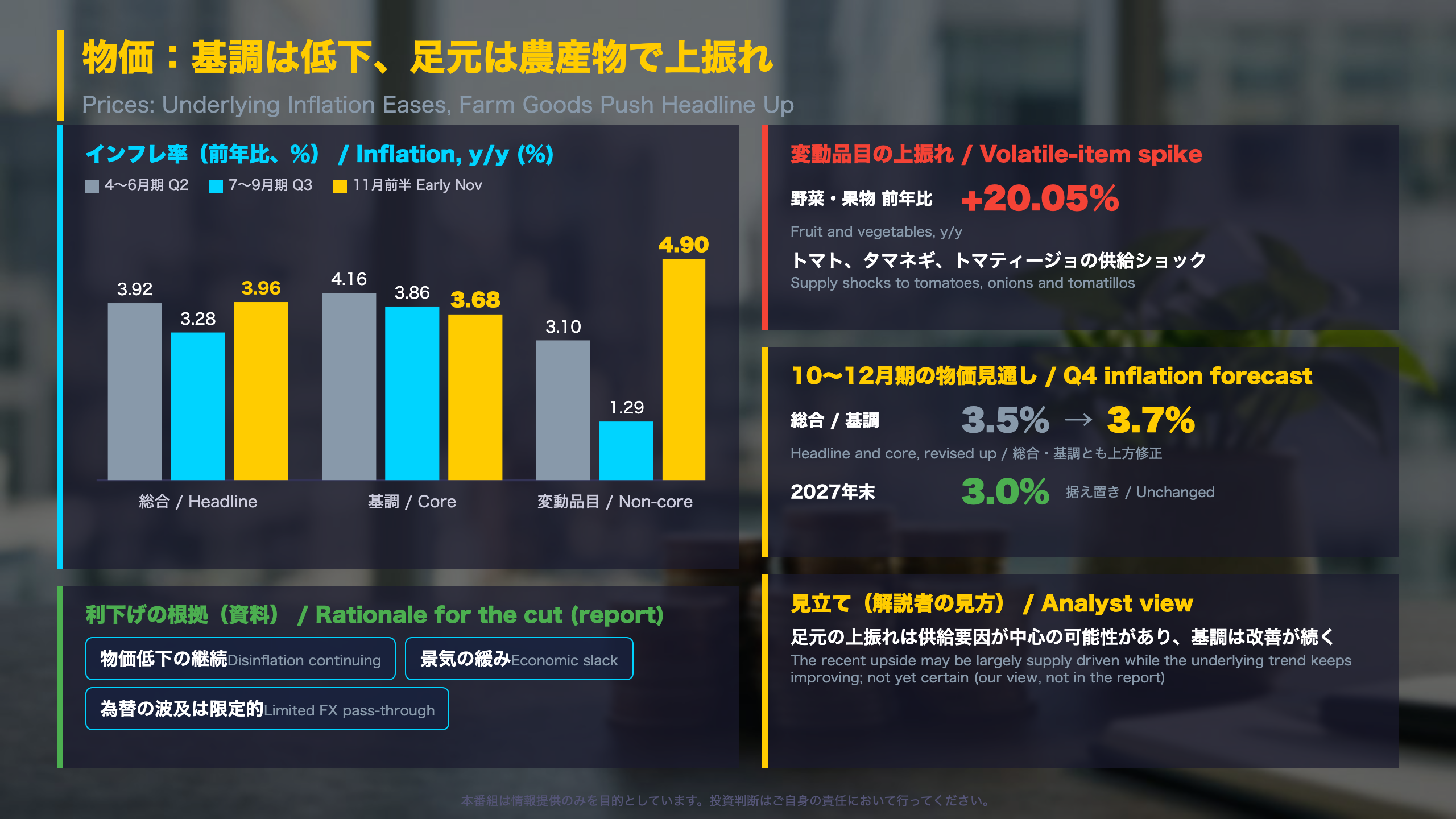
- Headline: 3.92% in Q2, 3.28% in Q3, 3.96% in the first half of November.
- Core (excluding agricultural goods, energy and government-set tariffs): 4.16%, 3.86%, 3.68%.
- Non-core: 3.10%, 1.29%, 4.90%.
Within core, goods inflation fell from 3.78% to 3.38% and services from 4.53% to 4.32%. The trimmed-mean indicator, which strips out the most extreme price moves, fell to 3.30%. For context, the Mexican CPI is compiled by INEGI and the central bank targets 3% with a one-point tolerance band.
What drove the rebound
Agricultural prices swung from -1.37% in Q3 to 6.65% in early November. Fruit and vegetables rose 20.05%, on new supply shocks affecting tomatoes, onions and tomatillos. Energy inflation was only 2.59% and gasoline 1.45%, which Banxico attributes to government price-stabilization policies.
Forecast revisions
Both headline and core forecasts for Q4 2026 rose from 3.5% to 3.7%, while every quarter from Q1 2027 is unchanged, with both measures at 3.0% by the end of 2027. The balance of risks remains tilted to the upside.
Expectations and real rates
Private-sector analysts expect 3.88% for end-2026 and 3.85% for end-2027. The ex-ante real policy rate is 2.33%, inside Banxico’s estimated neutral range of 1.8-3.6%. Producer prices for final goods for domestic consumption rose to 3.26% in October from 2.80% in Q3.
International comparison
US CPI inflation was 3.7% in September with core at 2.6%, while the euro area reached 4.0% in October on energy. Mexico’s headline rate sits below both, but its core rate is higher than the US CPI core.
Our reading
The report frames the cut around continued disinflation, slack and limited FX pass-through. Whether the vegetable shock proves transitory will show in the coming price releases. The next policy decision is February 11, 2027.
質疑で深める:利下げの理由、今後の姿勢、次の注目点
How the report frames the November cut
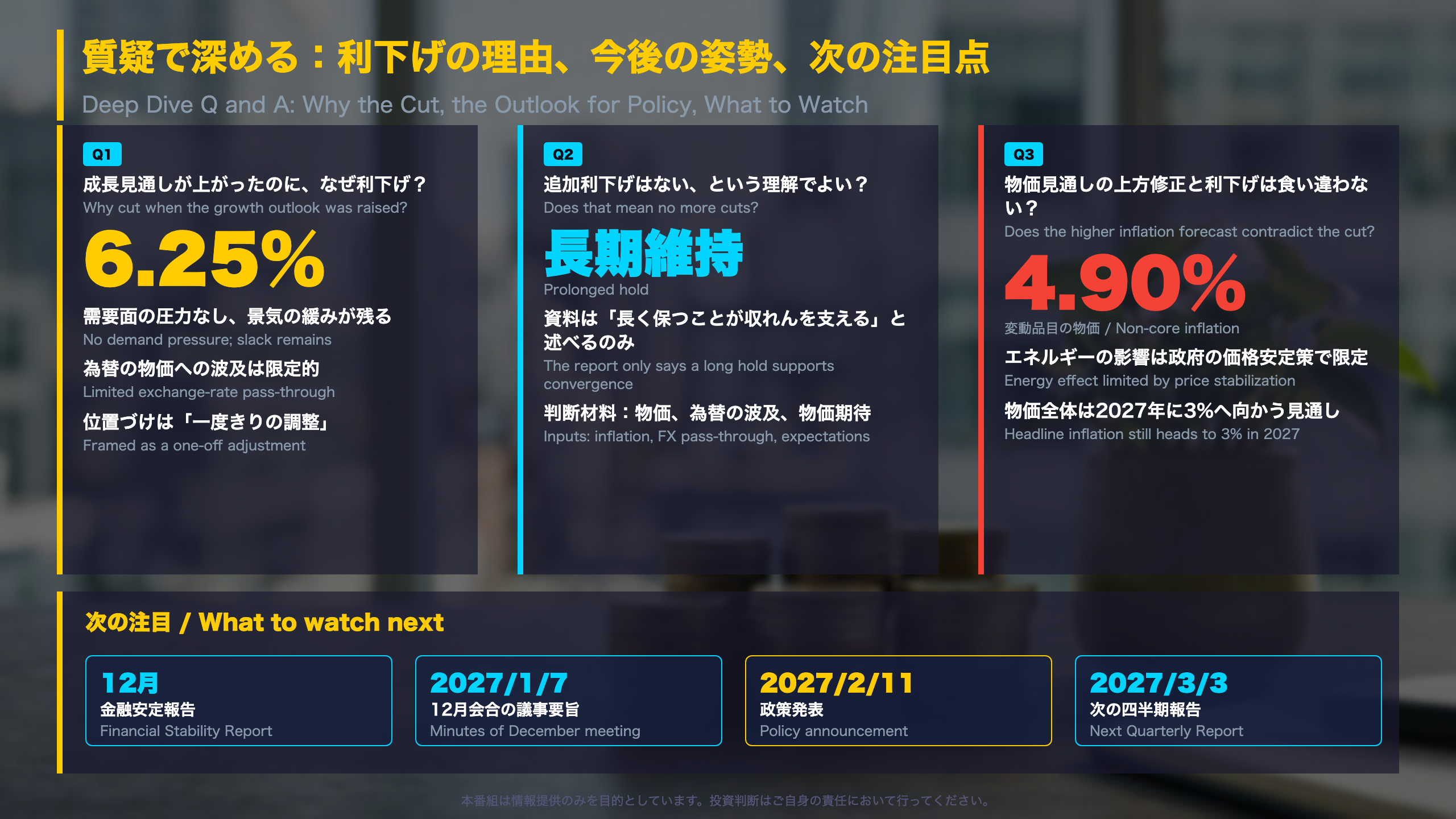
The report lists four reasons: disinflation has continued; economic slack limits the pass-through of exchange-rate moves to consumer prices; there are no demand pressures; and the restrictive effect of past tightening is still operating. The ex-ante real policy rate fell from 2.56% in June to 2.33%, inside the estimated neutral range of 1.8-3.6%.
Exchange rate and rate differentials
The peso touched 16.87 per dollar on September 4 and 19.37 on November 24. Since June 30, the currency is down 11.0%, and the 10-year yield is up 22bp. In the October Banxico survey, analysts expected 18.39 pesos for end-2026 and 18.64 for end-2027. Short-term rate differentials with the United States narrowed because the Fed hiked in September while Banxico cut.
Forward guidance wording
In May, Banxico declared the easing cycle finished, and in August it said holding was appropriate. The November move is described as a one-off adjustment (ajuste puntual), followed by a prolonged hold. The report does not say that no further cuts are possible. Future decisions will weigh observed and expected inflation, exchange-rate pass-through, slack and expectations.
International comparison
The ECB held its deposit rate at 2.50% in October after hikes in June and September, and the Fed held at 3.75-4.00%. Most advanced-economy central banks were tightening on energy-driven inflation, so Banxico is moving in the opposite direction from many peers, while emerging-market decisions overall were mixed.
Market context
The report notes that the peso depreciated and domestic yields rose from mid-September as global financial conditions tightened, and that sovereign risk indicators rose but stayed below most of 2025 levels. It makes no market forecast, and neither do we.
Upcoming calendar
The Financial Stability Report is due in December, the December meeting minutes on January 7, 2027, the first 2027 policy announcement on February 11, and the next Quarterly Report on March 3, 2027.
Disclaimer: This article is for informational purposes only. All investment decisions are made solely at your own risk.