This article was automatically generated by the NFC Market Live AI analysis system. (Updated: 2026-11-27 00:31 JST)
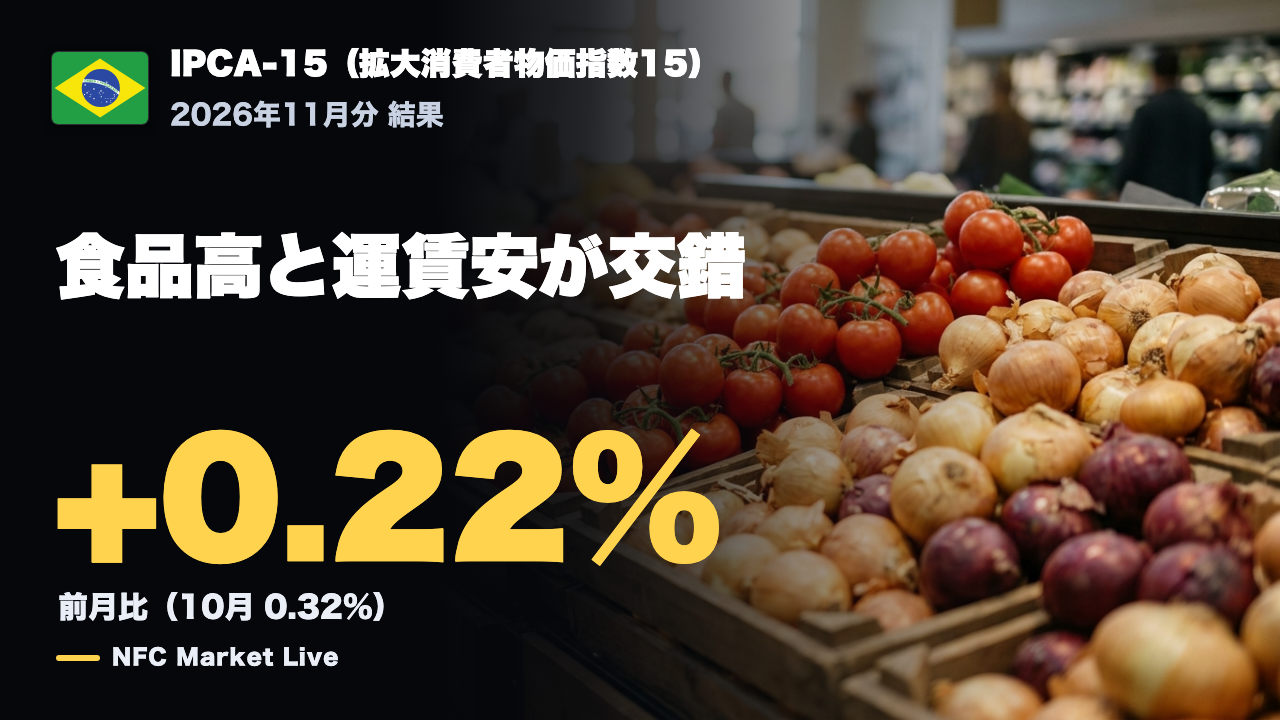
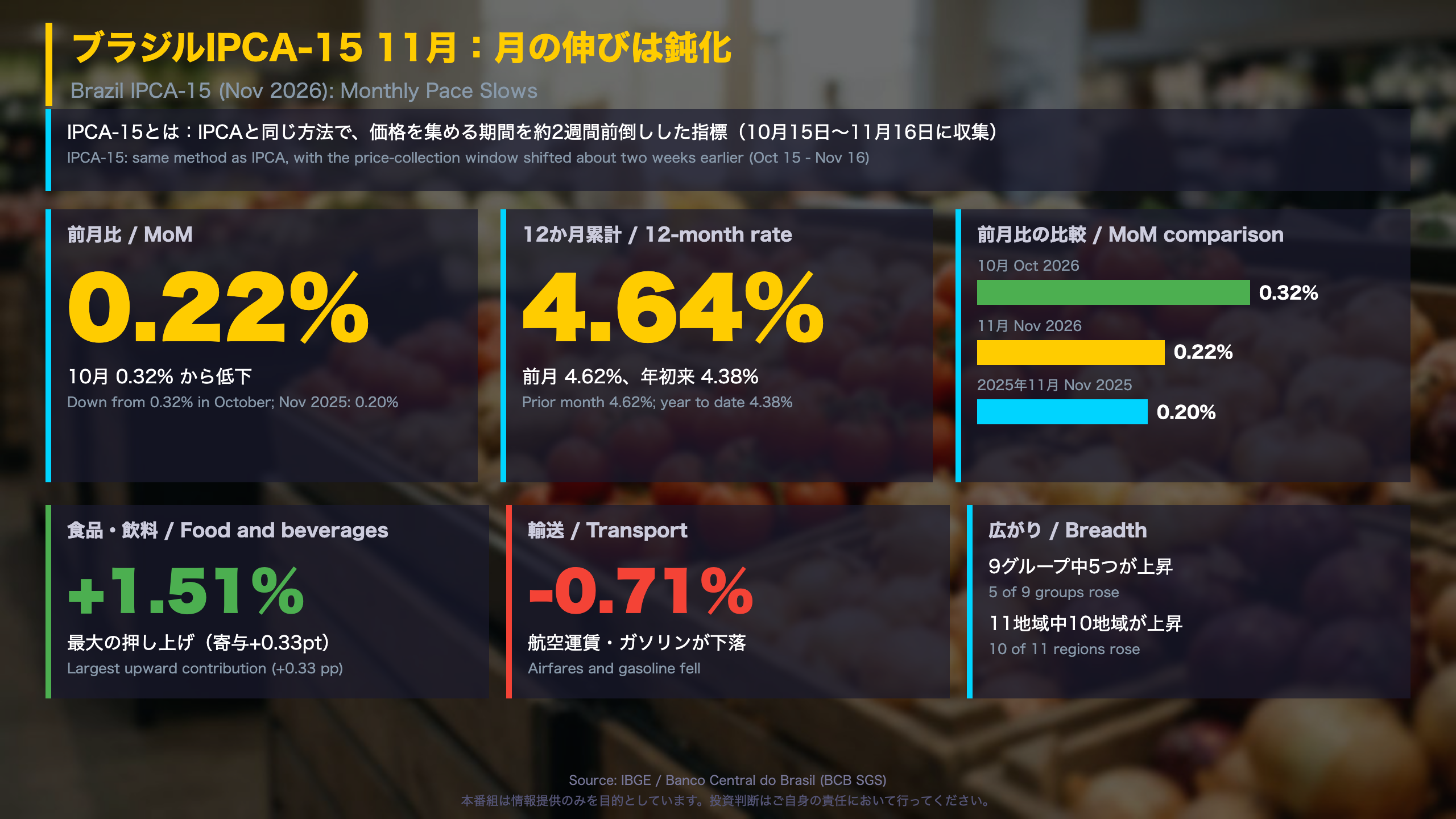
📊 Brazil’s IPCA-15 for November rose 0.22% month on month, slower than October’s 0.32%. The 12-month rate was 4.64%, slightly above the prior month’s 4.62%.
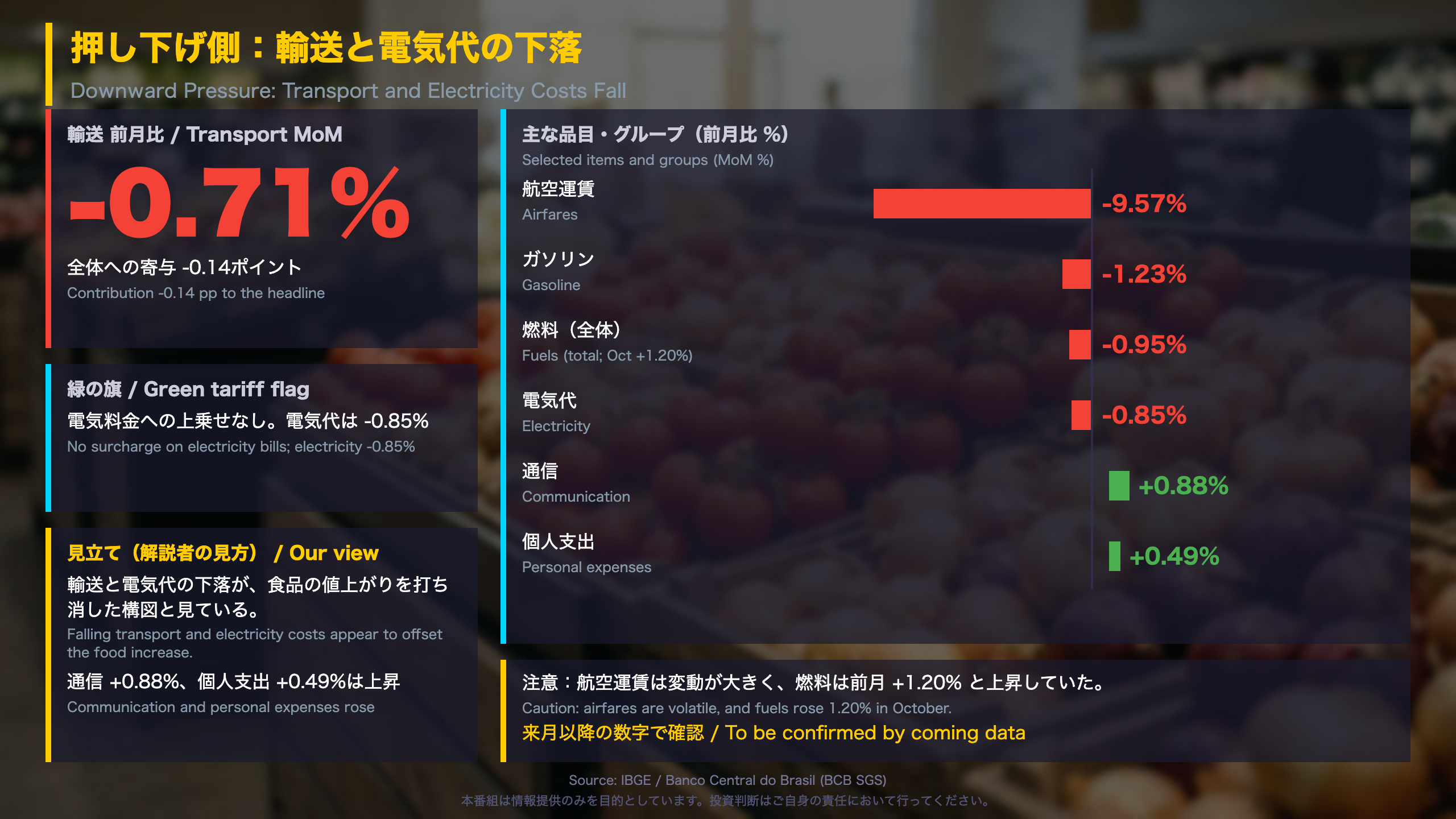
🍅 Food and beverages rose 1.51% (tomatoes +38.92%), while transport fell 0.71% (airfares -9.57%), largely offsetting it.
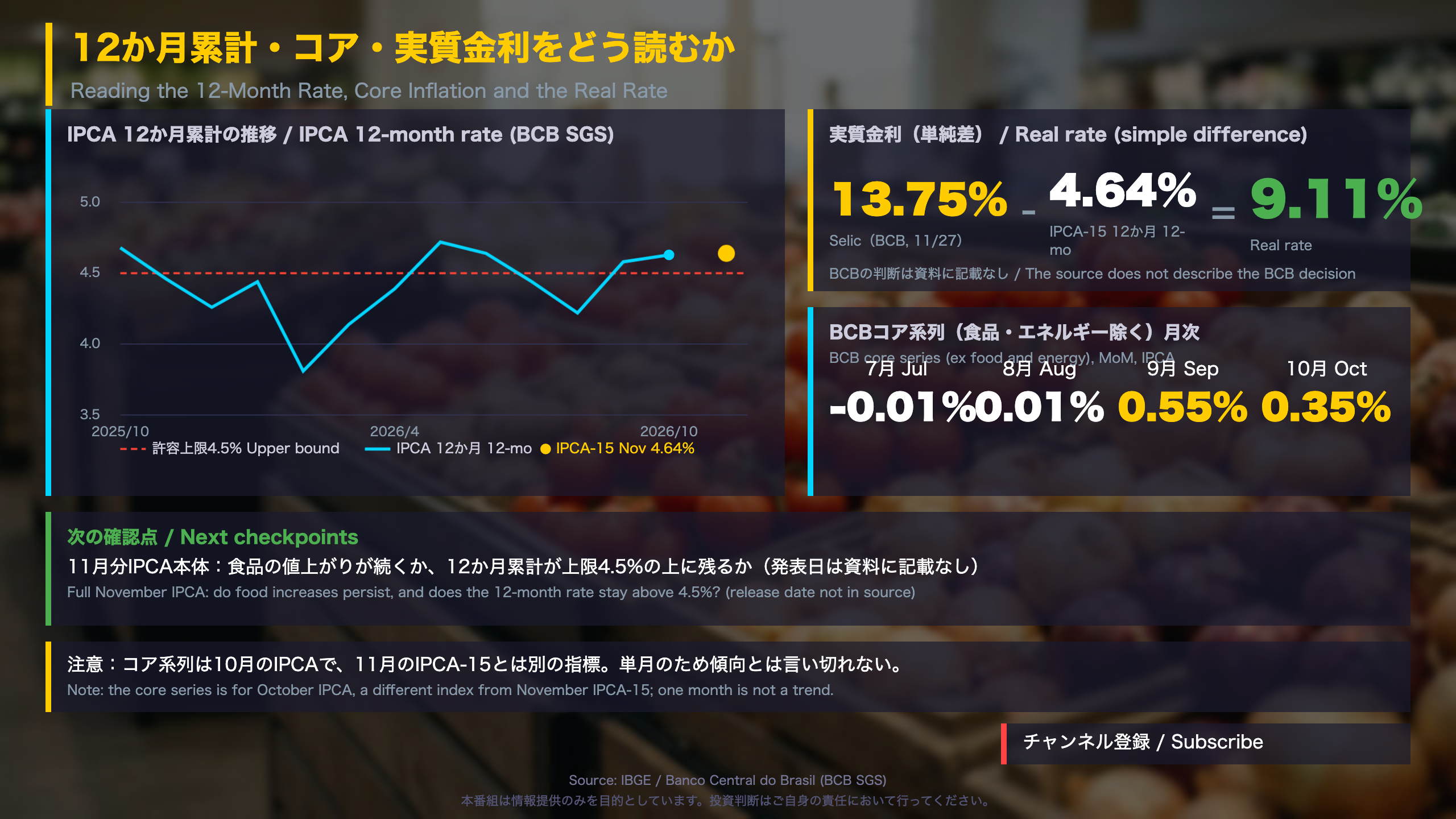
⚠️ The 12-month rate remains above the 4.5% upper bound of the central bank’s tolerance band. The BCB core series for October IPCA shows no acceleration, but it is a different index and a single month.
💡 Next checkpoint: the full November IPCA and whether food price increases persist.
サマリー:11月IPCA-15は月の伸びが鈍化、12か月累計は小幅上昇
Brazil IPCA-15, November 2026: A Mixed but Slower Month
Who publishes it? IBGE, Brazil’s national statistics agency, compiles the IPCA-15. It uses the same methodology as the headline consumer price index, IPCA, but collects prices over a window running roughly mid-month to mid-month (here Oct 15 to Nov 16). That makes it an early read on the full-month IPCA, much as a flash estimate would elsewhere.
Key numbers
- Monthly change: +0.22% (October: +0.32%; November 2025: +0.20%)
- Year to date: 4.38%
- 12-month rate: 4.64%, up from 4.62%
- Five of nine product groups rose; ten of eleven regions saw increases.
Why it matters
The Central Bank of Brazil (BCB) sets the Selic policy rate with an inflation target of 3.0% and a tolerance band whose upper edge is 4.5%. The 12-month reading sits above that edge. By contrast, the Fed and the Bank of Japan both frame their goals around 2%, so Brazil’s nominal inflation and rate levels are structurally higher.
Independent read
The month-on-month slowdown comes from offsetting moves: grocery prices accelerated while airfares, gasoline and electricity fell. The 12-month rate barely moved because November 2025 (0.20%) was close to this November (0.22%).
Market angle
This report alone does not tell us what the Copom will do, and the source contains no policy guidance. Investors typically watch whether the full November IPCA confirms the pattern. The release date for it is not stated in the source.
深掘り1:食品が最大の押し上げ要因
Food Is the Main Upward Force in November
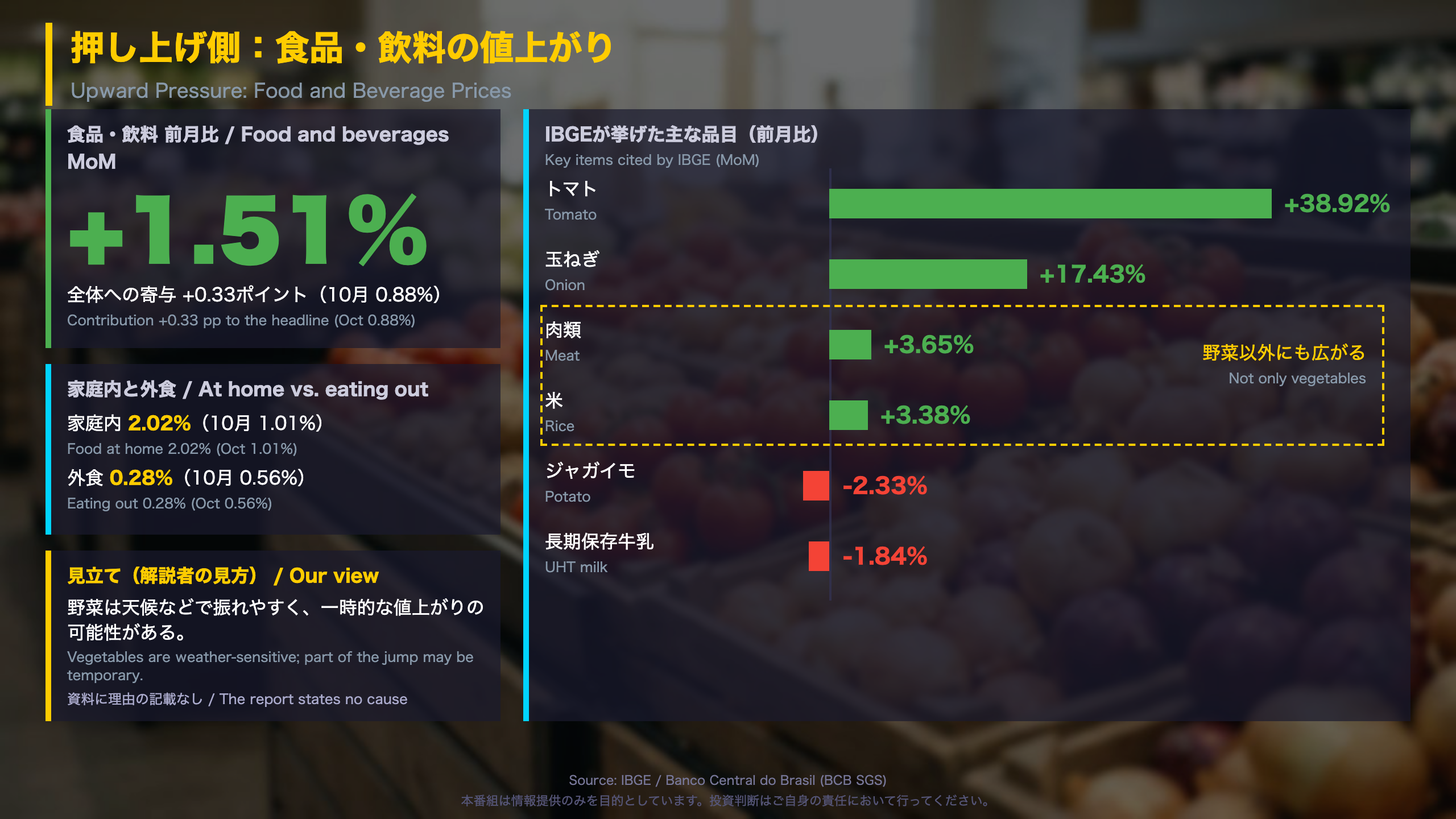
What the data say. Food and beverages rose 1.51% month on month (October: 0.88%), adding 0.33 percentage points to the headline IPCA-15 of 0.22%. Summing the listed contributions of the other eight groups gives roughly -0.11 points, so the headline gain rested on food.
Inside the grocery basket
- Food at home: 2.02% (October 1.01%)
- Eating out: 0.28% (October 0.56%)
- Tomatoes +38.92%, onions +17.43%, meat +3.65%, rice +3.38%
- Potatoes -2.33%, UHT milk -1.84%
IBGE (the Brazilian Institute of Geography and Statistics) notes that Salvador, the region with the biggest monthly gain at 0.68%, saw tomatoes up 43.71%.
How to read it
A bullish-on-inflation reader would stress that meat and rice also rose, so the pressure is not confined to volatile vegetables. A more benign reading is that tomatoes and onions are weather-sensitive items whose jumps may fade. The source gives no cause, so both views are interpretation, and a single month cannot establish a trend.
International context
Unlike US CPI, where food is a smaller share of the basket, Brazilian household budgets are more exposed to food prices, so grocery swings can move the headline more visibly.
What to watch
The full November IPCA will show whether the food acceleration persists. This report alone does not imply a policy decision by the central bank.
深掘り2:輸送の下落が押し上げを打ち消す
Transport and Electricity Offset the Food Surge
Headline. Transport fell 0.71% month on month (October: +0.05%), subtracting 0.14 percentage points from the IPCA-15. Airfares, down 9.57%, were the single largest negative item (-0.07 points).
Fuel is not uniform
Total fuels swung from +1.20% in October to -0.95%. Gasoline fell 1.23%, but vehicle natural gas (+1.06%), ethanol (+0.76%) and diesel (+0.09%) all rose.
The electricity flag explained
Brazil uses a colour-coded tariff flag system run by the electricity regulator. A green flag means no surcharge on bills. IBGE says the green flag stayed in force in November, and residential electricity prices fell 0.85%. Curitiba’s water tariff cut (-9.38%) also drove that city to the lowest regional reading, -0.27%.
Not everything fell
Communication rose 0.88% (internet +2.26%, mobile plans +1.71%) and personal expenses rose 0.49% (package tours +3.79%, lodging +1.63%).
Balanced interpretation
One reading is that transient transport and energy declines masked firmer services prices. Another is that falling fuel and fares reflect genuine easing. The source offers no causal explanation, and airfares are notoriously volatile, so one month proves little.
Comparison and watch points
In the US CPI, airfares are likewise a volatile component. The next data point, the full November IPCA, will show whether these declines persist. Nothing here amounts to a policy signal from the central bank.
質疑で深める:12か月累計、コア、実質金利をどう読むか
Reading the 12-Month Rate, Core and Real Rate
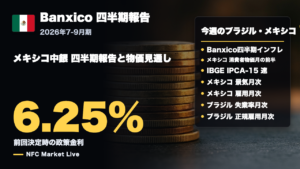
Institutional background. The Central Bank of Brazil (BCB) targets inflation of 3.0% with a tolerance band whose upper edge is 4.5%. Its Monetary Policy Committee, the Copom, sets the Selic rate, currently 13.75% per BCB data (as of Nov 27, 2026). IBGE’s IPCA-15 is an early read on the full-month IPCA.
The 12-month trajectory
The IPCA 12-month rate fell to 3.81% in February 2026, rebounded to 4.72% in May, and stood at 4.63% in October. The IPCA-15 reading of 4.64% is almost identical, though the two are distinct indices with different collection windows.
Why the cumulative rate barely moved
November 2025 (0.20%) dropped out of the 12-month window and November 2026 (0.22%) entered, so the net change was small.
Core check
The BCB series that excludes food and energy showed monthly changes of -0.01%, 0.01%, 0.55% and 0.35% for July to October 2026. October’s pace was below September’s, but this is a single month from a different index, so it signals no trend.
Real rate
Selic minus the 12-month IPCA-15 gives a simple real rate of about 9.1%. That is high relative to inflation, though the source does not describe the BCB’s decision framework.
Competing readings
Hawks would stress inflation above the band and food acceleration. Doves would point to softer core momentum and falling transport costs. On the US and Japan comparison: the Fed and BOJ both aim for 2%, so Brazil’s higher target band and rate level are structural features.
Market implications
This report alone does not determine currency or rates outcomes. A cautious reading is that the full November IPCA, and whether the 12-month rate dips below 4.5%, will help clarify the picture. The release date is not stated in the source.
Disclaimer: This article is for informational purposes only. All investment decisions are made solely at your own risk.