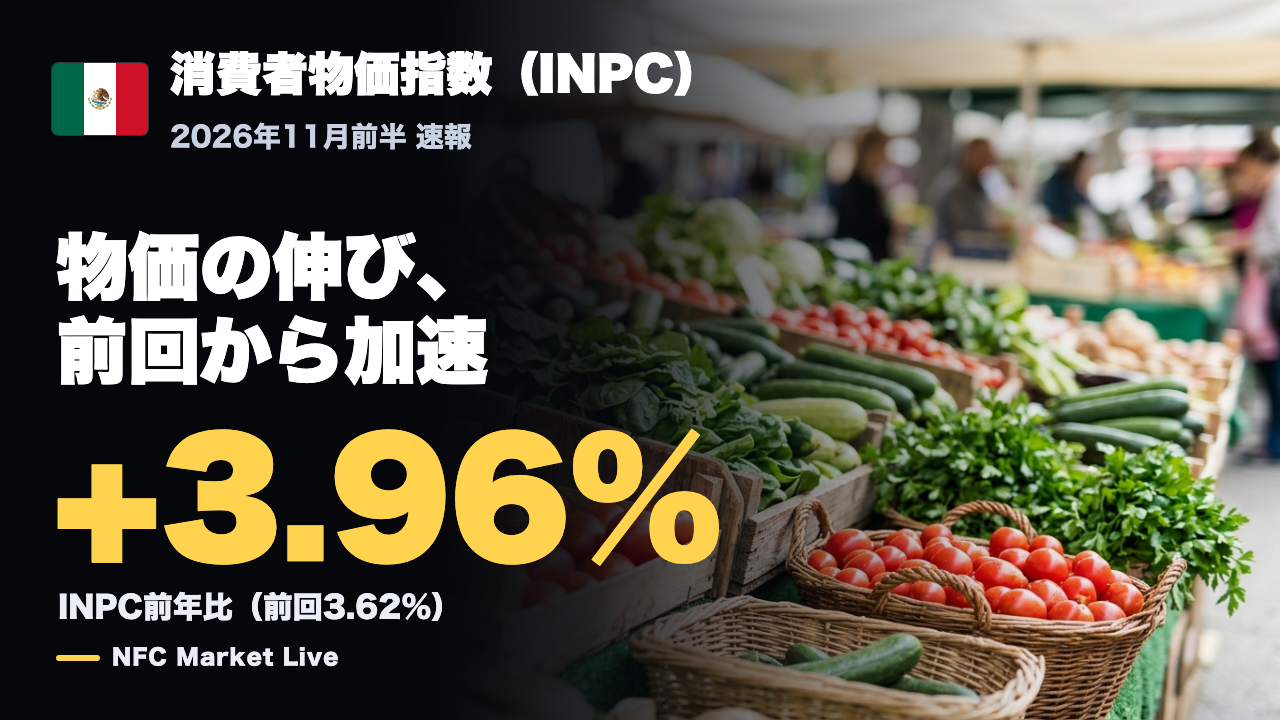
This article was automatically generated by the NFC Market Live AI analysis system. (Updated: 2026-11-24 23:34 JST)
📄 Primary Source
NFC Market Live
https://www.inegi.org.mx/contenidos/saladeprensa/boletines/2026/inpc/inpc_1q2026_11.pdf
📊 INEGI released Mexico’s CPI (INPC) for the first half of November on Nov 24.
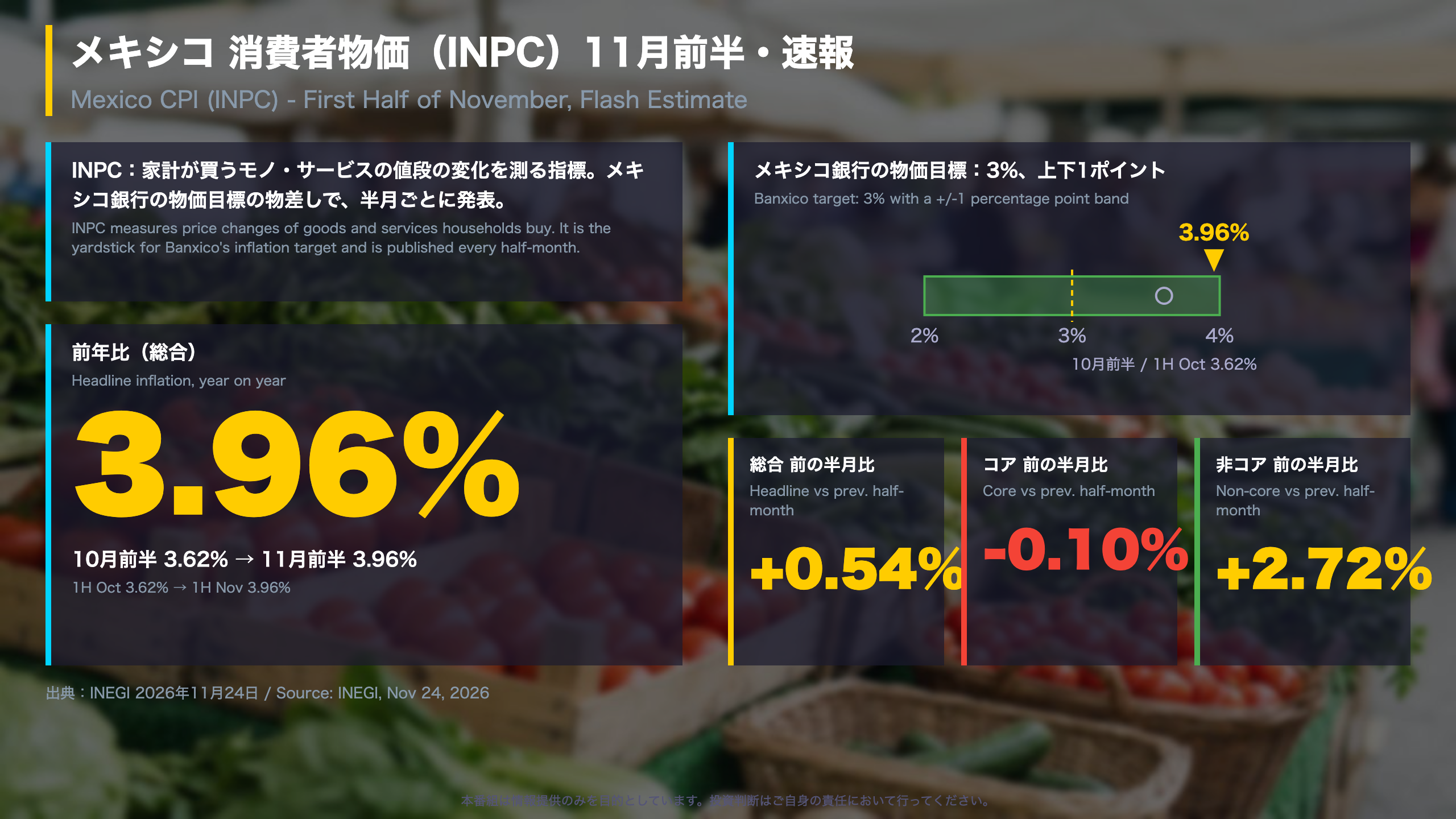
📈 Headline: +0.54% vs the previous half-month, +3.96% year on year (1H Oct: +3.62%), close to the 4% upper edge of Banxico’s 3% +/-1pt target range.
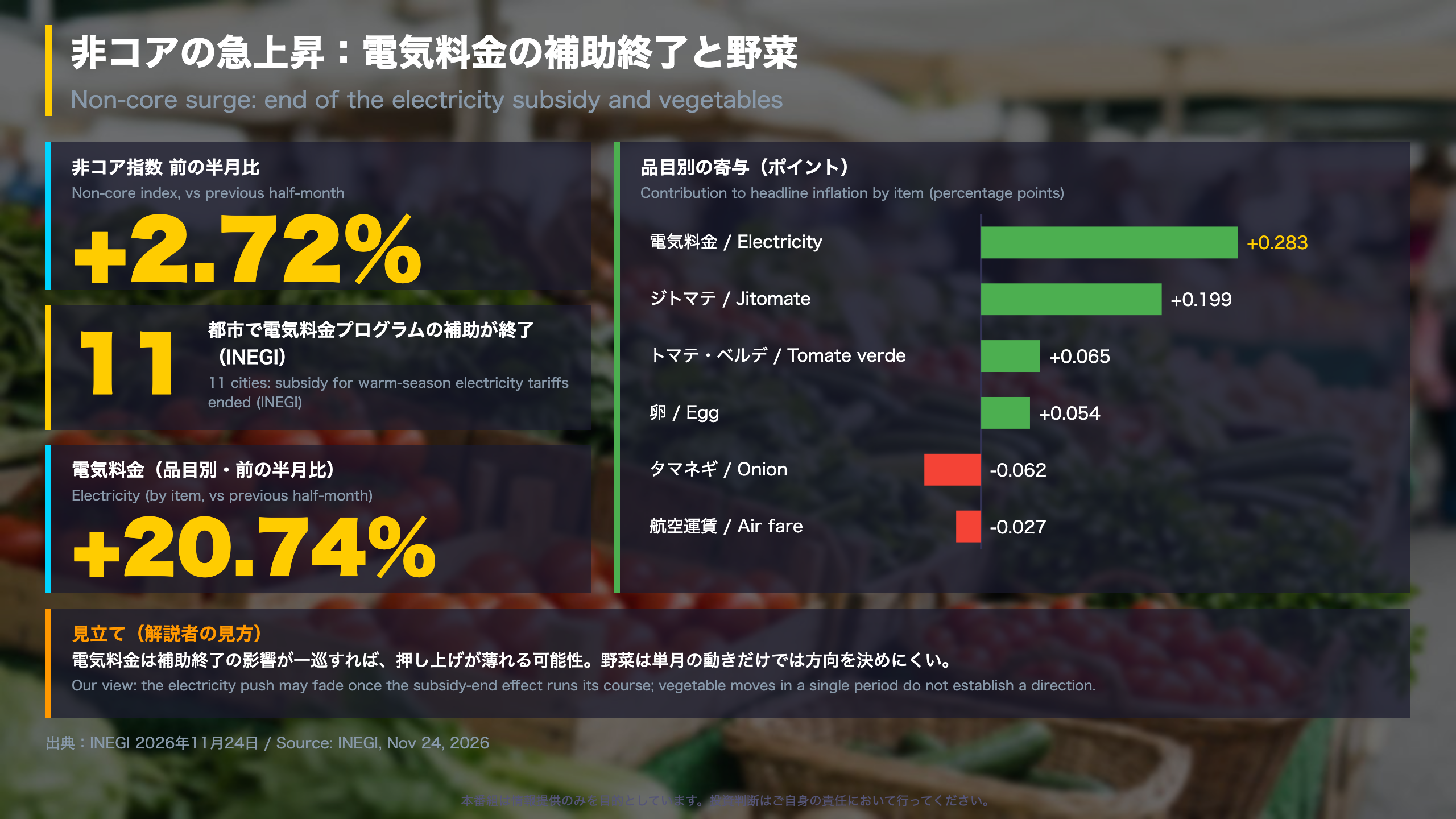
⚠️ Non-core rose 2.72% half-month on half-month; INEGI cites the end of the warm-season electricity tariff subsidy in 11 cities.
💡 Core fell 0.10% (annual +3.68%). A mixed picture, laid out as the release states it.
Next bi-weekly release: Dec 23.
サマリー:前年比3.96%、強弱が混在
Mexico’s CPI (INPC): First Half of November 2026
What is it? INPC is Mexico’s national consumer price index, compiled by INEGI, the national statistics institute. It is released every half-month. The central bank, Banco de México (Banxico), targets annual headline inflation of 3% with a tolerance of plus or minus 1 percentage point.
The numbers
– Headline: +0.54% vs the previous half-month; +3.96% year on year (1H Oct: +3.62%)
– Core: -0.10% half-month; +3.68% annual (1H Oct: +3.78%)
– Non-core: +2.72% half-month; +4.90% annual (1H Oct: +3.08%)
International context. Unlike the US CPI, which is published monthly, Mexico also publishes a bi-weekly print, giving an earlier read on prices. Banxico’s target is for headline inflation, similar in spirit to the Fed’s 2% goal but with an explicit 2-4% tolerance band. At 3.96%, the headline sits 0.04 points below the top of that band (our calculation).
Reading it fairly. On the encouraging side, core prices fell and annual core inflation edged lower. On the cautious side, the headline moved closer to the upper limit because volatile items, electricity and vegetables, jumped. A single half-month flash print should not be over-read; the next release is December 23.
For MXN-asset holders: these are the figures Banxico bases its judgment on. This channel reports the release as published and does not forecast policy or the peso.
非コアの急上昇:電気料金の補助終了と野菜
Non-Core Surge: Electricity Subsidy and Vegetables
What ‘non-core’ means. INEGI’s non-core index groups agricultural products plus energy and government-set tariffs, items whose prices are volatile or administered. Core strips them out to show underlying trends.
Half-month changes (1H Nov vs 1H Oct)
– Non-core: +2.72% vs +0.98%
– Agricultural: +3.18% vs -0.11%
– Fruits and vegetables: +5.50% vs -0.03%
– Energy and tariffs: +2.35% vs +1.85%
The electricity effect. INEGI says the end of the warm-season electricity tariff subsidy in 11 cities was the main driver (18 cities in the previous release). Electricity prices rose 20.74% and contributed 0.283 points to headline inflation, the largest among rising items. Sonora (+3.51%) and Sinaloa (+3.46%) posted the biggest regional moves, which overlaps with the affected cities, though INEGI does not explicitly link them.
Two ways to read it. Pressure side: annual non-core inflation accelerated to 4.90% from 3.08%, and annual agricultural inflation reached 6.65%. Offsetting side: onions (-16.88%) and air fares (-7.81%) fell. In our view, the electricity push may fade once the subsidy effect is absorbed, while vegetable moves in a single period do not establish a direction.
Comparison. The US CPI treats food and energy similarly in its ‘core’ definition; Mexico’s non-core also includes government-set tariffs, which makes policy-driven steps like this one visible in the data.
コア指数は前の半月から低下
Core Inflation: Context and Breakdown
Definition. INEGI’s core index excludes goods and services with high price volatility or prices that do not respond to market conditions. It is the closest Mexican analogue to the US ‘core CPI’, though the exclusions differ.
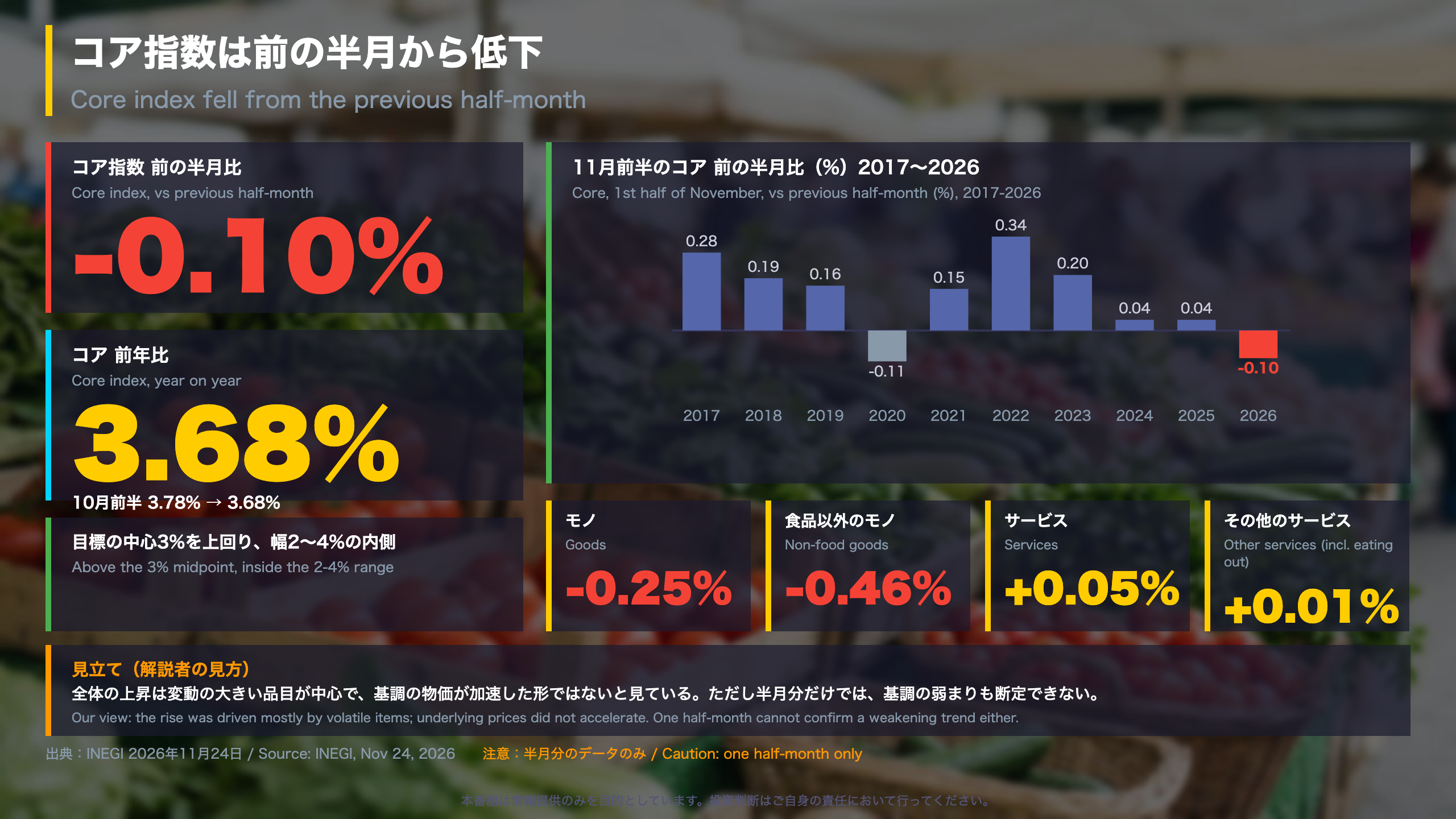
History (1H November, half-month change, %): 2017: 0.28 | 2018: 0.19 | 2019: 0.16 | 2020: -0.11 | 2021: 0.15 | 2022: 0.34 | 2023: 0.20 | 2024: 0.04 | 2025: 0.04 | 2026: -0.10. In INEGI’s ten-year chart, only 2020 and 2026 are negative.
Annual rates (2026 vs same period 2025)
– Goods: 3.16% vs 4.13%
– Services: 4.17% vs 4.50%
– Food, beverages and tobacco: 4.66%; non-food goods: 1.86%
– Core overall: 3.68% vs 4.32%
Sub-index swing. ‘Other services’ (restaurants, mobile telephony, car maintenance, etc.) rose 0.52% in 1H October but only 0.01% now. This is a single half-month and could be noisy.
Balanced view. Encouraging: core is lower than a year ago, and goods prices are falling in non-food categories. Cautious: services inflation remains above 4%, and core annual inflation is still above Banxico’s 3% midpoint, though inside the 2-4% band. We would not call a trend from one print.
Why it matters for MXN-asset holders: core is the series central banks usually read for underlying pressure. This channel reports the figures and does not forecast policy.
質疑:昨年同期との比較と次の注目点
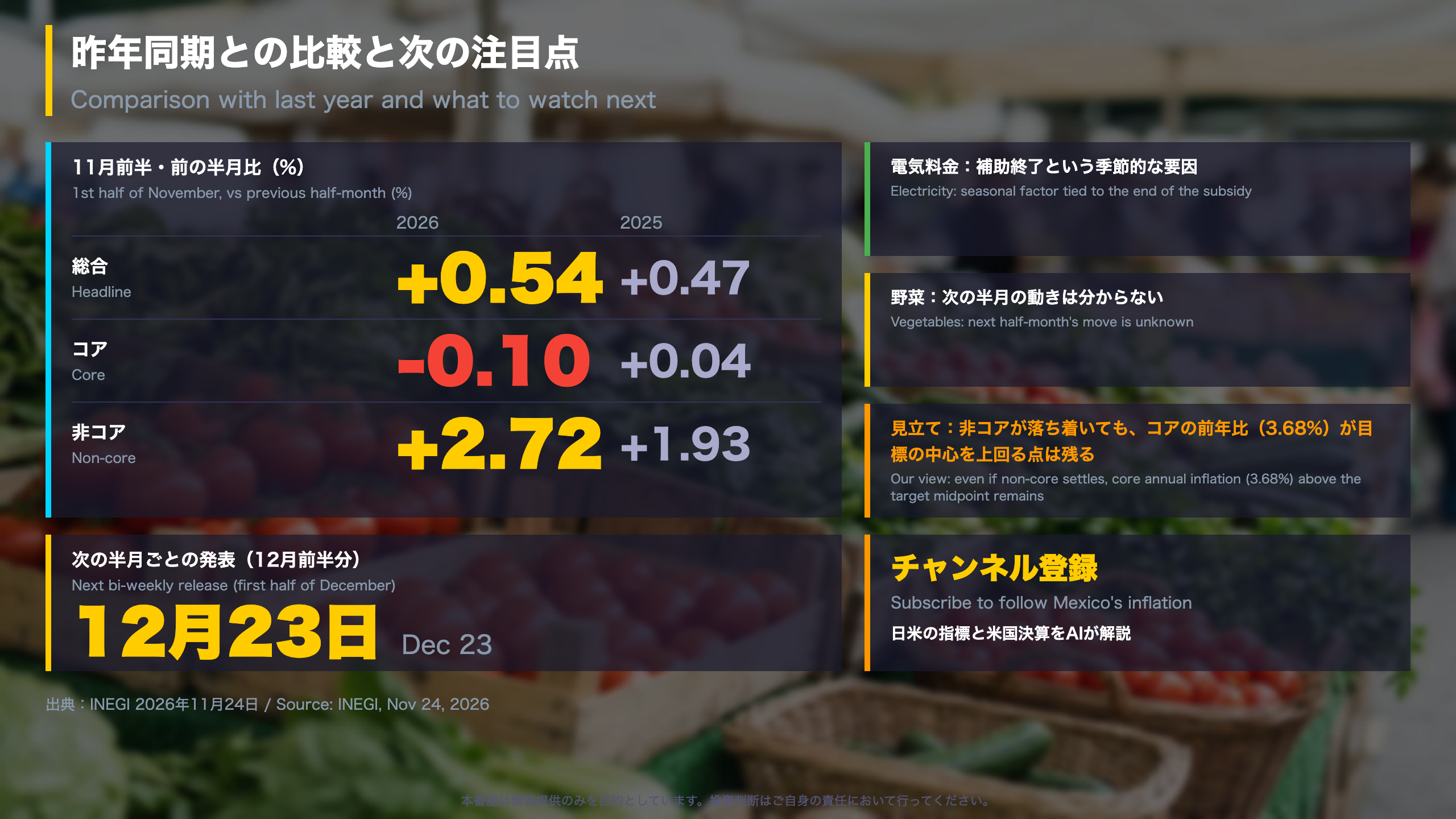
Q&A Follow-Up: Year-on-Year Comparison and Household Prices
Half-month change, 1H November (%)
– Headline: 0.54 (2026), 0.47 (2025), 0.37 (2024)
– Core: -0.10, 0.04, 0.04
– Non-core: 2.72, 1.93, 1.44
As the table shows, the headline half-month rise has grown for three straight years, while core is negative only this year. The composition, not just the headline, is what differs.
Household-level prices (annual)
– Food and non-alcoholic beverages: +5.28%, above the 3.96% headline
– Restaurants and accommodation: +5.87%; insurance and financial services: +8.98%
– Information and communication: -1.69%
– Minimum Consumption Basket (170 items defined with Coneval, the social policy evaluation council): +3.87% vs +3.69% a year earlier
Balanced reading. Constructive: annual core inflation eased to 3.68% and stays inside the 2-4% band; some categories, such as communication, are deflating. Cautious: headline inflation is only 0.04 points below the 4% upper limit (our calculation), and food prices are rising faster than the headline.
Comparison with the US. US CPI releases are monthly; Mexico’s bi-weekly print means the December 23 release (first half of December) arrives well before the monthly figure.
What to watch. Per INEGI, the next bi-weekly release is December 23. Key items: the electricity subsidy-end effect, vegetable prices, and the direction of core. This channel does not forecast policy or the peso.
Disclaimer: This article is for informational purposes only. All investment decisions are made solely at your own risk.