This article was automatically generated by the NFC Market Live AI analysis system. (Updated: 2026-11-21 00:16 JST)
📄 Primary Source
University of Michigan
http://www.sca.isr.umich.edu/
A walk-through of the University of Michigan’s final November consumer sentiment results.
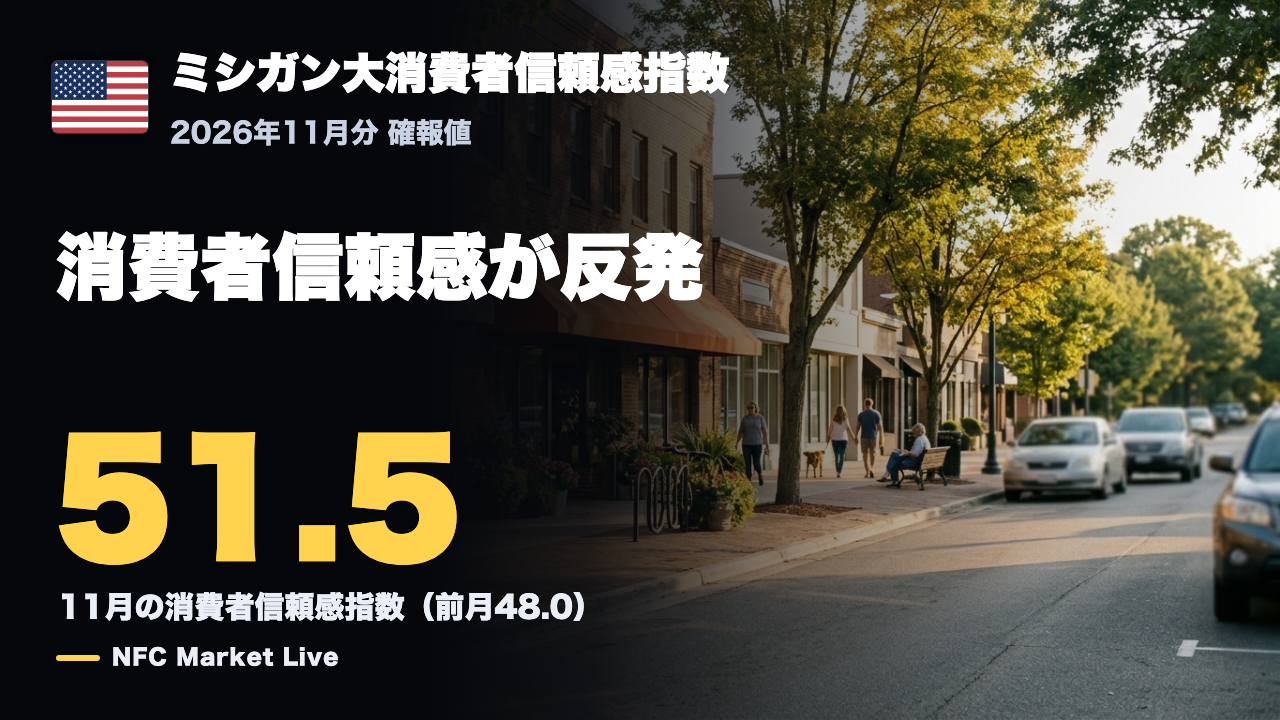
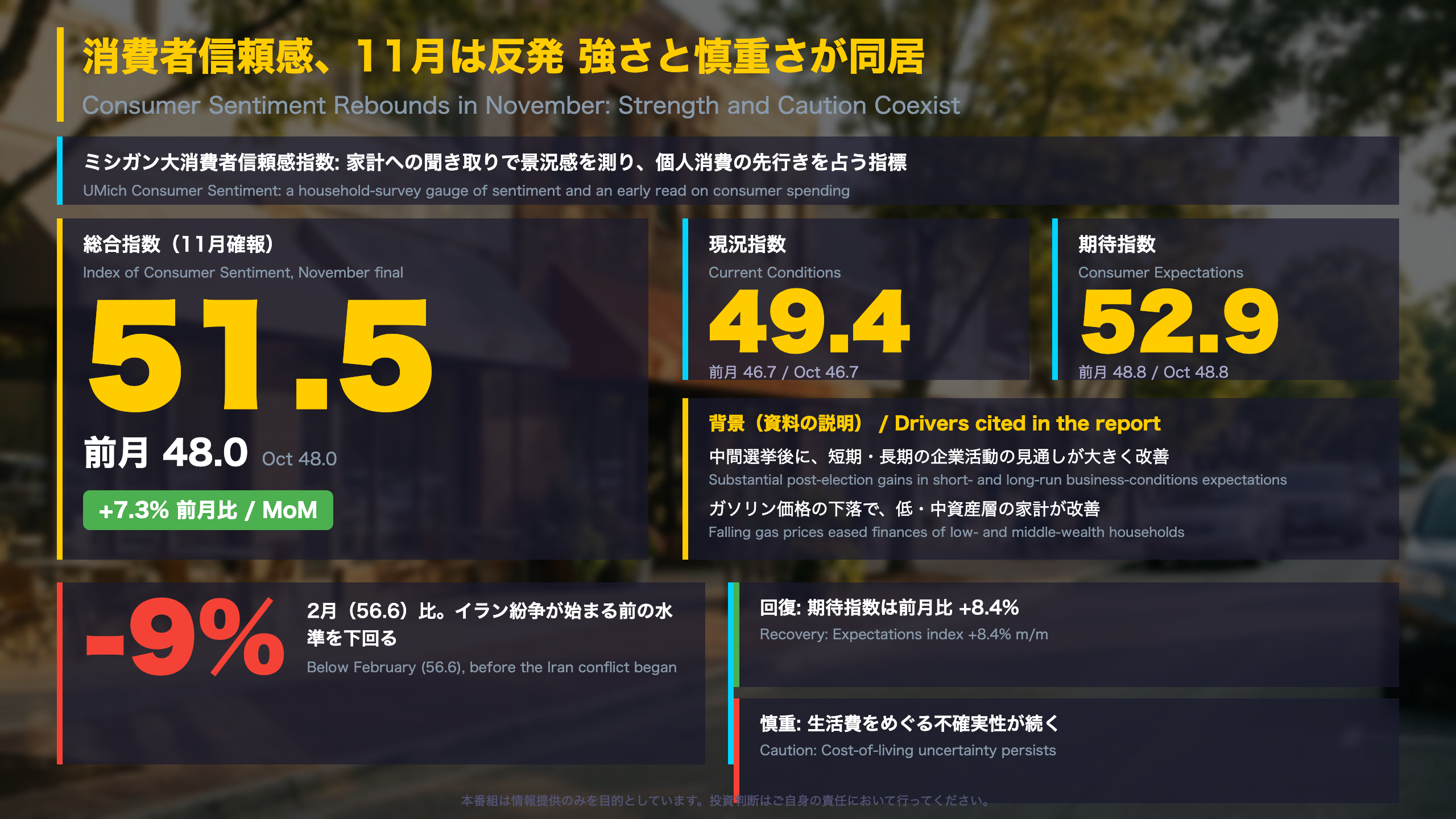
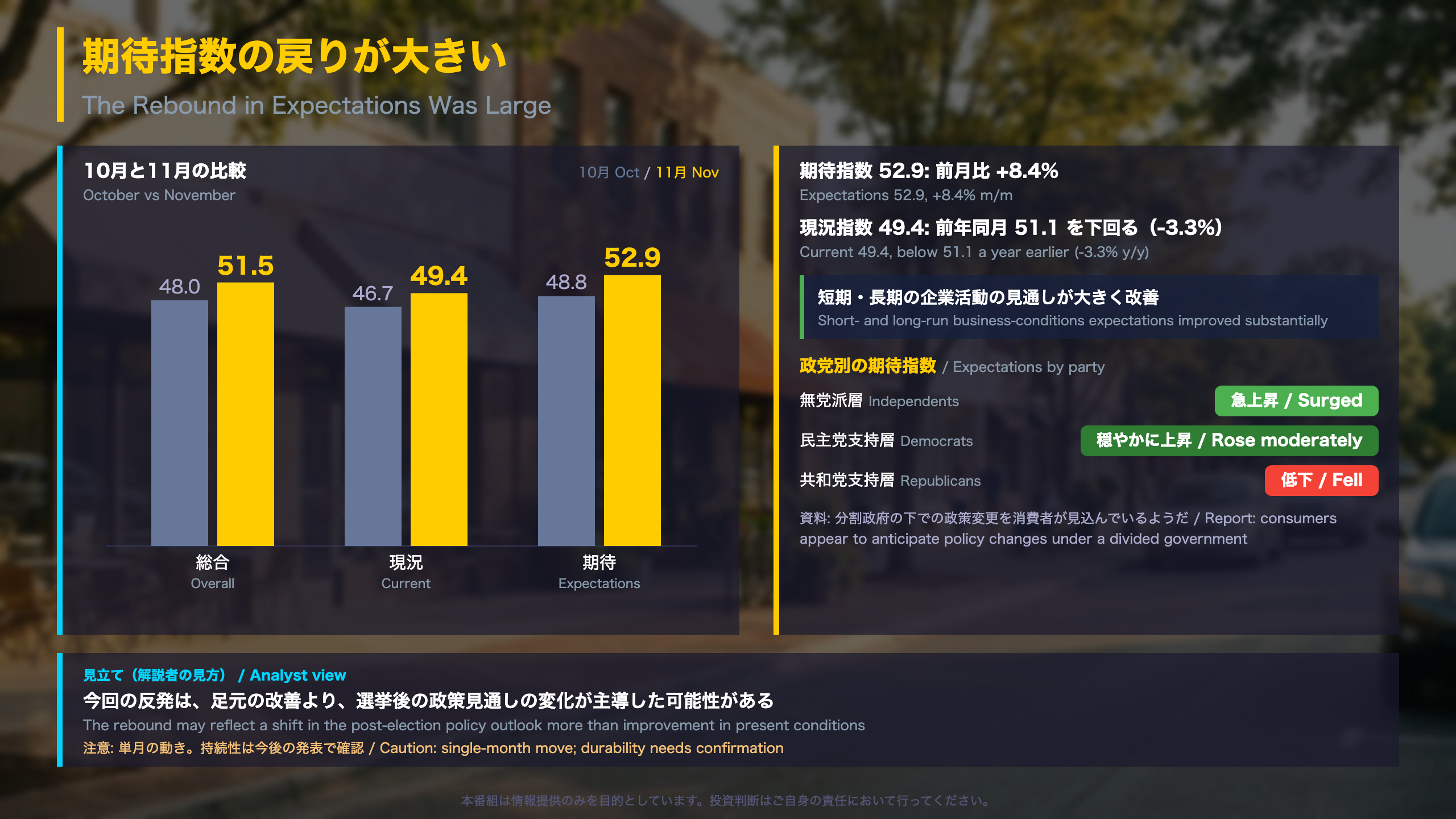
📊 The headline index rose to 51.5 from 48.0 in October. Current conditions were 49.4 and expectations 52.9.
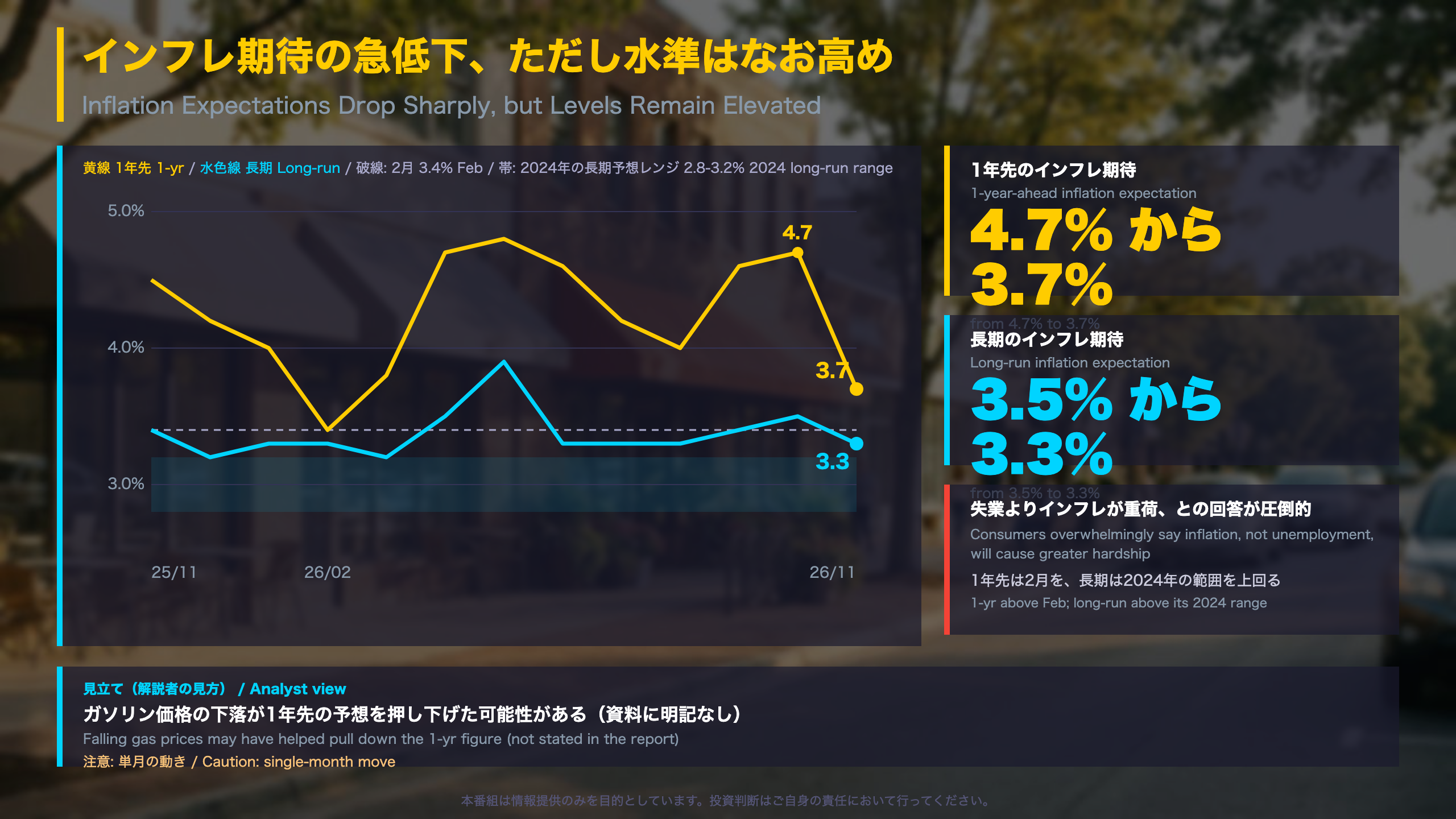
📉 Year-ahead inflation expectations fell from 4.7% to 3.7% and long-run expectations from 3.5% to 3.3%, yet the year-ahead figure is still above February’s 3.4% and the long-run figure above its 2024 range of 2.8-3.2%.
💡 We look at both the strength of the rebound in expectations and the caution that remains.
⚠️ Next up: preliminary December data on Friday, December 4.
消費者信頼感、11月は反発 強さと慎重さが同居
What this survey is
The Surveys of Consumers, run by the University of Michigan, is a monthly household survey. Its headline index is one of the most-watched gauges of how Americans feel about their finances and the economy. It is conceptually similar to the Conference Board’s confidence index but uses a different sample and method, and it directly tracks inflation expectations, which is why policymakers and markets follow it closely.
November final numbers
- Overall index: 51.5 (October 48.0; November 2025 51.0)
- Current conditions: 49.4 (October 46.7)
- Expectations: 52.9 (October 48.8)
Context
The headline is back near August’s 51.7 but sits 9% below February’s 56.6, the last reading before the Iran conflict began. The low of the past 24 months was 44.8 in May 2026. Interviews ran from October 20 to November 16, so the sample spans the midterm elections.
Why the composition matters
A rise led by expectations is a different signal from a broad-based recovery. Current conditions are still 3.3% below a year earlier, so the survey describes a better outlook rather than a clearly better present.
What to watch
The preliminary December reading is due Friday, December 4 at 10am ET. Comparing that release with this one will show whether the November move was a one-month swing or the start of a trend.
期待指数の戻りが大きい
Breaking down the rebound
Expectations outran current conditions
The University of Michigan splits its headline into two components: current economic conditions, which reflects households’ views of their present finances and buying conditions, and consumer expectations, which captures the six-month to five-year outlook. In November the gap widened: expectations 52.9 versus current 49.4, a 3.5-point spread versus 2.1 points in October.
- Expectations are at their highest since July (55.4).
- Current conditions (49.4) remain below September (50.9) and August (51.9), and 3.3% below November 2025 (51.1).
Politics and the survey
The report notes that independents swung to the left in the midterms and their expectations surged; Democrats rose more moderately; Republicans fell. Director Joanne Hsu writes that consumers “appear to anticipate potential changes to public policy under a divided government.”
Two readings
- Constructive: part of the post-election uncertainty has cleared, lifting the forward-looking components.
- Cautious: expectation-led gains tied to policy outlook can reverse, and present conditions have not yet recovered.
International comparison
Unlike hard data such as retail sales, this survey measures attitudes. Comparable gauges include the Conference Board index in the US and the Cabinet Office’s consumer confidence index in Japan, which also split present from forward-looking components.
Next
The preliminary December reading on December 4 will show whether current conditions begin to follow expectations.
インフレ期待の急低下、ただし水準はなお高め
Reading the inflation-expectations data
What is measured
The survey asks households how much prices will change over the next year and over the next 5 to 10 years; the headline figures are medians. Policymakers watch the long-run series because well-anchored expectations are considered important for price stability. Japan’s counterpart is the Bank of Japan’s Opinion Survey on the General Public’s Views and Behavior, which asks a similar question.
Recent path (median)
| Month | 1-year | Long-run |
|---|---|---|
| Jun | 4.6% | 3.3% |
| Jul | 4.2% | 3.3% |
| Aug | 4.0% | 3.3% |
| Sep | 4.6% | 3.4% |
| Oct | 4.7% | 3.5% |
| Nov | 3.7% | 3.3% |
The 3.7% reading is the lowest since February (3.4%). The 24-month peak was 6.6% in May 2025.
The report’s caveat
Director Hsu notes that the year-ahead figure is “meaningfully above the 3.4% seen in February,” and that long-run expectations remain above the 2024 range of 2.8% to 3.2%. Consumers still overwhelmingly say inflation, not unemployment, will cause greater hardship.
Two readings
- Easing: a one-point fall in the year-ahead median is large by the standards of this series.
- Not settled: October had risen to 4.7%, so the series is volatile and one month does not establish a trend.
What to watch
The preliminary December release on December 4 will show whether the year-ahead figure keeps moving toward February’s level.
質疑で深める: 実感・層ごとの違い・インフレ期待
Checkpoints for the next release
Survey scope
This final reading covers interviews completed between October 20 and November 16. The University of Michigan also published several special reports in recent weeks, including analyses of the expected economic implications of the midterm elections (October 30), long-run inflation expectations in historical context (October 23), and gasoline prices and expected spending (October 9).
Differences by wealth group
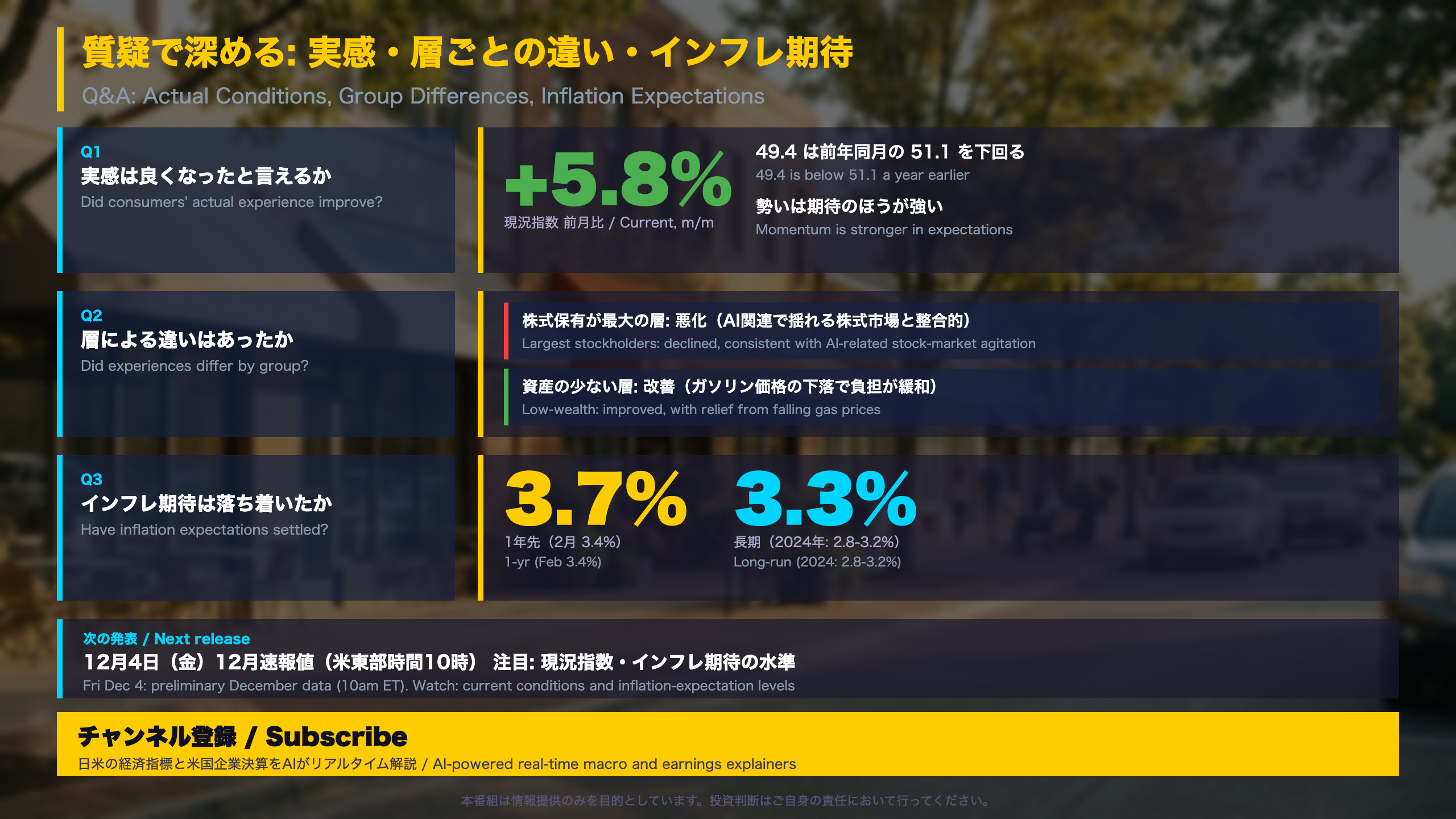
Per the report, personal finances improved for low-wealth consumers and, to a lesser extent, middle-wealth consumers, who benefited from falling gas prices. Those with the largest stockholdings reported a decline, which the report calls consistent with “continued AI-related agitation in stock markets.”
Two readings
- Broader improvement: current conditions, expectations and inflation expectations all moved in a better direction.
- Still recovering: current conditions are below a year ago, and inflation expectations remain above February’s level and the 2024 range.
Reference points for December
| Measure | November | Reference |
|---|---|---|
| Current conditions | 49.4 | Nov 2025: 51.1; Aug 2026: 51.9 |
| 1-yr inflation expectation | 3.7% | Feb 2026: 3.4% |
| Long-run inflation expectation | 3.3% | 2024 range: 2.8-3.2% |
Timing
The preliminary December data are due Friday, December 4 at 10am ET. Because preliminary readings are later finalized, comparing preliminary and final prints is part of normal analysis of this series.
Disclaimer: This article is for informational purposes only. All investment decisions are made solely at your own risk.