This article was automatically generated by the NFC Market Live AI analysis system. (Updated: 2026-11-27 21:53 JST)
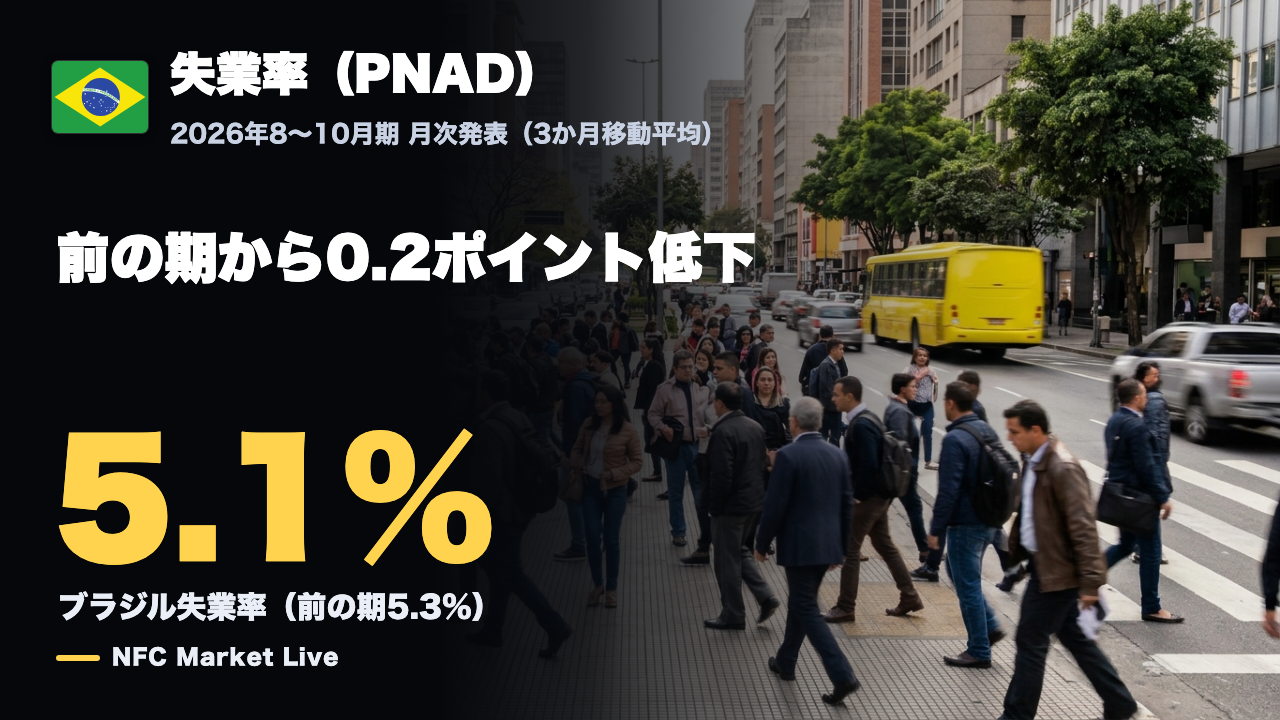
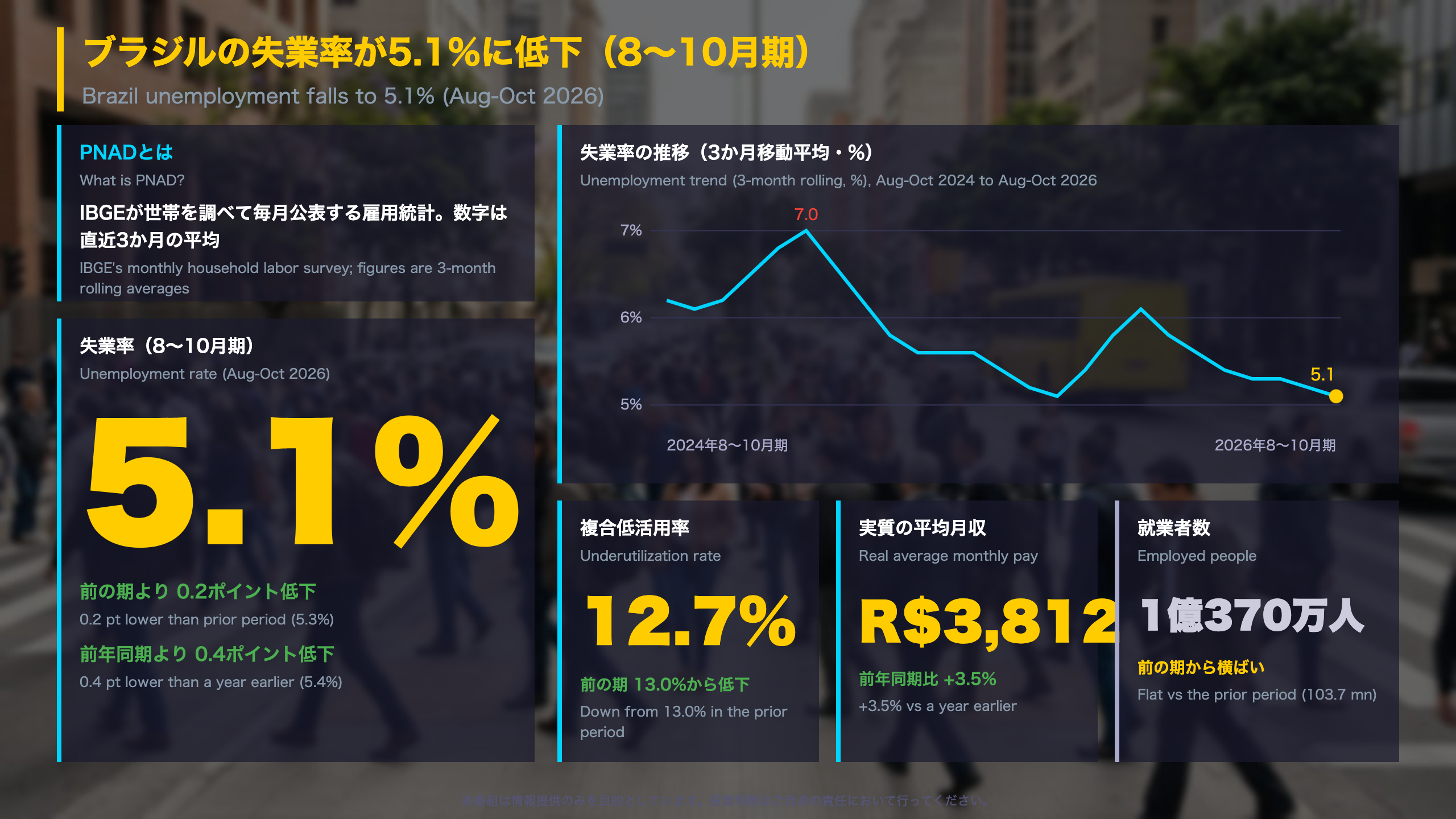
📊 IBGE’s PNAD household survey for August-October 2026: unemployment fell to 5.1%, down 0.2 pt from May-July (5.3%) and 0.4 pt from a year earlier (5.4%).
📉 The broad underutilization rate, which adds people working too few hours, was 12.7% (prior period 13.0%).
💰 Real average monthly pay reached R$3,812, up 1.0% from the prior period and 3.5% from a year earlier.
⚠️ Employment was flat at 103.7 million versus the prior period. Job gains came in transport/storage/mail and public administration/education/health; private formal jobs were flat.
💡 Numbers and wording follow the IBGE release.
サマリー:失業率5.1%に低下
Context: Brazil’s PNAD jobs survey
PNAD Contínua is the monthly household labor survey run by IBGE, Brazil’s national statistics agency, and it plays a role similar to the US household survey. Figures are three-month rolling averages, so consecutive releases share two months of data and single-period moves should not be over-read.
The headline
- Unemployment: 5.1% for August-October 2026, down 0.2 pt from May-July (5.3%) and 0.4 pt from a year earlier (5.4%).
- In IBGE’s trend table (25 periods from Aug-Oct 2024), 5.1% ties the low set in Oct-Dec 2025. The peak was 7.0% in Jan-Mar 2025.
- Versus the prior release (Jul-Sep: 5.2%), the rate is 0.1 pt lower, and the broad underutilization rate fell from 13.0% to 12.7%.
International comparison
Brazil’s series is a rolling three-month average, and the release does not state whether it is seasonally adjusted. The US headline rate is a single-month, seasonally adjusted figure, so cross-country comparisons need care.
Central-bank context
The Banco Central do Brasil (BCB) targets IPCA inflation of 3% with a 1.5-point tolerance band, set by the National Monetary Council. This release contains no inflation or policy data, and we draw no inference about BCB decisions or the real.
Independent read
Strong: unemployment, broad slack and pay all improved. Cautious: employment was flat versus the prior period, so the gain is concentrated in fewer unemployed people rather than visibly more jobs.
論点1:失業の減り方
Reading the slack indicators
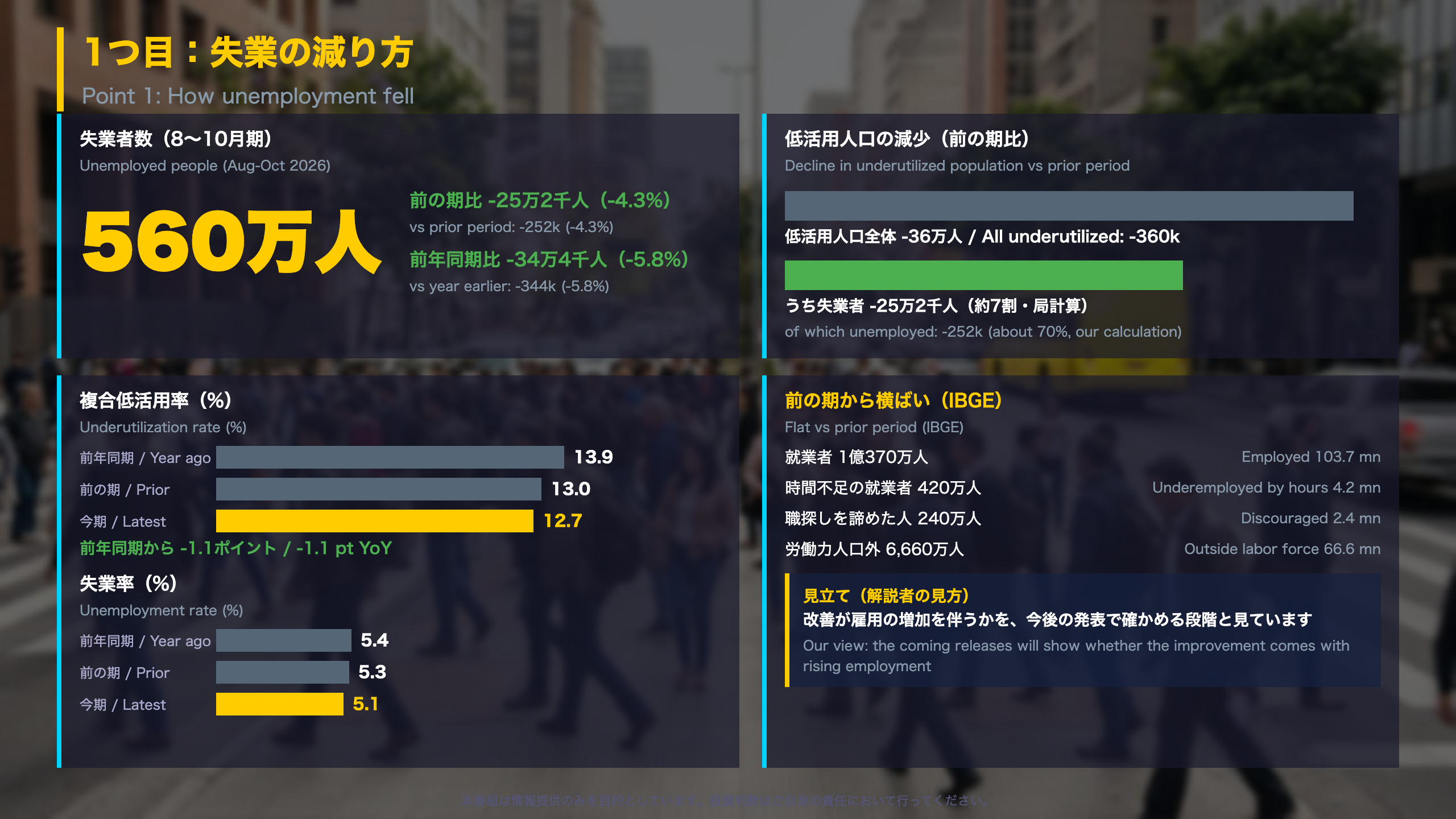
IBGE publishes several measures of labor-market slack. The headline unemployment rate counts people actively looking for work. The composite underutilization rate adds people working too few hours and others who want to work but are not counted as unemployed. It is broader than the US U-3 and closer in spirit to the US U-6.
Numbers for August-October 2026
- Unemployed: 5.6 million, down 252 thousand (-4.3%) from May-July and down 344 thousand (-5.8%) YoY.
- Underutilized population: 14.5 million, down 360 thousand vs the prior period and 8.0% lower YoY.
- Underemployed by hours: 4.2 million, flat. Discouraged workers: 2.4 million, flat vs the prior period and 8.9% lower YoY.
- Labor force: 109.2 million, flat; participation-related measures were also stable (employment level 59.0%).
Versus the prior release
In Jul-Sep, underemployment by hours rose 5.2% and discouraged workers rose 7.5% against the prior quarter. Both are flat in the latest release.
Independent analysis
The release does not explain why unemployment fell while employment was flat. Employment is up 1.1 million from a year earlier, so the annual picture is one of job growth. We read the three-month change as improvement concentrated in fewer unemployed people, and the next prints will show whether jobs follow. We make no inference about BCB policy or the real.
論点2:賃金と雇用の増えた分野
Pay: what IBGE reports
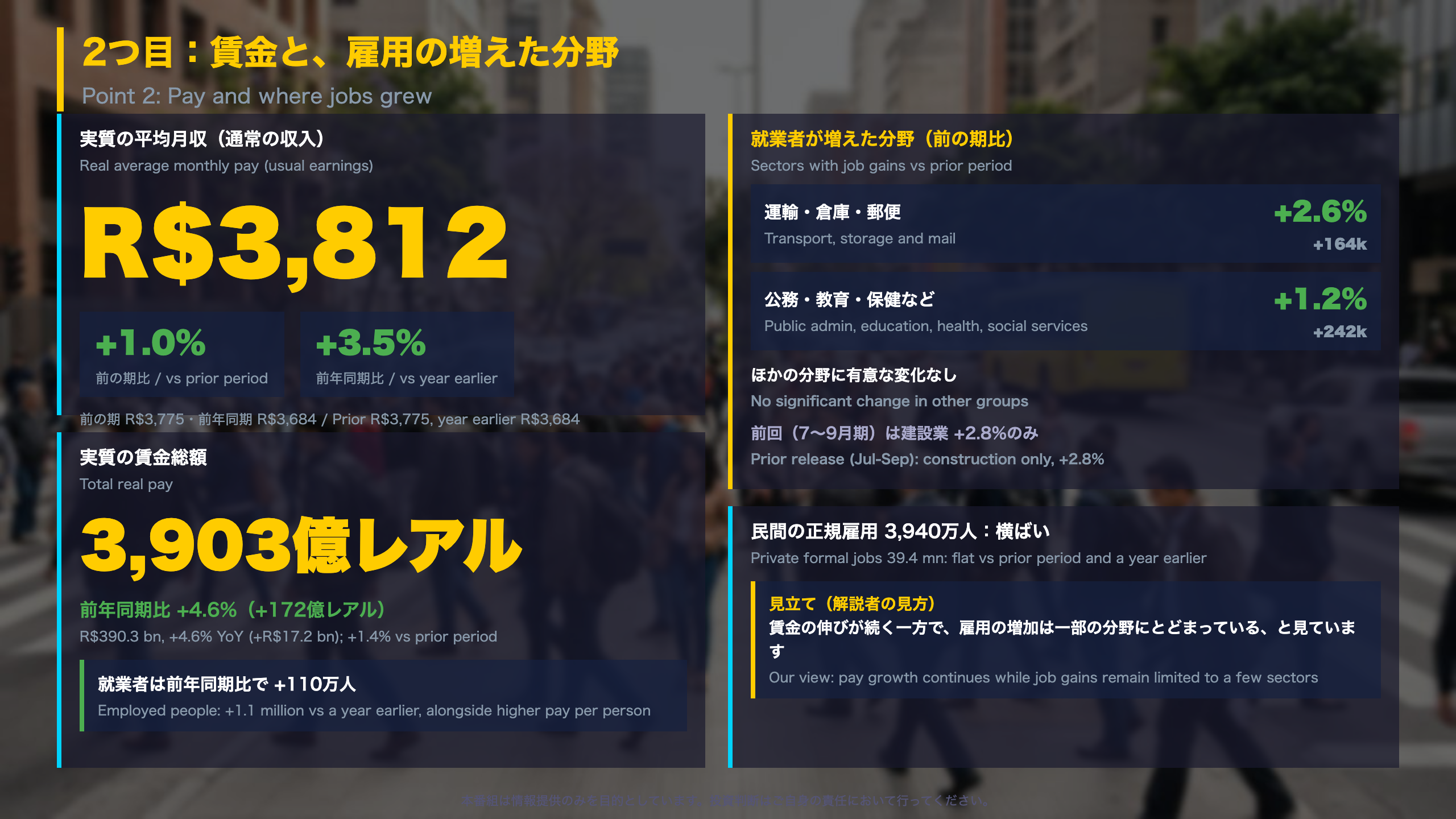
Real usual monthly pay was R$3,812 in August-October 2026, versus R$3,775 in May-July and R$3,684 a year earlier. Total real pay reached R$390.3 billion, up 1.4% on the prior period and 4.6% YoY. In the Jul-Sep release, average pay was R$3,790 (+3.6% YoY) and the total R$387.5 billion.
Where pay rose
- Versus the prior period: agriculture (+3.2%) and accommodation/food (+3.9%).
- Year on year: agriculture (+4.9%), commerce and vehicle repair (+6.1%), public administration/education/health (+2.6%) and domestic services (+5.8%).
- By job position, IBGE reports stability across all positions versus the prior period, while YoY gains appeared for domestic workers, public employees (+3.6%) and the self-employed (+3.9%). The release does not reconcile the +1.0% headline with these stable position-level readings.
Where jobs grew
Versus May-July, employment rose only in transport/storage/mail (+2.6%) and a broad group covering public administration, education, health and social services (+1.2%). In the prior release only construction rose (+2.8%). Private formal employment (39.4 million) was flat.
Independent analysis
Real pay growth near 3.5% YoY alongside 1.1 million more jobs is a constructive combination for household income. But gains are narrow by sector, and the release is silent on causes. We offer no inference about BCB policy or the real.
質疑:雇用は増えているのか
Employment composition and what to watch next
What IBGE reports
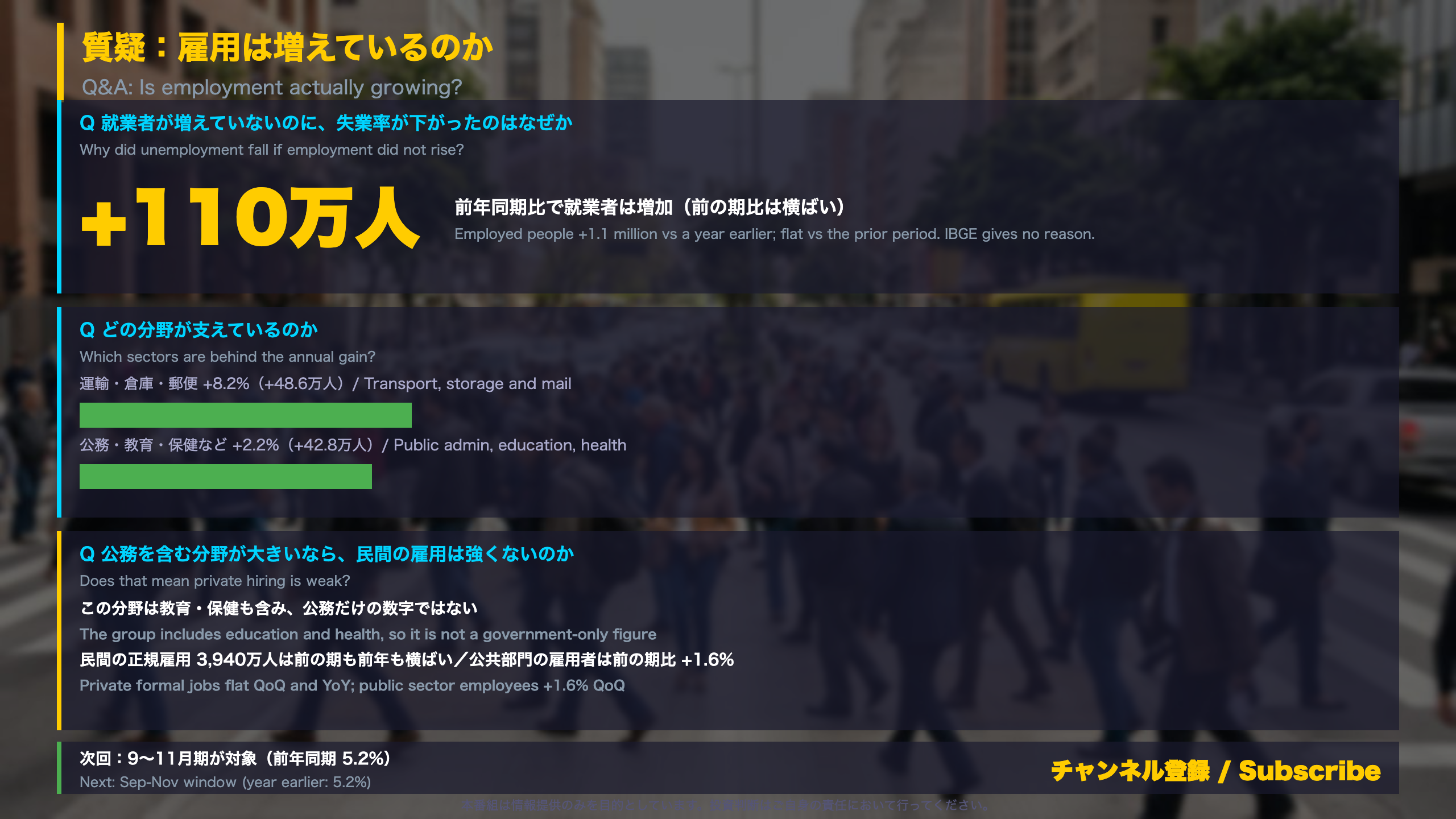
Employment stands at 103.7 million, flat versus May-July and up 1.1 million from a year earlier. The employment level (employed as a share of working-age people) is 59.0%, unchanged.
- Private formal employees: 39.4 million, flat QoQ and YoY.
- Private informal employees: 13.7 million; self-employed: 26.1 million; domestic workers: 5.5 million, all flat.
- Employers: 4.5 million, flat QoQ and +6.5% YoY.
- Public sector employees: 13.2 million, +1.6% QoQ and flat YoY.
Sector detail
Year on year, transport/storage/mail rose 8.2% (+486 thousand) and the broad group of public administration, education, health and social services rose 2.2% (+428 thousand). The same two groups led the previous release (+6.9% and +2.1%), suggesting they have driven annual job growth for two consecutive prints. Note that the second group is not government-only: it includes private education and health services.
Looking ahead
The next release covers September-November 2026. In IBGE’s trend table the same window a year earlier was 5.2%, followed by 5.1% for October-December 2025. The release does not give the next publication date, and the informality rate was not included in this text (it was 37.5% in the prior release).
Independent analysis
Bullish read: 1.1 million more jobs YoY, record-low-tying unemployment in the table and rising pay. Cautious read: gains are concentrated in two groups and private formal jobs are flat. We offer no inference about BCB policy or the real.
Disclaimer: This article is for informational purposes only. All investment decisions are made solely at your own risk.