This article was automatically generated by the NFC Market Live AI analysis system. (Updated: 2026-11-27 09:57 JST)
📄 Primary Source
総務省統計局
https://www.stat.go.jp/data/cpi/sokuhou/tsuki/pdf/kubu.pdf
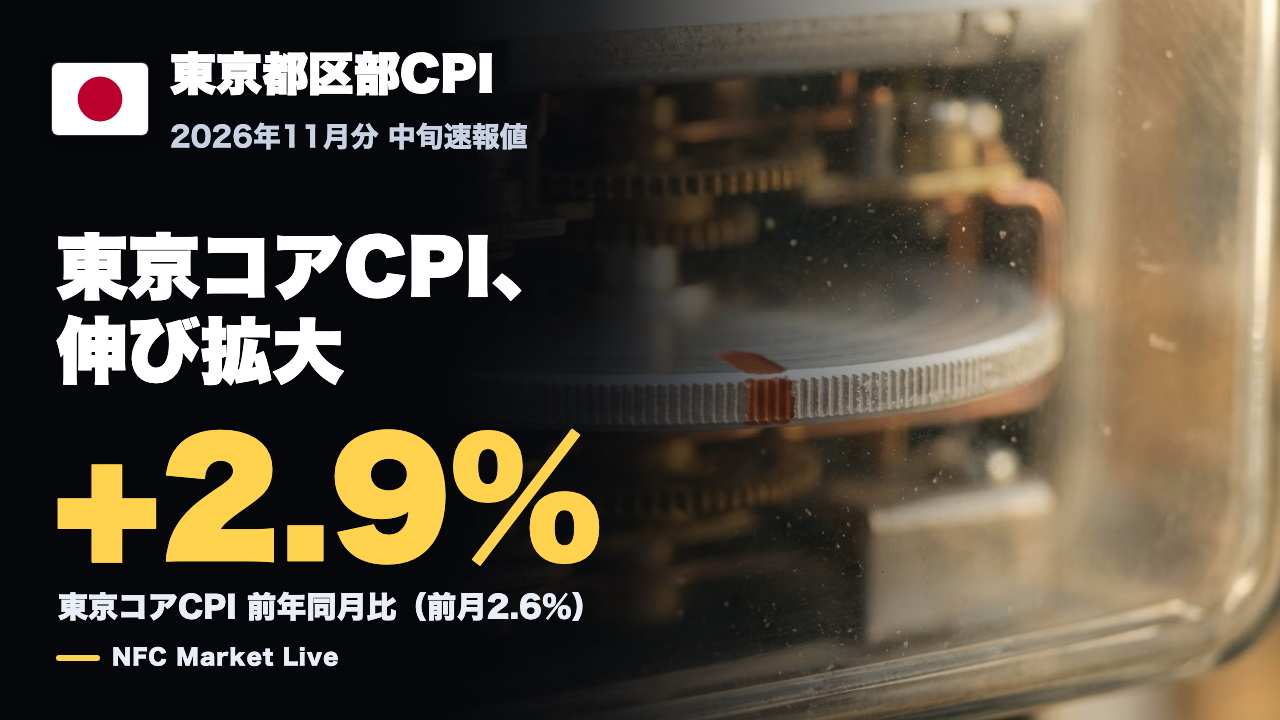
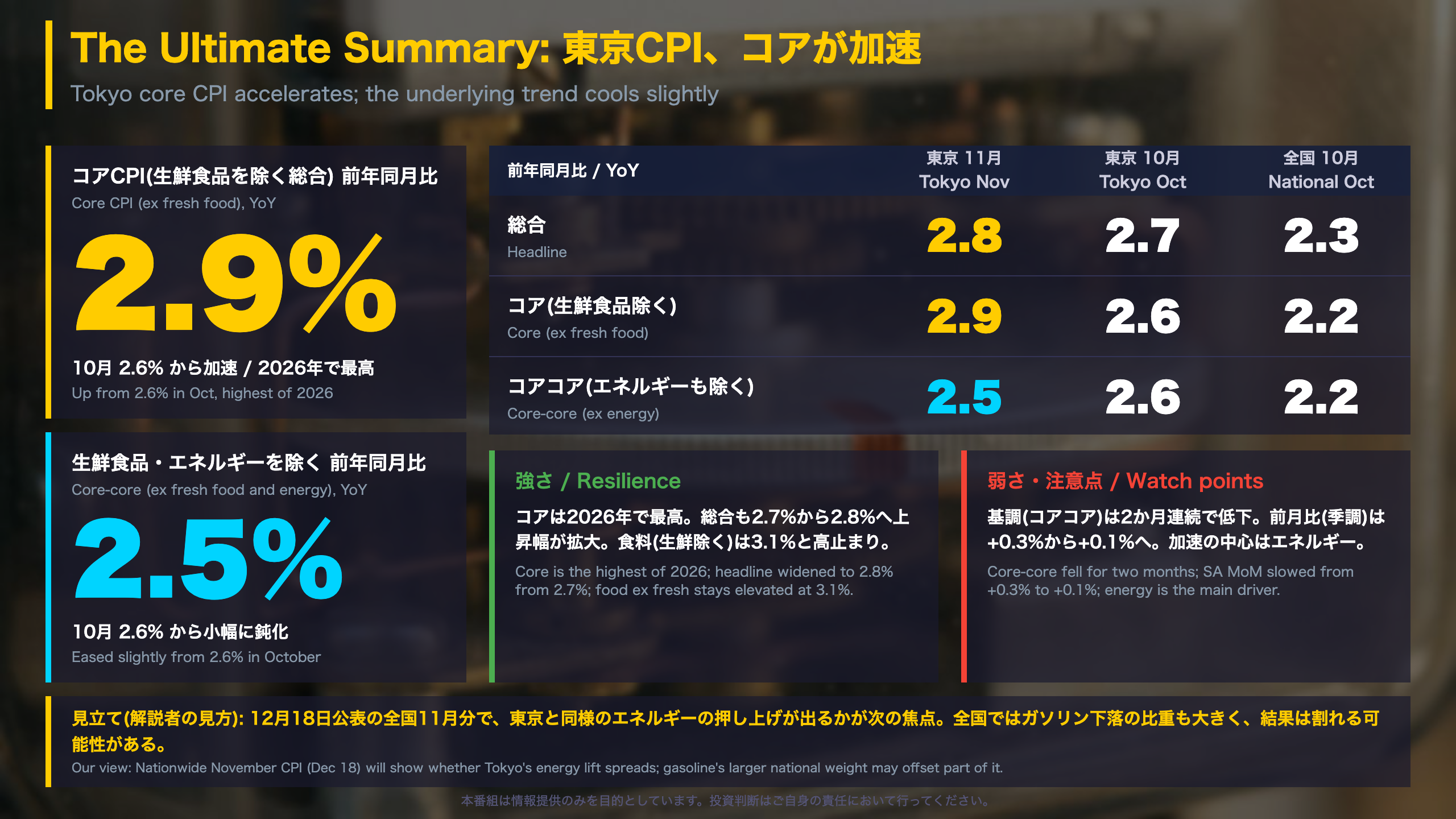
📊 On Nov 27, Japan’s MIC released Tokyo’s November CPI flash. Core CPI (ex fresh food) rose 2.9% YoY, up from 2.6% in October.
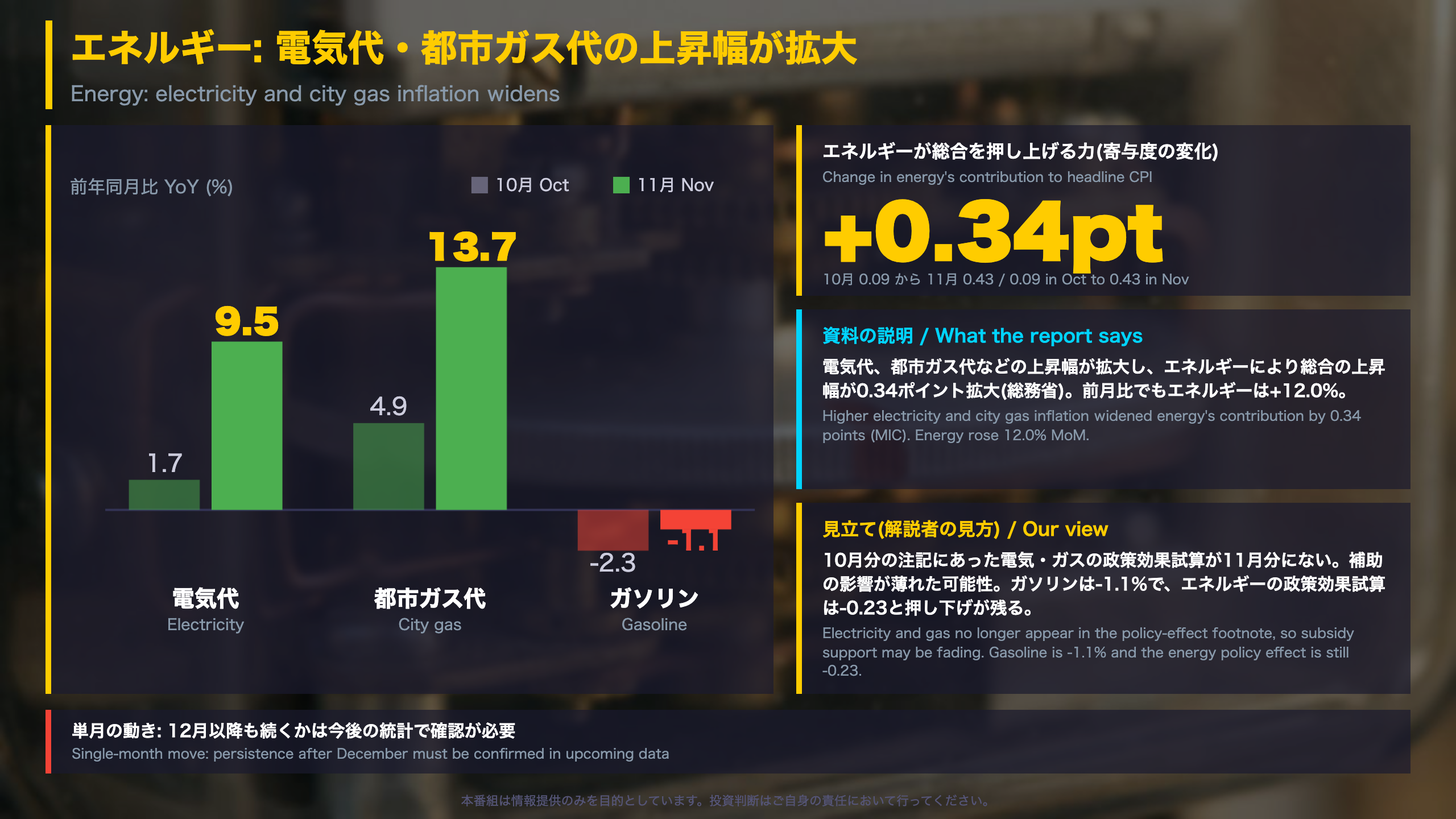
⚡ Higher electricity and city gas prices widened energy’s upward push on the headline by 0.34 percentage points.
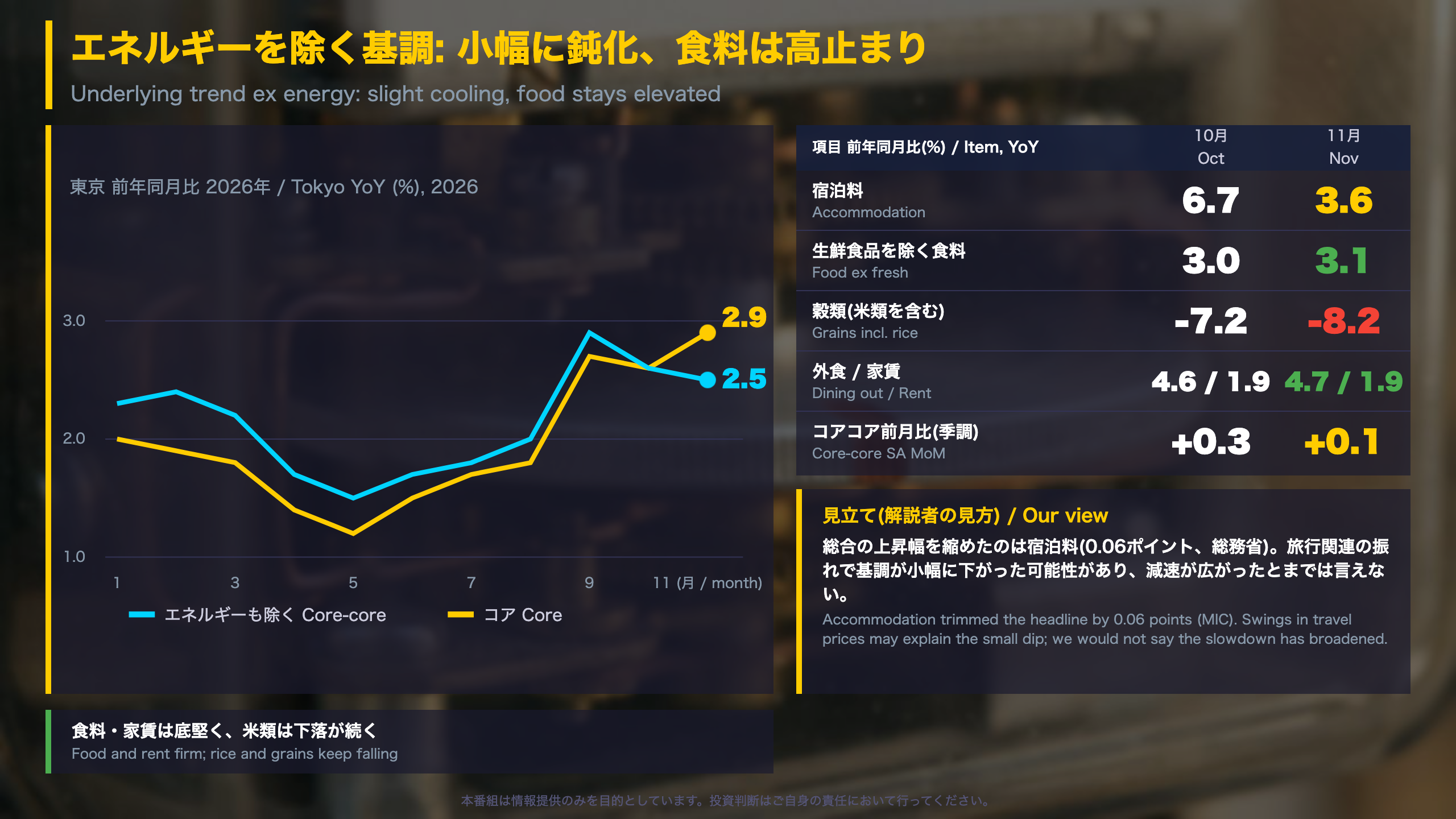
📉 Excluding both fresh food and energy, CPI eased slightly to 2.5% from 2.6%.
💡 We compare Tokyo with October’s nationwide core of 2.2% and weigh the strengths and softness. Next test: nationwide November CPI on Dec 18.
The Ultimate Summary: 東京CPI、コアが加速
Reading Tokyo and Nationwide CPI Side by Side
Tokyo’s 23-ward CPI is published by Japan’s Ministry of Internal Affairs and Communications (MIC) as a mid-month flash, roughly a month before the nationwide figures. It plays a role similar to flash inflation estimates in other economies, although it covers only the capital.
| YoY | Tokyo Nov | Tokyo Oct | National Oct |
|---|---|---|---|
| Headline | 2.8% | 2.7% | 2.3% |
| Core (ex fresh food) | 2.9% | 2.6% | 2.2% |
| Core-core (ex fresh food and energy) | 2.5% | 2.6% | 2.2% |
Context
Tokyo’s core rate was 2.0% in January and 1.2% in May, jumped to 2.7% in September, and now stands at 2.9%, the highest of 2026. The core-core measure peaked at 2.9% in September and has slipped for two months.
Two readings
- Persistent pressure: Headline and core both widened, and food excluding fresh items is still 3.1%.
- Energy-driven: The MIC states that higher electricity and city gas prices widened the energy contribution by 0.34 points, while the underlying gauge cooled and its seasonally adjusted monthly gain fell to 0.1%.
The report contains no policy commentary, and we do not speculate on rates or currencies. Market participants who follow the Bank of Japan will likely watch both the headline and underlying gauges. The next datapoints are nationwide November CPI on December 18 and Tokyo’s December CPI on December 25.
エネルギー: 電気代・都市ガス代の上昇幅が拡大
Energy Components: What Moved
The MIC’s energy table shows a sharp swing between October and November in Tokyo.
| Item | Weight (per 10,000) | Oct YoY | Nov YoY | Nov contribution | Nov MoM |
|---|---|---|---|---|---|
| Energy | 460 | 2.2% | 9.5% | 0.43 | 12.0% |
| Electricity | 279 | 1.7% | 9.5% | 0.27 | 14.2% |
| City gas | 118 | 4.9% | 13.7% | 0.16 | 13.0% |
| Kerosene | 6 | 11.6% | 15.5% | 0.01 | 3.8% |
| Gasoline | 53 | -2.3% | -1.1% | -0.01 | -0.1% |
Energy’s contribution to the headline rose from 0.09 to 0.43 points.
A change in the footnote
Last month’s footnote estimated policy effects (including the abolition of the provisional gasoline tax) at -0.35 for energy, with -0.12 for electricity and -0.04 for city gas. This month’s note lists only energy at -0.23, kerosene at -0.02 and gasoline at -0.21. Electricity and gas are gone. The report gives no explanation, so any link to subsidies is our interpretation.
Two views
- Fading support: The footnote change coincides with the jump in electricity and gas inflation.
- Single-month noise: A 12.0% monthly rise in energy is large, and a December reversal cannot be ruled out.
International and market context
Energy bills are often steered by regulated tariffs and fuel-cost pass-through in Japan, which differs from the more market-driven pricing common in the US. Nationwide October data showed electricity at 1.6% and energy at 2.2%, so December 18’s national release will show whether Tokyo’s move is widespread. The report contains no market commentary, and we do not speculate on rates or the yen.
エネルギーを除く基調: 小幅に鈍化、食料は高止まり
The Underlying Trend in Tokyo
Core-core CPI (excluding fresh food and energy) is the measure most analysts use to gauge Japan’s underlying price momentum, much like US core CPI. Tokyo’s year-on-year readings for 2026 were:
| Month | 1 | 2 | 3 | 4 | 5 | 6 | 7 | 8 | 9 | 10 | 11 |
|---|---|---|---|---|---|---|---|---|---|---|---|
| Core-core | 2.3 | 2.4 | 2.2 | 1.7 | 1.5 | 1.7 | 1.8 | 2.0 | 2.9 | 2.6 | 2.5 |
| Core | 2.0 | 1.9 | 1.8 | 1.4 | 1.2 | 1.5 | 1.7 | 1.8 | 2.7 | 2.6 | 2.9 |
After spiking in September, core-core has declined for two months but remains above its April to August range. The seasonally adjusted monthly gain slowed to 0.1%, the smallest since May.
Components
- Accommodation: 6.7% in October to 3.6%, down 2.7% on the month, trimming the headline by 0.06 points. The MIC explicitly names this.
- Food ex fresh: 3.1%, contributing 0.73 points; eating out is up 4.7% and prepared foods 4.8%.
- Grains (including rice): down 8.2%, a drag of 0.17 points.
- Rent: steady at 1.9%.
Two readings
- Cooling: Two consecutive declines and a smaller monthly gain hint at softer momentum.
- Noise: The dip is explained largely by volatile accommodation prices, while food and rent remain firm.
The report contains no policy remarks; we do not speculate on Bank of Japan decisions or markets. The next check is Tokyo’s December CPI on December 25, which will show whether core-core holds near 2.5%.
質疑で深める: 東京の跳ねは全国に波及するか
Why Tokyo and National Weights Matter
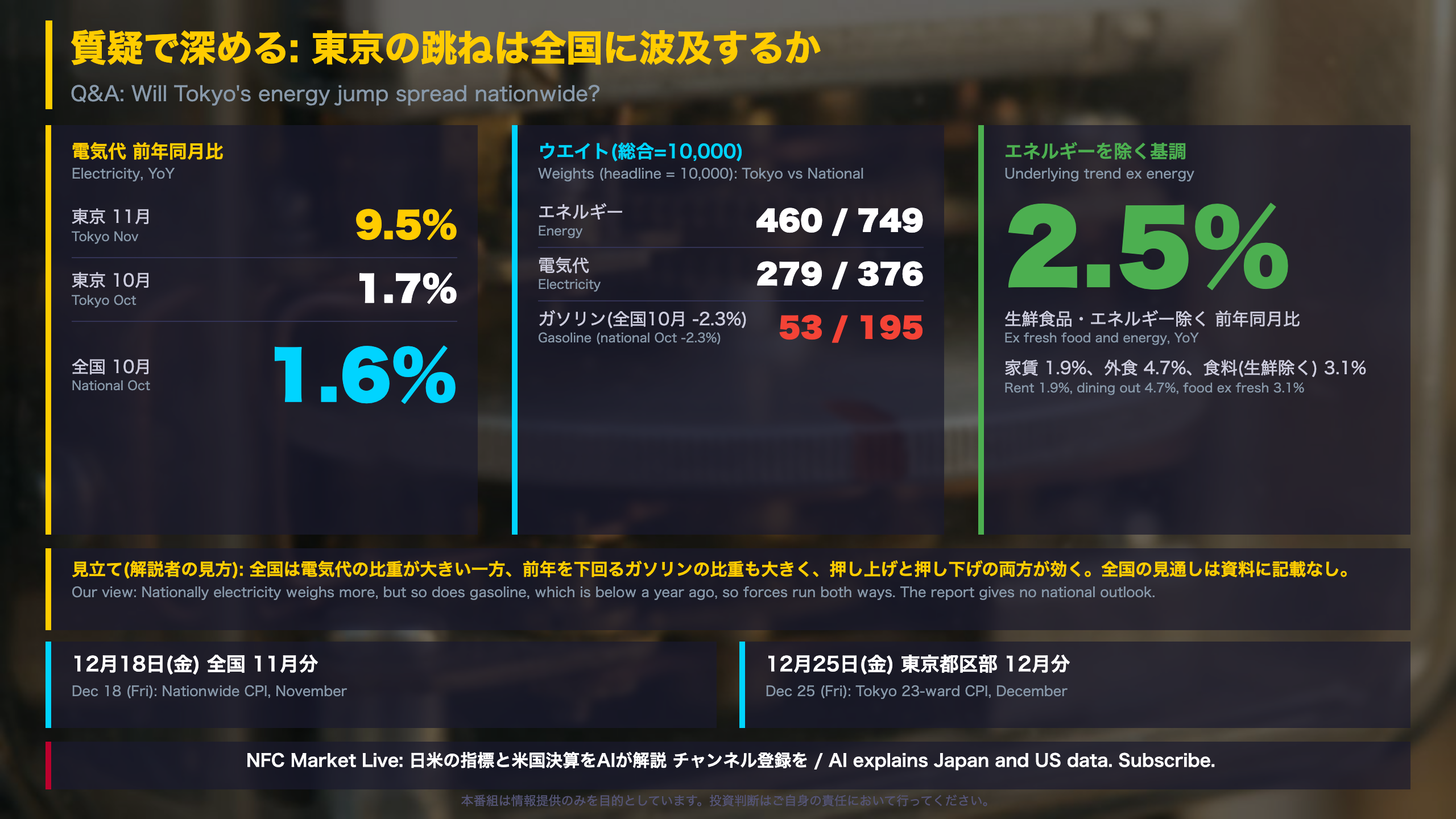
Tokyo’s CPI covers the 23 wards only, while the nationwide index reflects a broader household basket. Expenditure weights (per 10,000) differ in ways that matter for energy.
| Item | Tokyo | National | National Oct YoY |
|---|---|---|---|
| Energy | 460 | 749 | 2.2% |
| Electricity | 279 | 376 | 1.6% |
| City gas | 118 | 89 | 5.3% |
| Gasoline | 53 | 195 | -2.3% |
Nationally, electricity carries more weight than in Tokyo, but gasoline, which is below year-ago levels, carries much more. Both upward and downward forces therefore act on the national index.
Comparison with the past
Nationwide October readings were 2.3% headline, 2.2% core and 2.2% core-core. Tokyo’s October core was 2.6%, so Tokyo ran 0.4 points above the nation, and November’s Tokyo core is 2.9%.
“The estimated effect of abolishing the provisional gasoline tax and related policies on national October CPI was -0.97 for energy,” per the MIC.
Two readings
- Spillover: Tokyo’s electricity and gas inflation widened sharply, so a similar move nationally is possible.
- Caution: Tokyo is a mid-month flash with narrower coverage, and the policy drag on the national energy index is larger, so the outcome may differ.
The report offers no national forecast, and we do not speculate on rates or the yen. The reference points for December 18 are October’s nationwide electricity at 1.6%, energy at 2.2% and core-core at 2.2%. Tokyo’s December CPI follows on December 25.
Disclaimer: This article is for informational purposes only. All investment decisions are made solely at your own risk.