This article was automatically generated by the NFC Market Live AI analysis system. (Updated: 2026-11-27 09:56 JST)
📄 Primary Source
Ministério do Desenvolvimento
https://www.gov.br/trabalho-e-emprego/pt-br/noticias-e-conteudo/2026/novembro/dados-do-novo-caged-de-outubro-serao-apresentados-na-segunda-feira-30
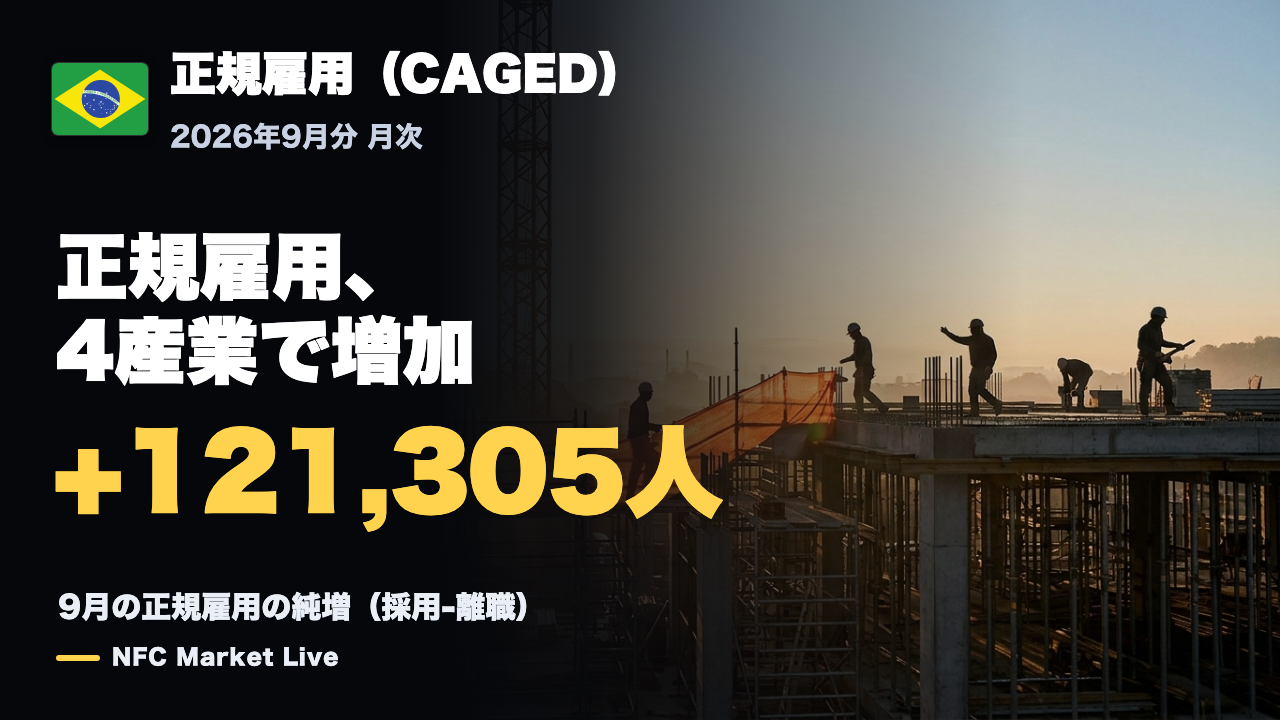
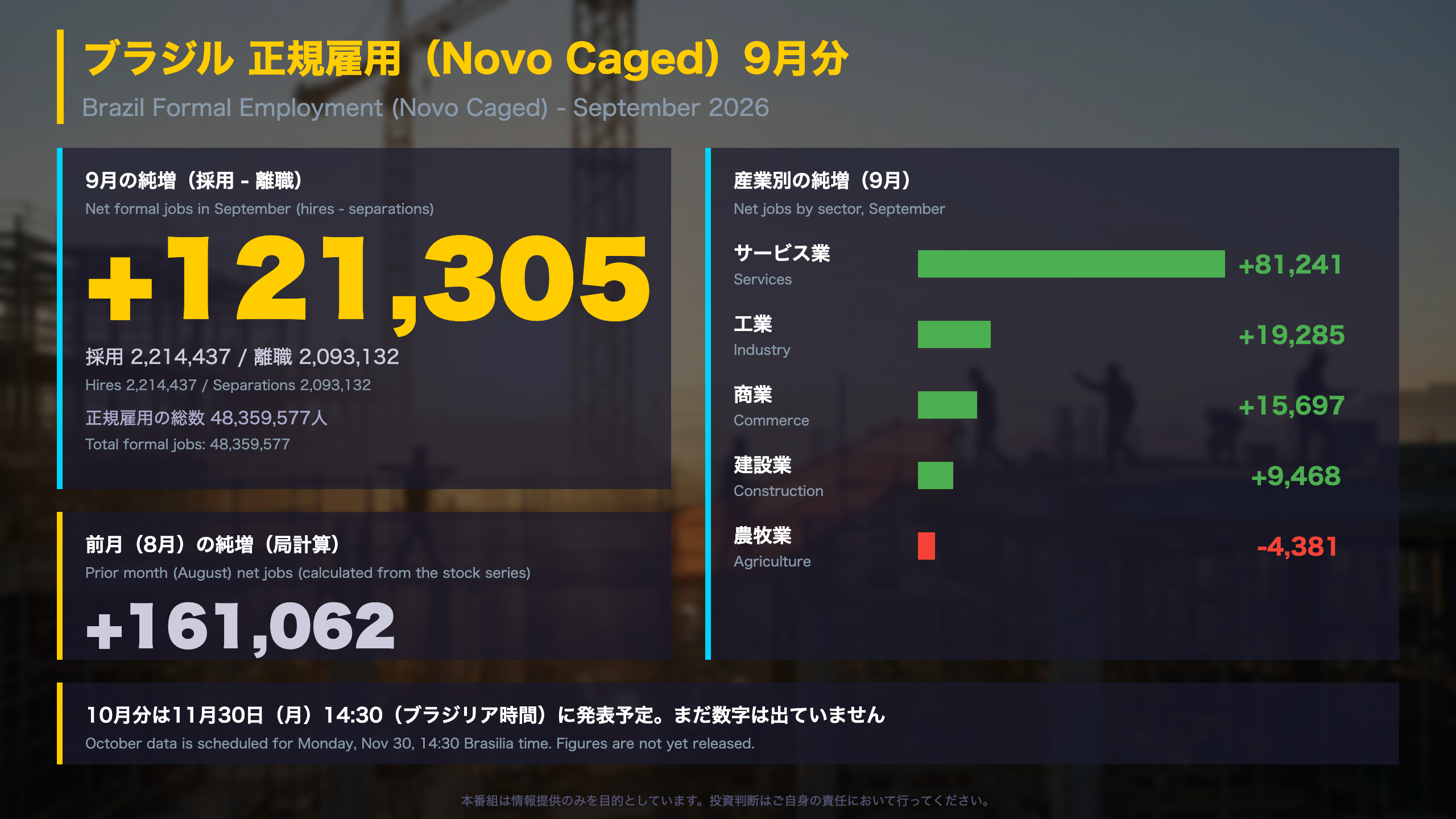
📊 Brazil’s Labor Ministry Novo Caged data for September: net formal job creation of +121,305 (hires 2,214,437, separations 2,093,132).
💡 Four of five major sectors added jobs, led by services (+81,241); agriculture alone fell (-4,381). Year to date: +1,248,914 (+2.65%).
⚠️ The net gain was smaller than August by our calculation, while the real wage for new hires rose 1.88% year on year.
📅 October data is scheduled for Monday, November 30 at 2:30 p.m. Brasilia time.
サマリー:9月の正規雇用は+12.1万人、強弱が混在
What Novo Caged measures
Novo Caged is the monthly formal-employment registry published by Brazil’s Ministry of Labor and Employment (MTE). It records hires and separations that employers report, and the difference is the net formal job creation. It covers formal payroll jobs only, so it is not comparable with IBGE’s household survey (PNAD), which also captures informal work. Think of it as closer in spirit to the US monthly payroll change than to an unemployment rate.
September 2026 in numbers
- Hires: 2,214,437; separations: 2,093,132; net: +121,305
- Stock of formal jobs: 48,359,577
- Cumulative since January 2023: +5,653,169
- Women +62,989, men +59,129; workers up to 24 years old +106,293
Context from the central bank series
The stock series (BCB SGS 28763) implies August net creation of +161,062 and September 2025 of +214,609 (our calculation). September 2026 was therefore smaller than both.
Balanced reading
Resilience: four of five sectors added jobs and 26 states posted gains.
Softness: the pace slowed from August and from a year earlier, and agriculture shrank by 4,381.
This note makes no forecast for the currency or monetary policy. For reference, the central bank’s inflation target is 3% with a 1.5-point tolerance band, but this release contains no inflation data.
What comes next
October data is due Monday, November 30 at 2:30 p.m. Brasilia time (about 2:30 a.m. on December 1 in Tokyo).
深掘り1:9月の増加の中身(産業・地域・雇用の形)
Digging into September: sectors, states and contract types
Sector detail (net jobs)
| Sector | Net jobs |
|---|---|
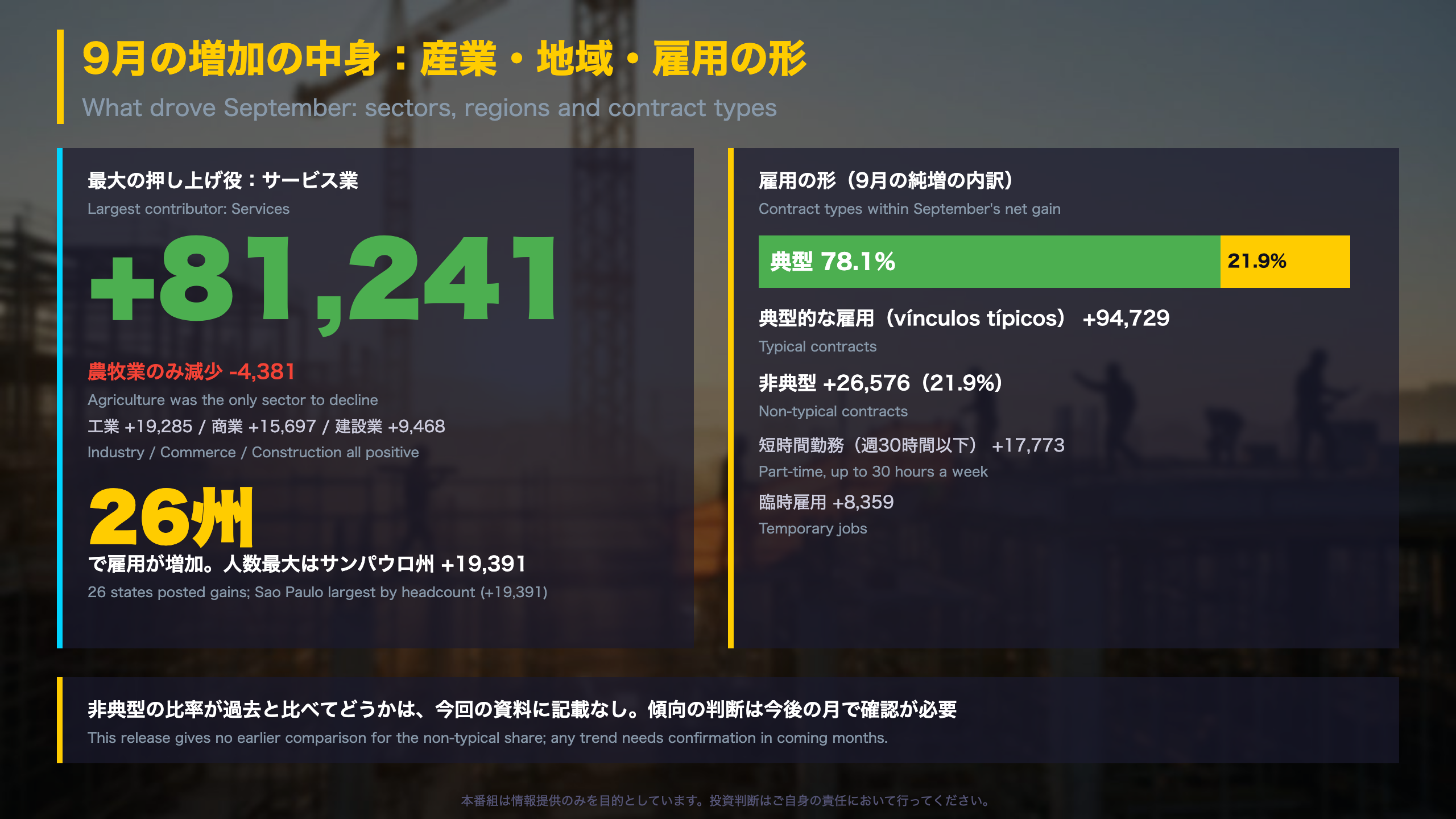
| Services | +81,241 |
| Industry | +19,285 |
| Commerce | +15,697 |
| Construction | +9,468 |
| Agriculture | -4,381 |
Regional picture
By headcount, São Paulo (+19,391), Pernambuco (+13,371) and Alagoas (+11,110) led. In relative terms, Alagoas (+2.47%), Amapá (+1.35%) and Roraima (+1.23%) ranked highest. Small northern and northeastern states can top a percentage ranking with modest absolute gains, so the two lists differ.
Contract types
MTE splits jobs into typical contracts (+94,729, 78.1%) and non-typical ones (+26,576, 21.9%). The non-typical group is mostly part-time work of up to 30 hours a week (+17,773) and temporary contracts (+8,359). For a US reader, this is loosely analogous to the full-time versus part-time and temporary split in payroll data.
Two readings
Constructive: gains were broad across sectors and states, and typical contracts supplied most of the increase.
Cautious: the release does not show how the non-typical share compares with earlier months, so no trend can be inferred.
What to watch
The October release will show whether services keep leading and whether agriculture’s decline persists. This note offers no forecast for the Brazilian real or for central bank decisions.
深掘り2:1-9月の累計、建設とサービスが牽引
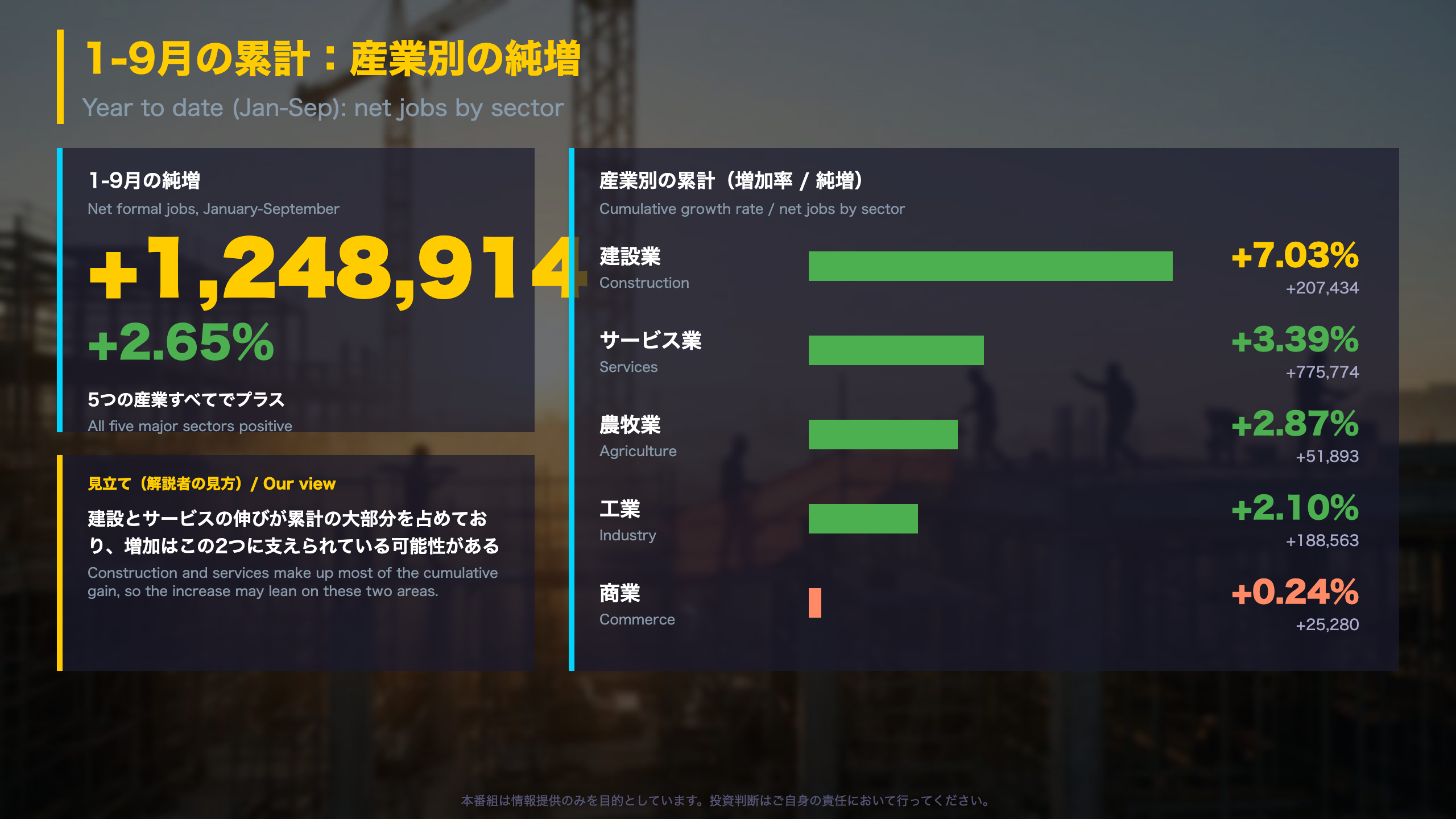
Year-to-date detail: where the 1.25 million came from
Sector table (MTE, January-September 2026)
| Sector | Net jobs | Growth |
|---|---|---|
| Services | +775,774 | +3.39% |
| Construction | +207,434 | +7.03% |
| Industry | +188,563 | +2.10% |
| Agriculture | +51,893 | +2.87% |
| Commerce | +25,280 | +0.24% |
Sub-sector highlights
- Services: public administration, defense and social security, education, and health and social services added 276,355 (+4.76%).
- Construction: infrastructure works (+82,909), building construction (+66,883) and specialized construction services (+57,642).
- Industry: food manufacturing (+55,929) and motor vehicles, trailers and bodies (+26,878).
- Agriculture: farm support activities (+15,353), coffee (+7,464) and garlic (+3,667).
States
São Paulo (+322,551), Minas Gerais (+129,777) and Rio de Janeiro (+86,489) led by headcount; Amapá (+7.75%), Roraima (+4.54%) and Piauí (+4.52%) led in percentage terms. Every state was positive.
Balanced view
Strength: all five sectors and all states gained, and construction at +7.03% was the fastest-growing group.
Unevenness: commerce rose just 0.24%.
The ministry does not give the reasons behind these sector differences, so any explanation here would be speculation. This is a descriptive note, not a forecast for the real or for monetary policy.
質疑:勢い・昨年比・賃金、そして次回の発表
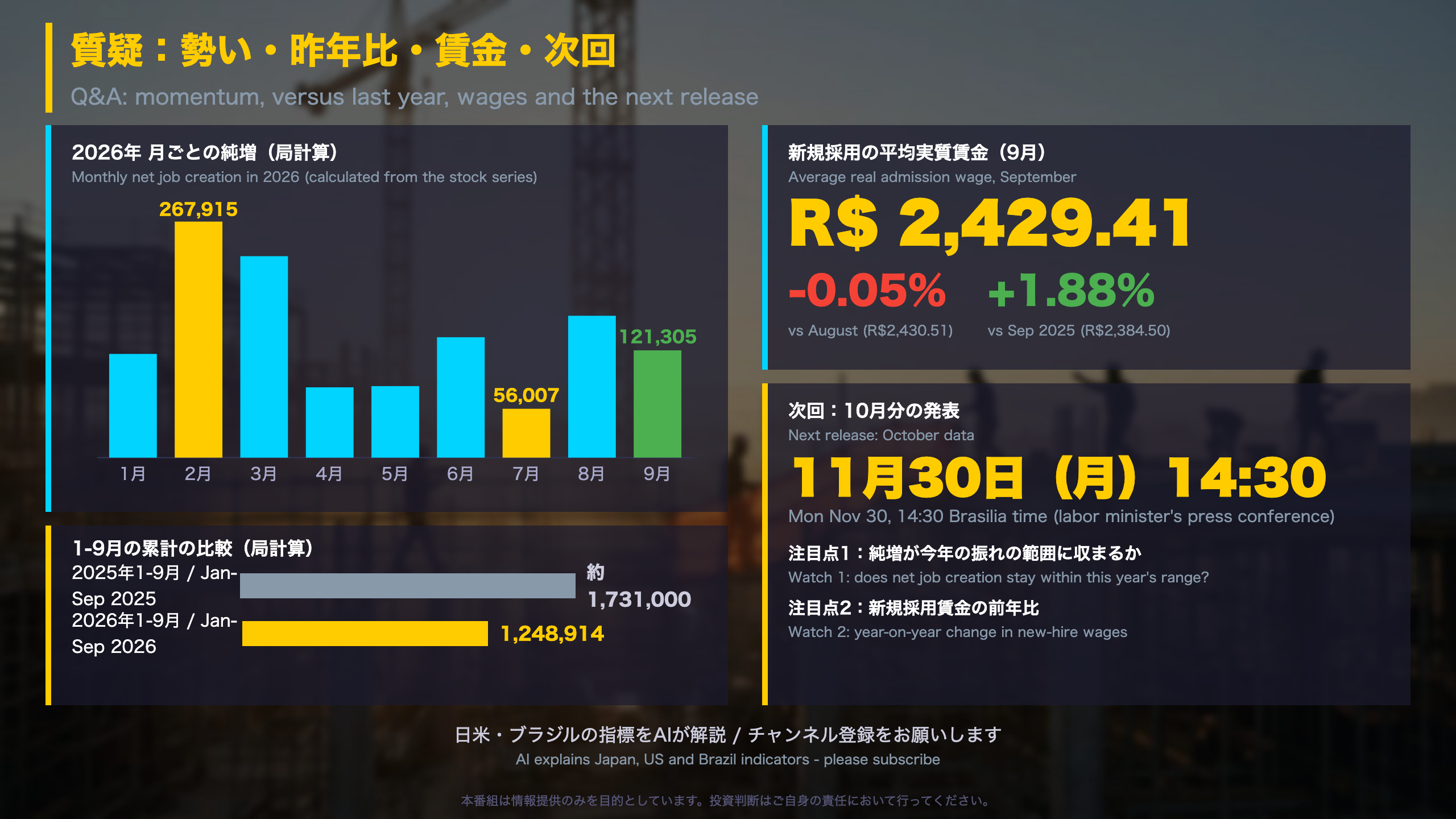
Monthly volatility, year-on-year comparison and wages
2026 monthly net job creation (our calculation from the stock series)
Jan +117,725; Feb +267,915; Mar +227,736; Apr +79,266; May +81,475; Jun +136,423; Jul +56,007; Aug +161,062; Sep +121,305. September’s figure is exactly the median of the nine months, which is why a single month is a weak basis for calling a change in momentum.
Versus last year
By our calculation, January-September 2025 net creation was about 1,731,398, against 1,248,914 this year, and September 2025 (+214,609) was higher than September 2026. December has produced large net losses two years running (-555,242 in 2024 and -635,579 in 2025); the ministry does not explain why, so we draw no conclusion.
Wages
The average real admission wage was R$2,429.41 in September, down R$1.10 (-0.05%) from August’s R$2,430.51 but up R$44.90 (+1.88%) from R$2,384.50 a year earlier. Note this covers new hires only, not wages of all workers.
Two readings
Resilient: pay for new hires is higher than a year ago and September fits within this year’s range.
Softer: cumulative hiring trails last year’s pace.
Release logistics
October data will be presented by Labor Minister Luiz Marinho on Monday, November 30 at 2:30 p.m. Brasilia time (2:30 a.m. December 1 in Tokyo), with full data on the Novo Caged panel. This is not a forecast for the real or for central bank policy.
Disclaimer: This article is for informational purposes only. All investment decisions are made solely at your own risk.