This article was automatically generated by the NFC Market Live AI analysis system. (Updated: 2026-11-27 00:28 JST)
📄 Primary Source
NFC Market Live
https://www.inegi.org.mx/contenidos/saladeprensa/boletines/2026/iooe/IOE2026_11.pdf
📊 A walk-through of the October 2026 ENOE labor survey released by Mexico’s INEGI on November 26.
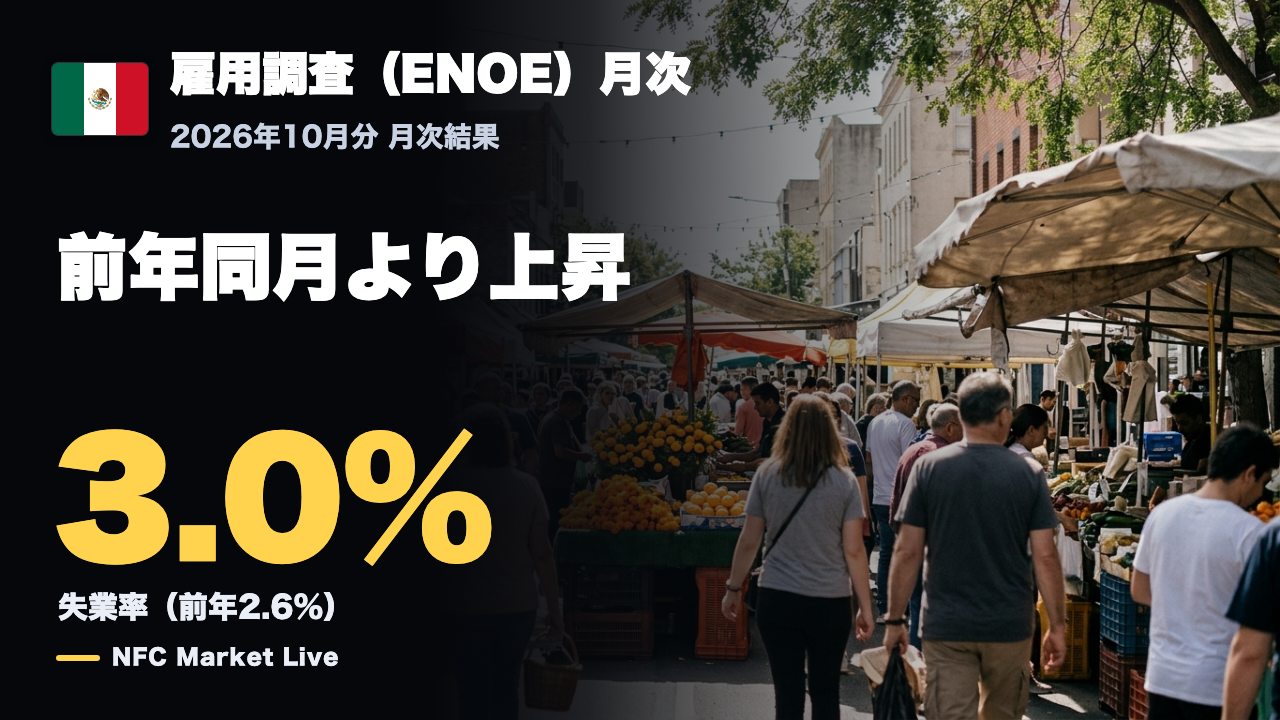
📉 The unemployment rate was 3.0%, up from 2.6% a year earlier, and employment was 185 thousand lower year on year. The share of people jobless for more than three months also rose.
📈 On the other side, underemployment eased to 7.2% (7.5% a year ago) and construction employment rose by 313 thousand.
💡 A month with both weaker and better signals. It is a single month, so the next release (November data, December 24) is the check point.
※ Explanation of primary sources only. Not investment advice.
サマリー:10月のメキシコ雇用統計(ENOE)
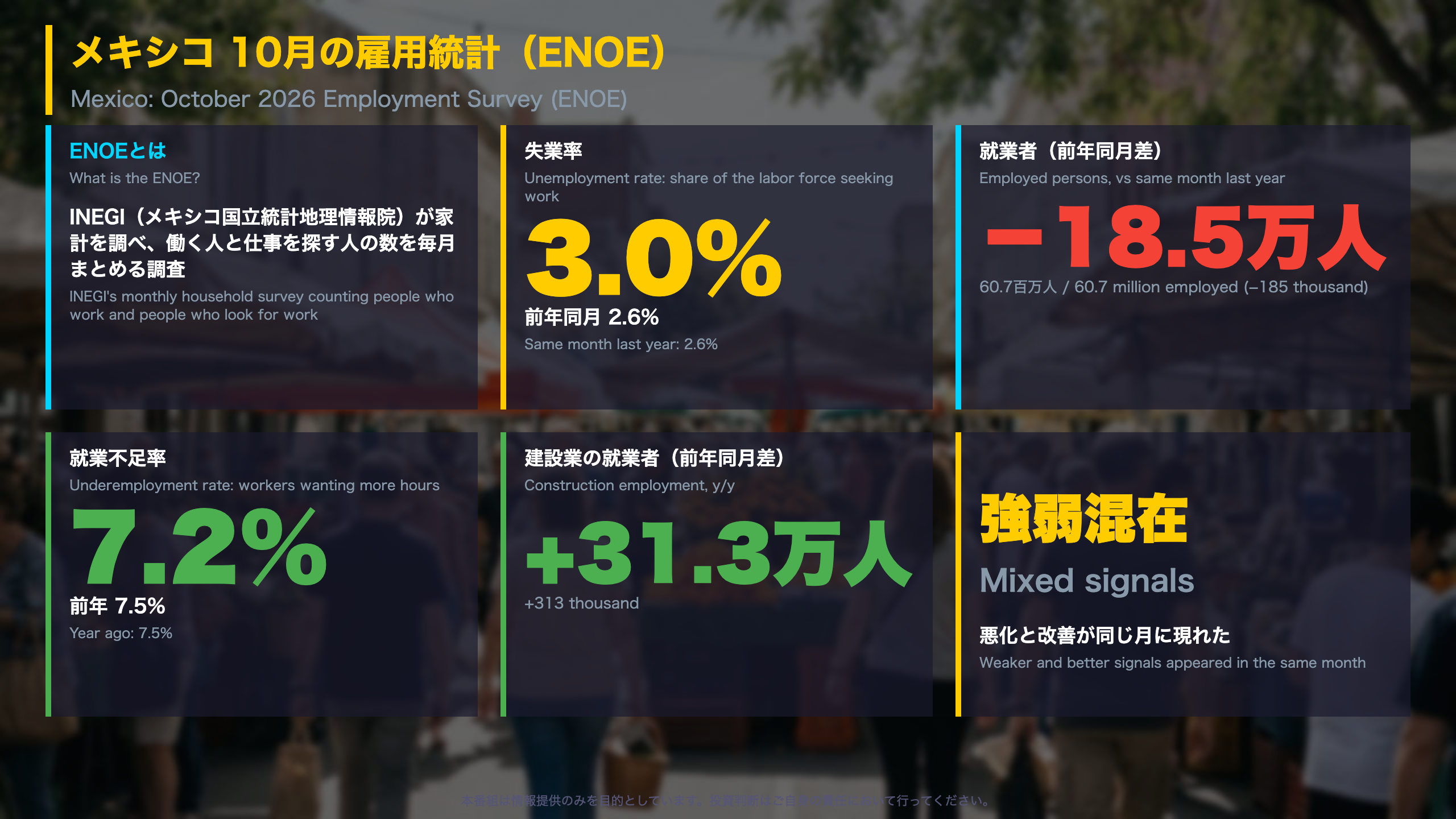
About the ENOE
The ENOE (Encuesta Nacional de Ocupación y Empleo) is INEGI’s continuous household survey and the main source of Mexican labor-market data. Like the US household survey behind the BLS unemployment rate, it classifies people as employed, unemployed or outside the labor force based on a reference week. INEGI also publishes seasonally adjusted series built with X-13ARIMA-SEATS.
October 2026 at a glance
- Unemployment rate: 3.0% (2.6% a year earlier)
- Participation rate: 59.2% (59.9%)
- Underemployment rate: 7.2% (7.5%)
- Informality rate: 55.7%, unchanged
- Critical conditions of employment rate: 38.6% (37.8%)
Context
October unemployment readings in INEGI’s long table were 3.9% in 2021, 3.3% in 2022, 2.7% in 2023, 2.5% in 2024 and 2.6% in 2025. The October participation rate has now fallen four years in a row. With 55.7% of workers in informal employment, INEGI points readers to complementary measures such as underemployment and critical conditions, so this report is best read as a set of indicators rather than a single rate.
What this release is not
It is a statistical release, not a policy document. It contains no guidance from Banxico, and this note makes no forecast for rates or the peso. The next release, covering November, is due December 24, 2026.
深掘り1:失業率の上昇と失業期間の長期化
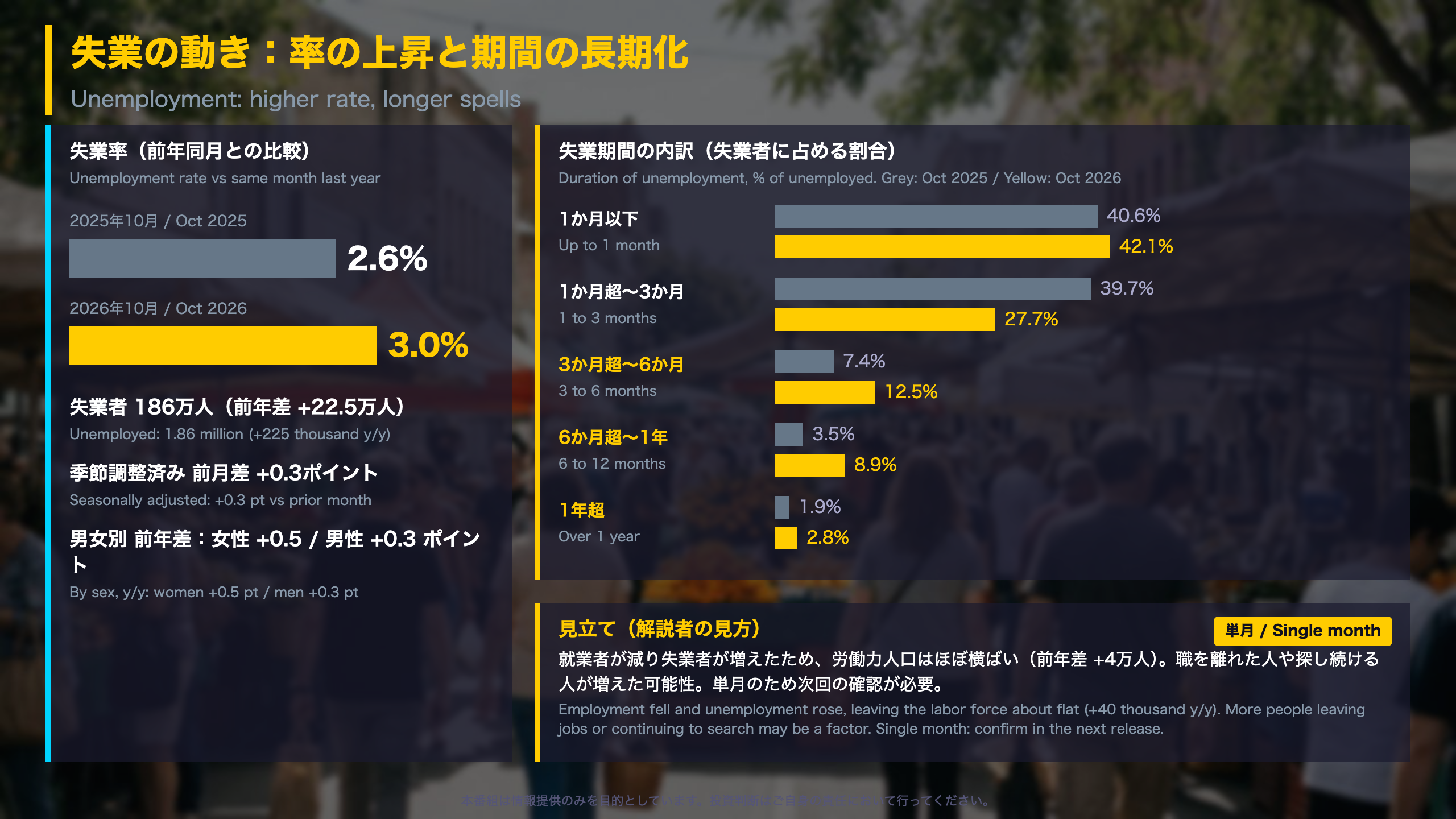
Reading the rise in unemployment
INEGI defines the unemployed as people who did not work even one hour in the reference week, said they were willing to work and took steps to find a job. That is close in spirit to the ILO-style definition behind the US BLS household survey, so the 3.0% rate is broadly comparable in concept, though not in level, with US readings.
Who is unemployed
- Unemployed people: 1.86 million, up 225 thousand from a year earlier.
- Women: 752 thousand (+118 thousand). Men: 1.10 million (+106 thousand).
- Age mix: the 45-64 group rose to 20.0% of the unemployed from 17.4%, while the 15-24 group fell to 31.2% from 36.3%.
Duration of joblessness (share of the unemployed)
- Up to one month: 42.1% (40.6%)
- One to three months: 27.7% (39.7%)
- Three to six months: 12.5% (7.4%)
- Six to twelve months: 8.9% (3.5%)
Seasonally adjusted and urban view
The seasonally adjusted national rate was 3.0%, +0.3 point from September; for women it was 3.1% (+0.6) and for men 2.8% (+0.1). The 32-city aggregate rose to 3.5% (+0.4 point on the month). INEGI builds these series with econometric methods, and monthly differences use unrounded figures.
Two readings
The larger share jobless for three months or more suggests longer searches. At the same time, the share jobless for a month or less also edged up, which could mean new entrants to job search continue to arrive. These are shares of the unemployed, not changes in headcount. This note makes no rate or currency forecast.
深掘り2:就業の中身は量が減少、質は強弱混在
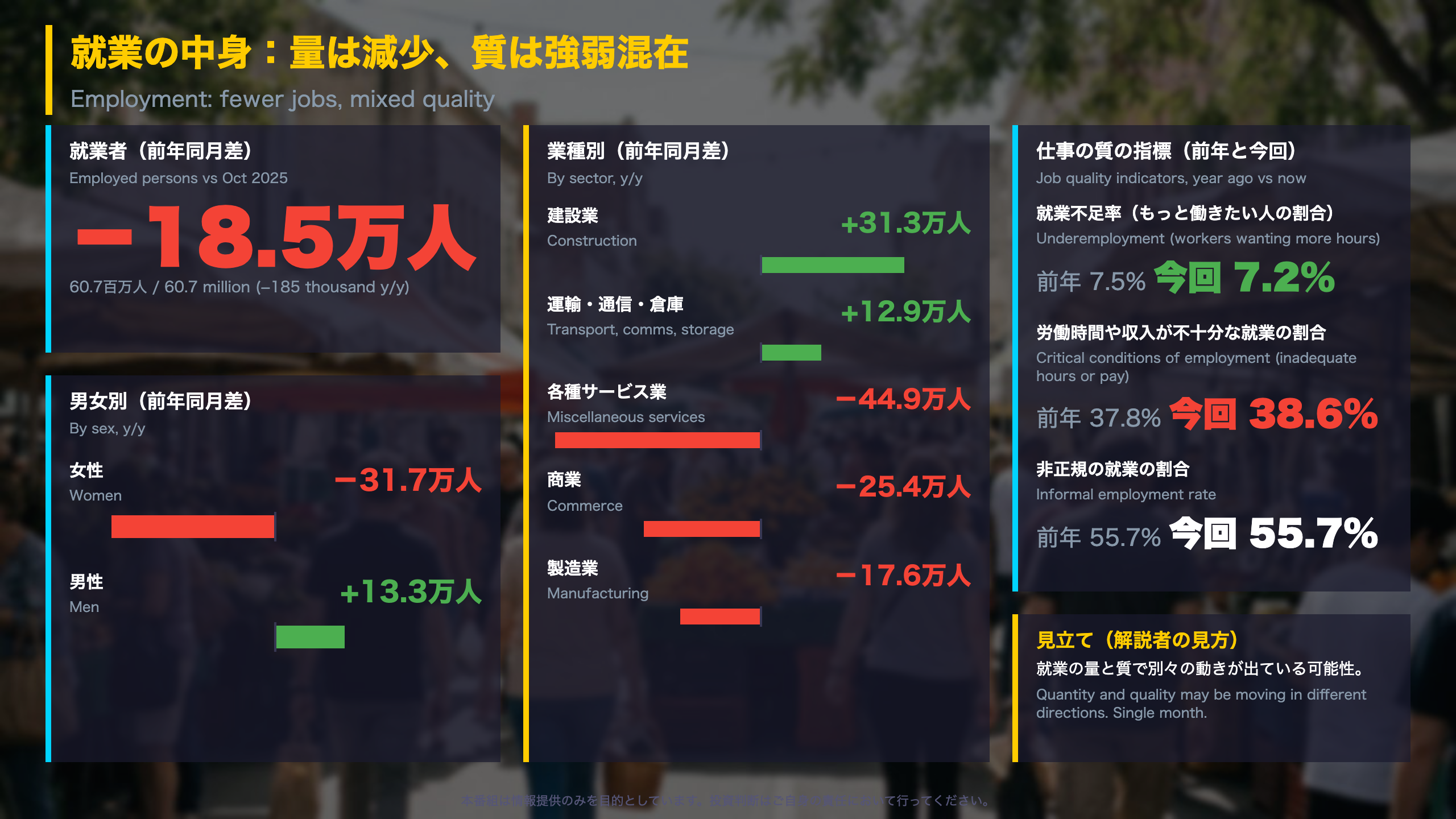
The composition of employment
Employment was about 60.7 million, 185 thousand fewer than a year earlier. Behind the net decline sit offsetting moves by status: wage and salary workers fell 166 thousand, unpaid workers fell 237 thousand, while employers rose 181 thousand and own-account workers rose 37 thousand.
Sector detail (year-on-year)
| Sector | Change |
|---|---|
| Construction | +313 thousand |
| Transport, communications, storage | +129 thousand |
| Restaurants and lodging | +88 thousand |
| Miscellaneous services | -449 thousand |
| Commerce | -254 thousand |
| Manufacturing | -176 thousand |
Compared with the September release
In September the year-on-year drop in wage and salary workers was 782 thousand, and construction was among the largest decliners (-167 thousand). In October wage and salary losses narrowed to 166 thousand and construction swung to a gain.
Job quality and a data caution
The critical conditions rate (insufficient hours or pay, based on minimum-wage equivalents from January 2026) was 38.6%, against 37.8%. The informal-sector employment rate was 30.4%, up 0.8 point. In the income table, the share earning one to two minimum wages jumped to 32.0% from 26.7% while the unspecified category shrank from 15.2% to 9.6%; INEGI gives no reason, so cross-category comparisons need care.
This note offers no forecast for monetary policy or the currency.
質疑:前回9月との比較と次の確認点
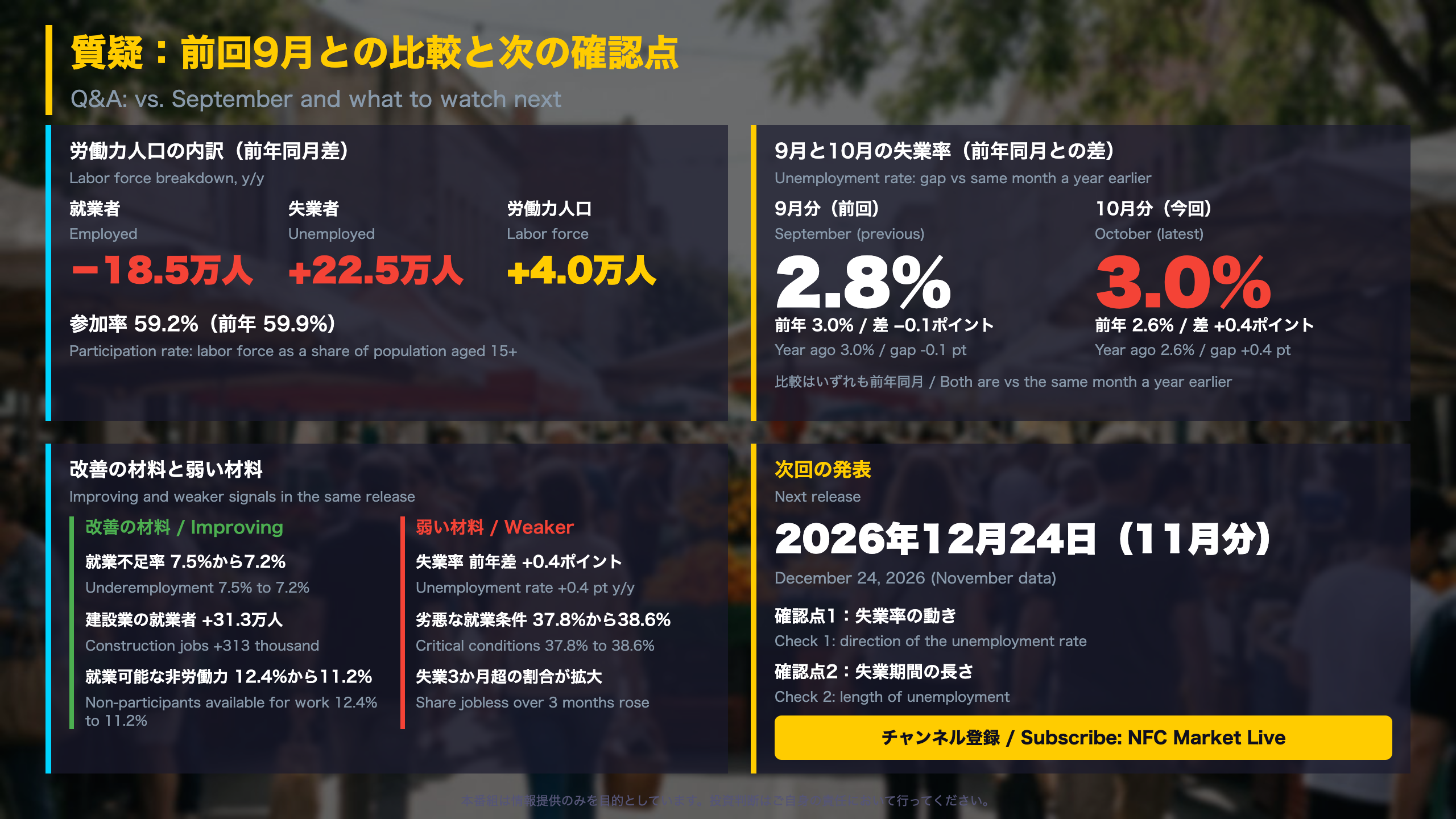
Setting October beside September
Because raw figures carry seasonal patterns, the cleanest comparison is each month’s gap against the same month a year earlier.
| Indicator | September (year ago) | October (year ago) |
|---|---|---|
| Unemployment rate | 2.8% (3.0%) | 3.0% (2.6%) |
| Participation rate | 58.5% (59.6%) | 59.2% (59.9%) |
| Underemployment | 6.7% (7.3%) | 7.2% (7.5%) |
| Informality | 54.3% (54.9%) | 55.7% (55.7%) |
The unemployed headcount was 92 thousand below a year earlier in September and 225 thousand above in October, which is why the direction of the comparison changed.
Seasonally adjusted monthly moves (national)
Unemployment 3.0% (+0.3 point), participation 58.8% (+0.3), underemployment 6.7% (+0.2) and informality 55.3% (+0.9). INEGI notes that adjusted figures come from econometric methods and that differences use unrounded values.
How far to read it
The ENOE is a rotating-panel household survey of roughly 150 thousand dwellings per quarter, much like the US household survey in design philosophy, so single-month swings carry sampling noise. The release shows better and worse signals side by side: lower underemployment and stronger construction against a higher unemployment rate and more people jobless for over three months.
Next
The next release covers November and is due December 24, 2026. This note makes no forecast for Banxico, rates or the peso; it simply flags the data to compare.
Disclaimer: This article is for informational purposes only. All investment decisions are made solely at your own risk.