📺 Watch the Full Video Analysis
This article was automatically generated by the NFC Market Live AI analysis system. (Updated: 2026-11-26 04:15 JST)
📊 A walkthrough of the Fed’s November Beige Book.
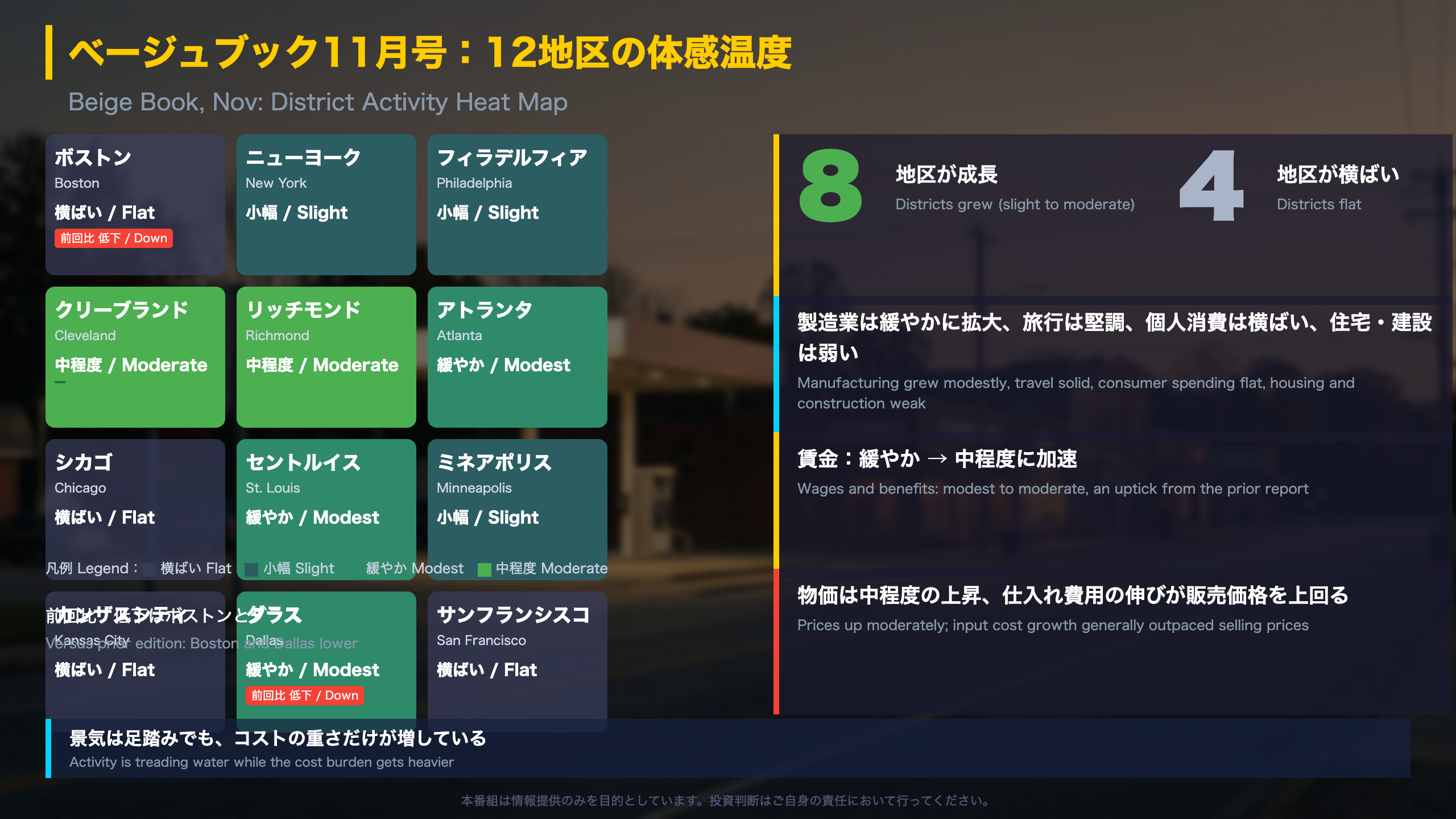
Eight of the twelve districts reported growth and four reported no change.
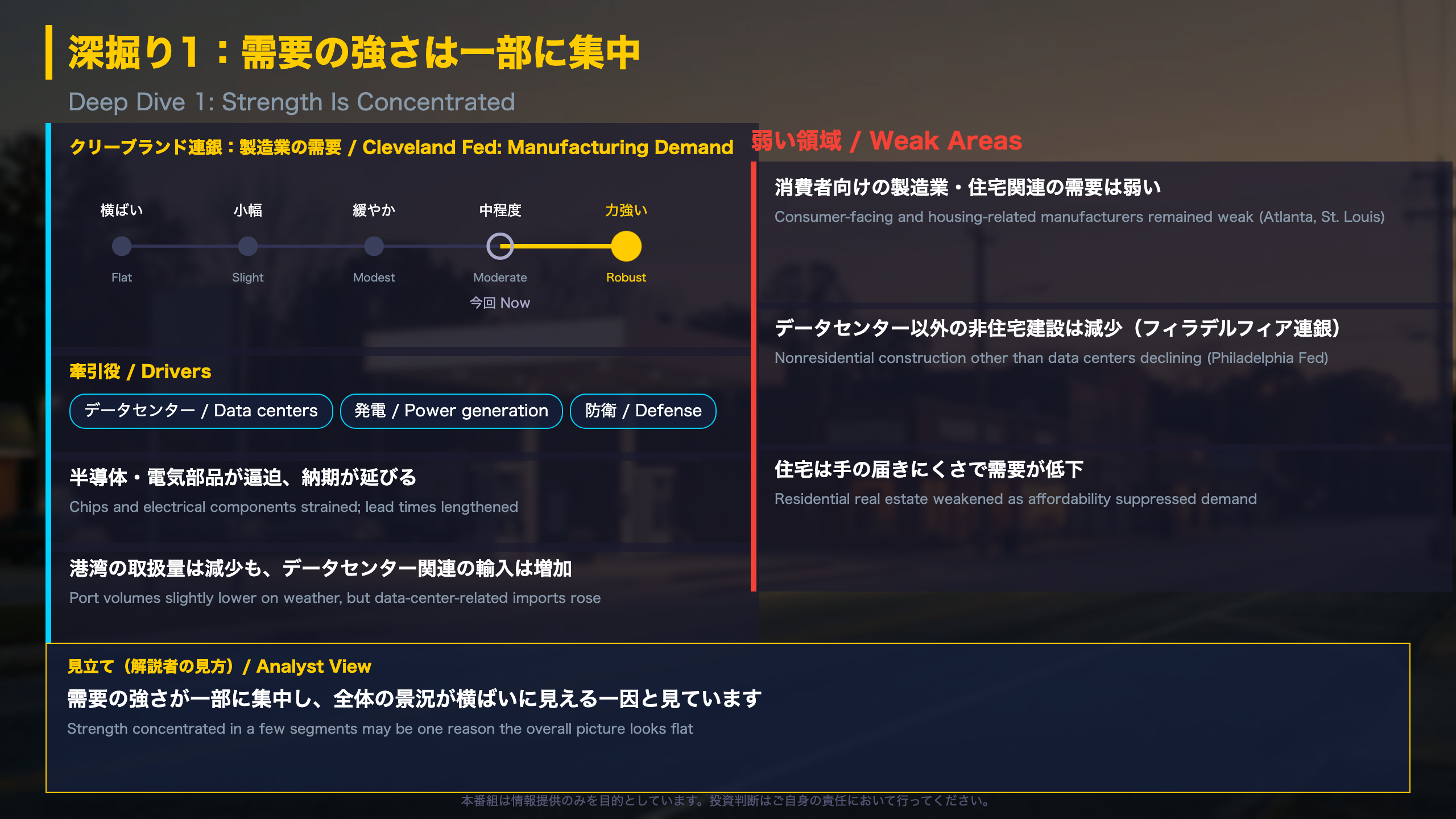
📈 Manufacturing expanded modestly and travel was solid. Cleveland said manufacturing demand strengthened to robust.
📉 Consumer spending was little changed, while housing and construction stayed weak.
💡 Wage growth stepped up from modest to moderate, and input cost growth generally outpaced selling prices.
⚠️ The report summarizes comments from contacts outside the Fed and does not reflect the views of Fed officials.
What to watch: selling prices and wages after contract renewals early in the year, and whether consumer spending moves beyond flat.
サマリー:12地区の体感温度マップ
What the Beige Book is
The Beige Book is a periodic summary of anecdotes gathered by the twelve regional Federal Reserve Banks from business owners, bankers and community groups. It complements hard data such as payrolls and CPI, and it states it is “not a commentary on the views of Federal Reserve officials.” This edition was prepared by the Atlanta Fed with information through November 16. A rough Japanese analogue is the Bank of Japan’s Regional Economic Report, which also reads local conditions through interviews.
Headline read-through
- Eight districts grew, four were flat. Cleveland and Richmond reported moderate growth; Boston, Chicago, Kansas City and San Francisco reported little or no change.
- Versus the prior edition: Boston slipped to flat, Dallas cooled from moderate to modest, and Cleveland improved from modest to moderate.
- Outlooks are mixed. Most districts expect slight to moderate growth and Kansas City upgraded its six-month view, but Philadelphia said growth expectations diminished across all firms and Chicago contacts expect a slight decrease over the coming year.
Why wages deserve attention
Wages and benefits rose moderately, “an uptick from modest increases in the previous report,” while hiring was mostly to replace attrition. Limited job creation alongside firmer pay in hard-to-fill roles is a different pattern from broad labor-market overheating.
What to watch
Whether the flat districts turn up and whether wage pressure persists in the next edition.
深掘り1:需要の強さは一部に集中
Where the strength is
Manufacturing is the bright spot in this Beige Book, but it is narrow. Cleveland described demand as robust, driven by data center buildouts, power generation and defense, plus market share gains and catch-up on deferred orders. Atlanta cited “exceptional demand” from data center construction and aerospace, with backlogs expected to support demand into 2027. Dallas reported Gulf Coast refiners averaging 95 percent utilization, partly by deferring routine maintenance.
Where it is not
St. Louis noted a Tennessee consumer-packaged goods maker planning to cut production next quarter after inventories rose. Atlanta said consumer-facing manufacturers, especially discretionary items and home building products, remained weak. Philadelphia said nonresidential construction outside data centers is declining.
Two readings
- Constructive: backlogs stretch into 2027 and supply bottlenecks (chips, electrical components) signal real orders.
- Cautious: Atlanta utility contacts called future power demand uncertain as data center projects face higher costs and complicated planning, and a Boston financial contact flagged uncertainty about the sustainability of AI-related capital spending.
Context for non-U.S. readers
This resembles other economies where a capex theme lifts industrials while household-facing sectors lag. The key question for the next edition is whether strength broadens beyond data-center-linked segments. We draw no market-direction conclusions from this report.
深掘り2:コストの上昇と価格転嫁のずれ
The numbers behind the cost-price gap
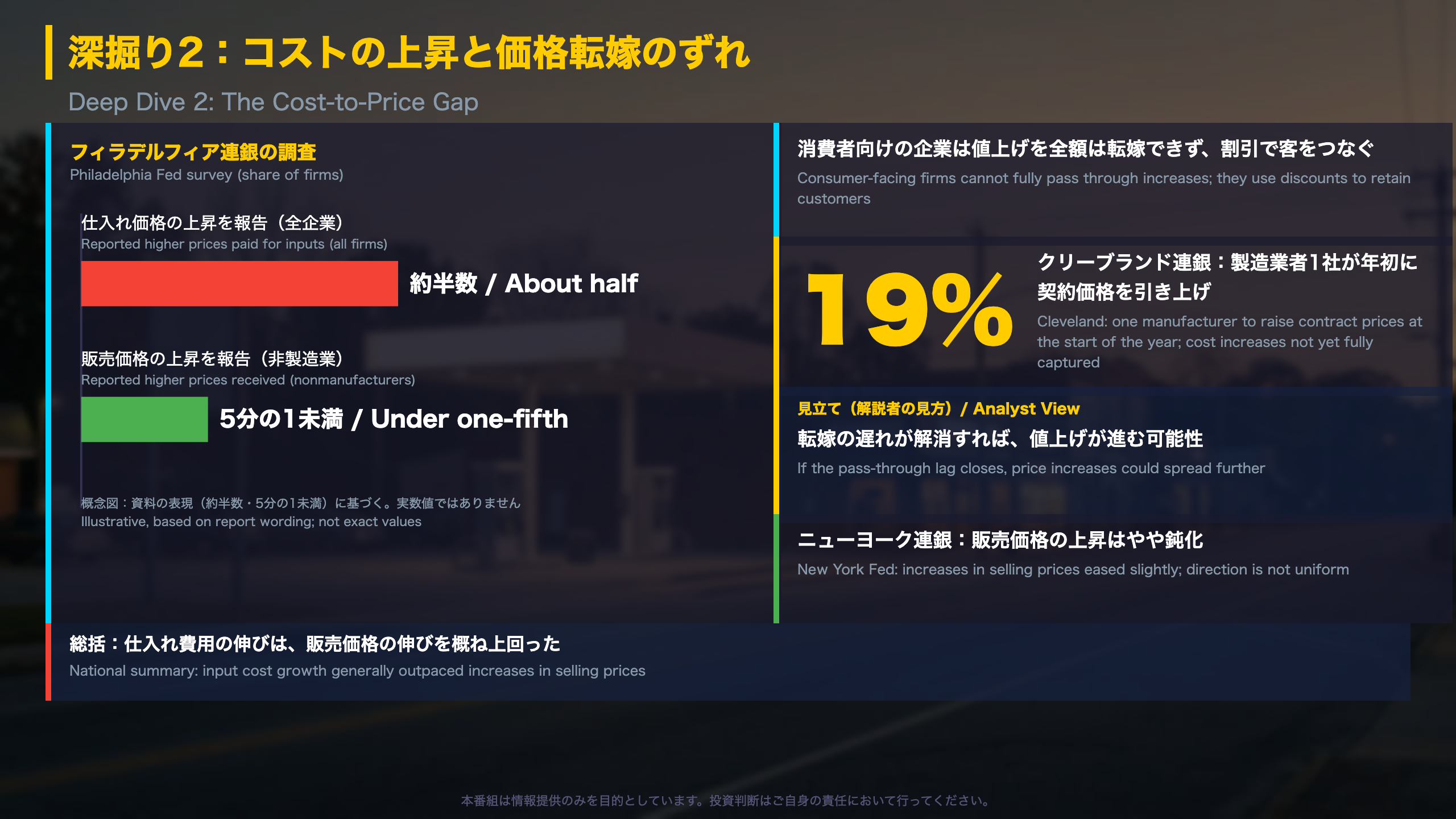
The national summary says “input cost growth generally outpaced increases in selling prices,” with firms citing energy, transportation, healthcare, insurance and tariff-related costs.
- Philadelphia: about half of all firms reported higher input prices, but under one-fifth of nonmanufacturers reported higher prices received. A staffing contact cited wages up 5 percent year over year.
- Cleveland: nonlabor cost pressure was robust for the twelfth straight period; one auto dealer said incentives were up 17.5 percent from the prior month; a manufacturer’s contract prices rise 19 percent at the start of the year.
- Minneapolis: about one-third of firms raised prices in October, while about half saw higher nonlabor input prices.
- Chicago: a retail analyst expects holiday retail prices about 2.5 percent higher than last year.
Signs of easing
Kansas City said fuel prices decreased recently, Minneapolis reported modestly lower retail fuel prices, and Philadelphia respondents expect their own price increases over the next year to be lower than current ones. New York said selling-price increases eased slightly.
Why it matters in context
This is the “margin squeeze” pattern: input costs lead, selling prices lag. Unlike the Japanese CPI, Beige Book price commentary is qualitative and mixes producer and consumer experiences. We make no rate-path inference from it.
What to watch
Pricing plans for 2027, including those already factoring in health-insurance increases, and whether consumer-facing firms regain pricing power.
質疑で深める:賃金加速の中身と次の焦点

Beyond the Q&A: labor, households and rates
A labor market of low hiring and pockets of scarcity
New York described large firms hiring for growth while smaller ones stay in a “low hire, low fire” environment. Boston heard a range of AI effects on employment: limited effects, retraining staff to work alongside AI, and hiring less because of AI. Cleveland contacts reported both AI-enabled hiring restraint and new AI and data-privacy legal roles. Philadelphia’s staffing contacts noted effective entry-level pay varying widely, from about $11-12 an hour at childcare centers to $22 in one community.
Household and credit signals
- Boston: two bankers worry delinquencies could rise this winter as households face potentially very large heating bills.
- New York: delinquency rates continued to worsen.
- Dallas: overall loan performance weakened slightly after improving for two periods.
References to interest rates
A Cleveland banker said commercial clients wanted to lock in current rates ahead of anticipated rate increases in the coming months, and a New York builder said some customers pulled projects forward in anticipation of further rate increases. These are business contacts’ expectations, not Fed officials’ views, and we do not extrapolate a policy path.
What to watch
Early-year contract repricing, wage trends, and whether consumer spending moves beyond flat. For readers used to Japan’s Tankan or Regional Economic Report, the Beige Book offers a similar qualitative texture on pricing power and hiring intentions.
Disclaimer: This article is for informational purposes only. All investment decisions are made solely at your own risk.