This article was automatically generated by the NFC Market Live AI analysis system. (Updated: 2026-11-25 22:46 JST)
📄 Primary Source
U.S. Bureau of Economic Analysis
https://www.bea.gov/sites/default/files/2026-11/gdp3q26-2nd.pdf
📊 BEA released the second estimate of Q3 2026 GDP on November 25.
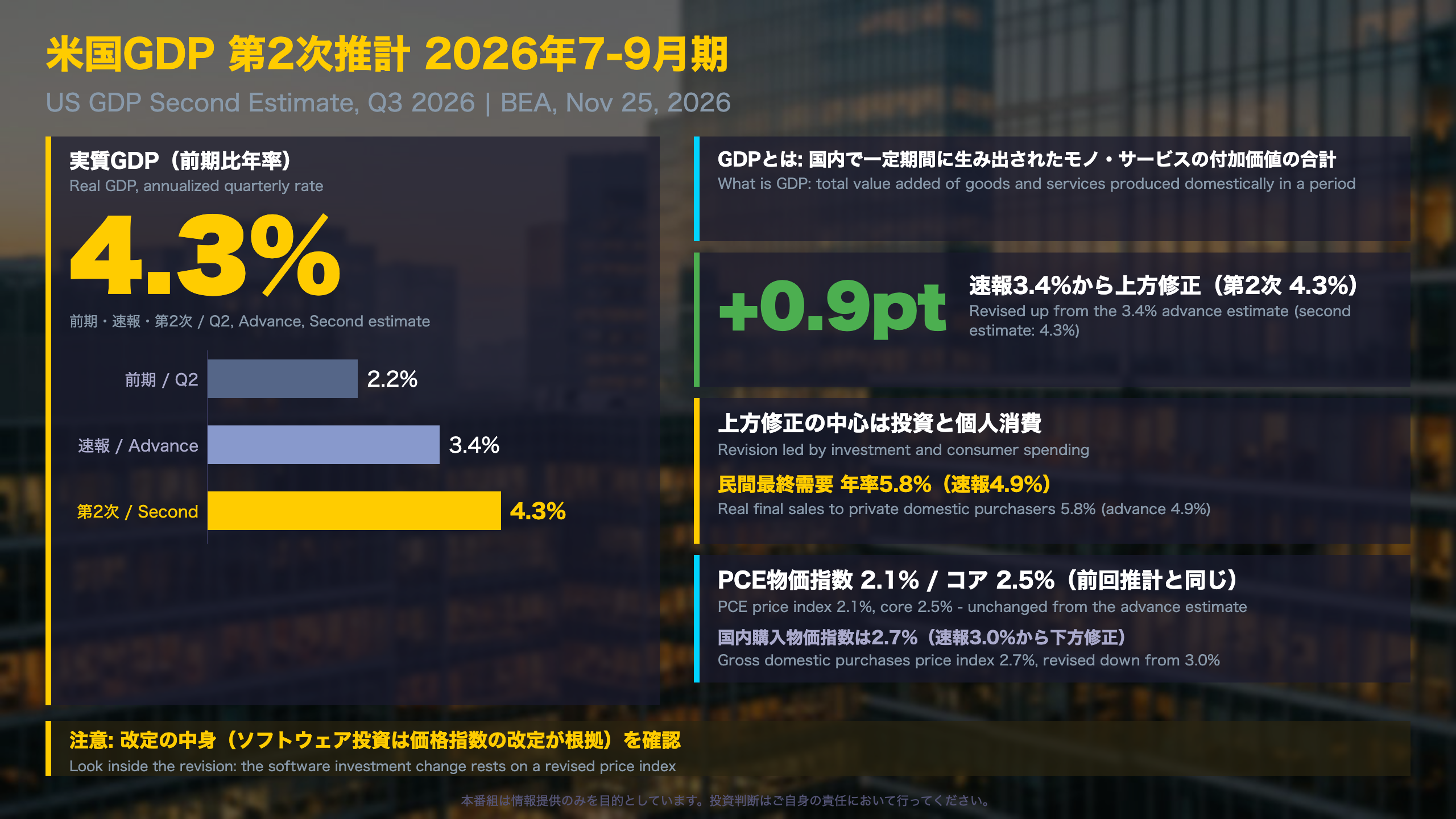
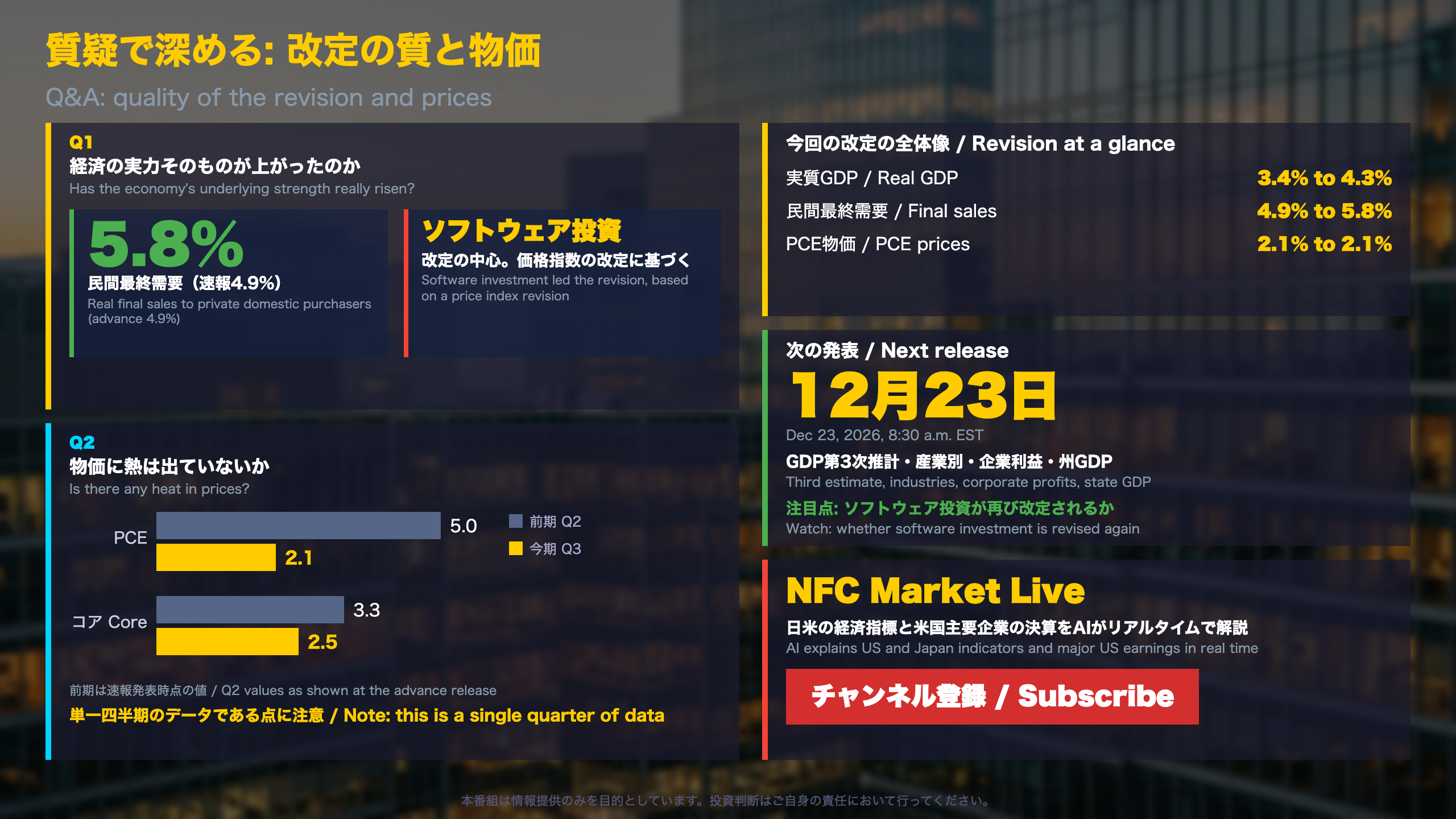
📈 Real GDP grew 4.3% annualized, revised up 0.9 point from the 3.4% advance estimate. Real final sales to private domestic purchasers rose 5.8%.
💡 The revision was led by investment (software) and consumer spending. The software revision rests on a revised price index.
⚠️ The PCE price index (2.1%) and core PCE (2.5%) were unchanged from the advance estimate. GDI rose 4.4% and profits from current production rose $206.0 billion.
📅 Next: the third estimate on December 23.
サマリー:米GDP第2次推計、年率4.3%に上方修正
Q3 GDP: Second Estimate Lifts Growth to 4.3%
The U.S. Bureau of Economic Analysis (BEA), part of the Commerce Department, publishes quarterly GDP in three steps: advance, second and third estimates. Today’s second estimate put real GDP growth at 4.3% annualized for July-September 2026, up 0.9 percentage point from the advance figure of 3.4%.
What changed
- Real final sales to private domestic purchasers: 5.8% (advance 4.9%)
- Current-dollar GDP: 6.2% (advance 5.6%)
- Gross domestic purchases prices: 2.7% (advance 3.0%)
- PCE prices: 2.1%; core PCE: 2.5%, both unchanged
BEA quotes growth at annualized rates; the unannualized quarterly rate moved from 0.8% to 1.1%.
International context
Japan’s Cabinet Office likewise publishes a first and a second preliminary GDP estimate, but U.S. readers should note that the BEA second estimate arrives about four weeks after the advance and swaps in new source data. Q2 growth was 2.2%.
Balanced read
Strength: both the headline and private demand were revised up while inflation measures did not move higher. Caution: much of the revision traces to software investment based on a revised price index, and health care services were revised down.
Next: the third estimate arrives on December 23, with industry detail and corporate profits.
深掘り①:上方修正0.9ポイントの出どころ
Inside the Revision: Software Investment and Consumer Goods
The advance picture
The October 29 advance estimate attributed the investment gain mainly to private inventories and equipment, led by information processing equipment such as computers and peripherals. Government spending rose because Strategic Petroleum Reserve sales were smaller than in Q2, a bookkeeping pattern BEA says has no direct effect on GDP.
What the second estimate changed
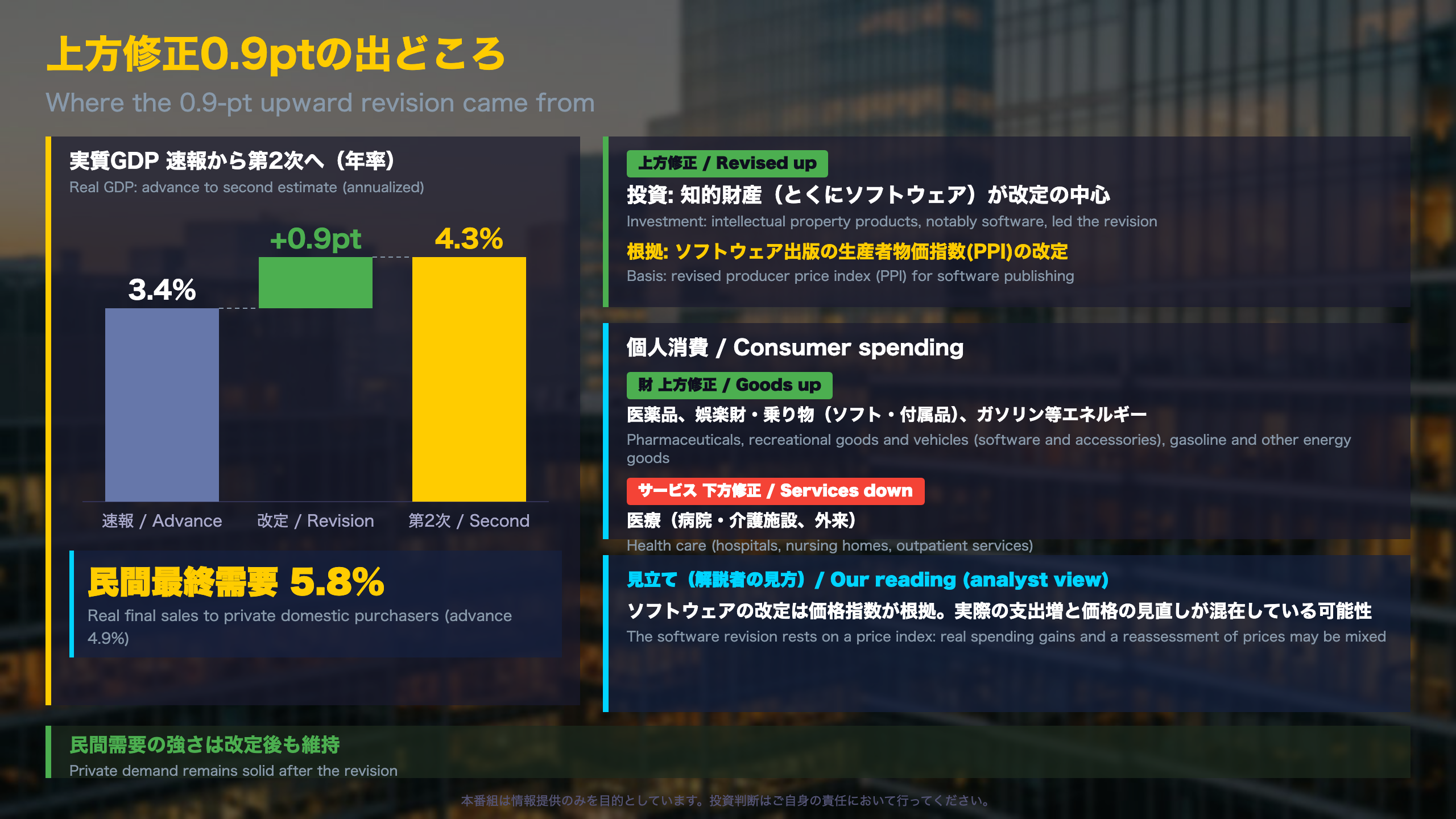
- Investment: intellectual property products, notably software, led the upward revision. BEA ties it mainly to revised Producer Price Index data for system and application software publishing.
- Consumer goods: revised up, led by pharmaceuticals, recreational goods and vehicles (mainly computer software and accessories), and gasoline and other energy goods.
- Consumer services: revised down, led by health care, using newly available Quarterly Services Survey data from the Census Bureau.
Why it matters
Real GDP is nominal spending deflated by prices, so a revised price index can move real investment even when dollar spending is unchanged. That is why we separate real spending gains from measurement changes. Japan’s Cabinet Office faces the same issue when deflators are revised.
Balanced read
Bull case: real final sales to private domestic purchasers rose to 5.8% from 4.9%. Cautious case: part of the lift comes from price data, and services were revised down.
Watch the December 23 third estimate for further changes.
深掘り②:生産と所得の両面、企業利益と物価
Production vs Income: GDI, Profits and Prices
GDP and GDI
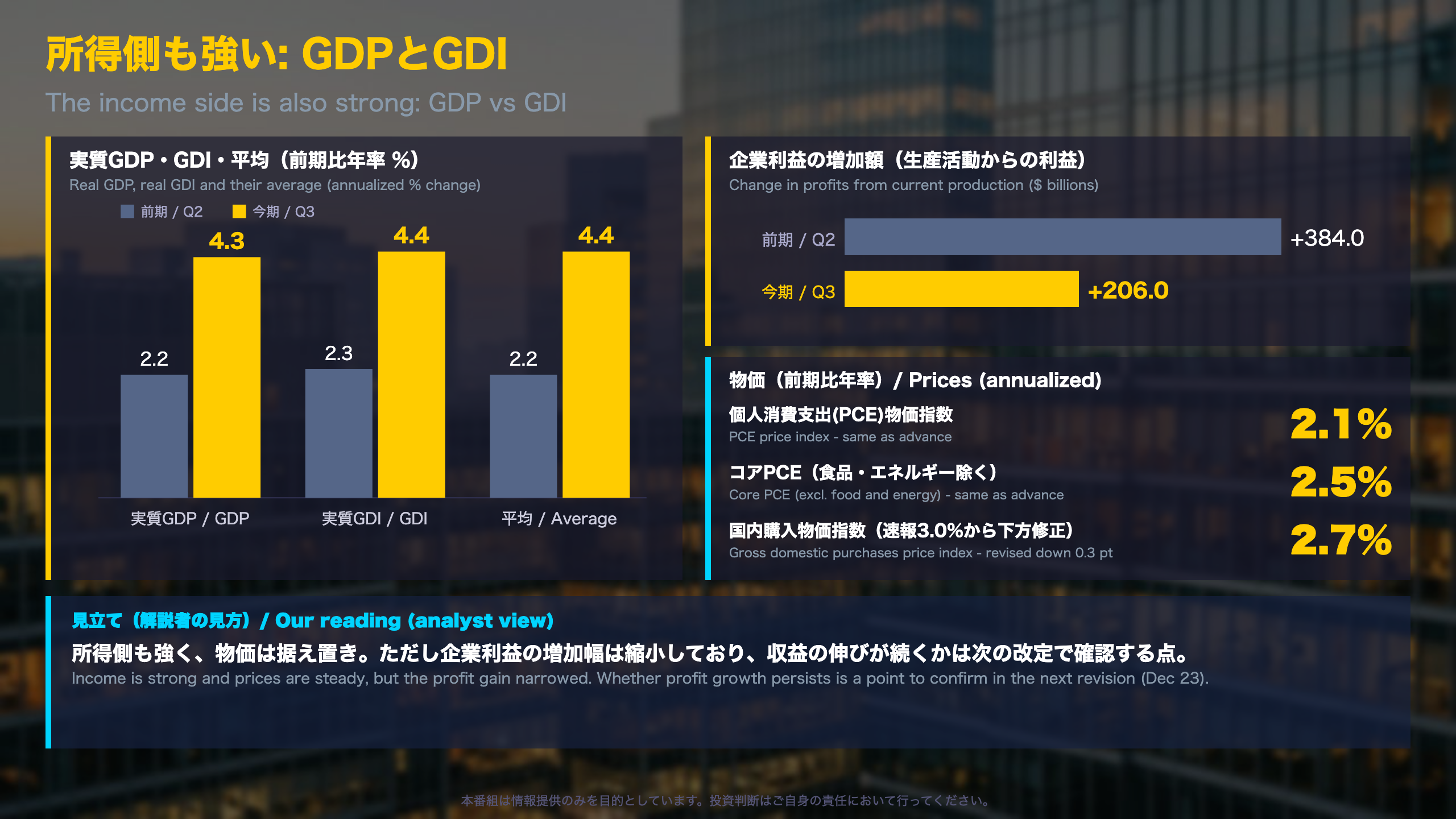
GDP measures output (spending); gross domestic income (GDI) adds up the income that output generates. In theory they match, but they draw on different source data, so BEA publishes both. Real GDI rose 4.4% annualized in Q3 versus 2.3% (revised) in Q2. The average of GDP and GDI also rose 4.4%, versus 2.2% (revised).
| Measure | Q2 | Q3 |
|---|---|---|
| Real GDP | 2.2 | 4.3 |
| Real GDI | 2.3 | 4.4 |
| Average | 2.2 | 4.4 |
Corporate profits
Profits from current production (with inventory valuation and capital consumption adjustments) rose $206.0 billion, versus a $384.0 billion gain in Q2. Profits are still rising, but the increase narrowed. Industry detail comes with the third estimate on December 23.
Prices
- Gross domestic purchases prices: 2.7%, revised down 0.3 point from 3.0%
- PCE prices: 2.1%; core PCE: 2.5%, both unchanged
- At the advance release, Q2 readings were 5.6% (purchases), 5.0% (PCE) and 3.3% (core)
Context for global readers
The Federal Reserve tracks PCE prices, which is why the GDP report’s price lines matter beyond growth. Japan’s CPI is built differently, so the two are not directly comparable.
Balanced read
Bull case: output and income agree and prices were steady. Cautious case: the profit gain narrowed, and this is one quarter of data.
質疑で深める:改定の質と物価、次の注目点
Q&A Notes: How to Read a GDP Second Estimate
The three-step schedule
| Stage | Date | Real GDP |
|---|---|---|
| Advance | Oct 29 | 3.4% |
| Second | Nov 25 | 4.3% |
| Third | Dec 23 | pending |
Each step replaces earlier assumptions with newer source data. This time, health care services used newly available Census Quarterly Services Survey data, and software investment reflected a revised Producer Price Index.
Reading the revision
- A 0.9 point revision reflects better data, not a sudden change in activity. Revisions can also run the other way in later releases.
- Real final sales to private domestic purchasers rose to 5.8%, which supports the demand story, but part of the investment revision depends on a price index.
- PCE prices at 2.1% matched the advance estimate and sit below the Q2 reading of 5.0% shown at the advance release. This is one quarter of data.
International comparison
Japan’s Cabinet Office also revises GDP as new surveys arrive, notably the Ministry of Finance corporate survey, so revisions are a feature of both systems.
What to watch
The December 23 release brings the third estimate plus industry GDP, corporate profits and state GDP. Key checks: software investment, health care services, and the size of the profit gain. BEA will also publish this release in HTML only from January 2027.
Disclaimer: This article is for informational purposes only. All investment decisions are made solely at your own risk.